
In short
Snorkeling in Kīhei, Maui is convenient at Kamaʻole I, II and III, while Ulua-Mōkapu and Keawakapu just south offer stronger reef-focused options for confident swimmers. Go in calm morning conditions, choose for the least-confident swimmer, and use guided instruction rather than independent shore snorkeling if anyone cannot swim.
Key takeaways
- 🌊 Ulua-Mōkapu is a practical reef-focused option for confident newer snorkelers, but the County of Maui lists no lifeguard.
- 🏖️ Kamaʻole I, II and III offer the most convenient Kīhei snorkeling logistics, including lifeguards, restrooms and showers.
- 🥽 Hawaiʻi Ocean Safety's 2026 guidance says snorkelers should be experienced ocean swimmers; flotation does not make independent snorkeling suitable for non-swimmers.
- 🐢 Turtle sightings are possible but never guaranteed, and NOAA recommends staying at least 10 feet away on land and in the water.
- ✅ A beach name is not a forecast, so check live safety and water-quality information before every entry.
In this guide
- Is there good snorkeling in Kīhei, Maui?
- Which Kīhei snorkeling beach fits your group?
- What makes a Kīhei beach easier for beginners?
- When should you snorkel near Kīhei?
- How do you choose a beach on the morning of your snorkel?
- Where can you snorkel near Kīhei for free?
- How do you protect turtles and coral while snorkeling?
- When is a guided snorkel better than going alone?
- What else do visitors ask about Kīhei snorkeling?
- What should you do before leaving your hotel?
Beach names are not forecasts. Before entering, check Hawaiʻi Ocean Safety's 2026 snorkeling guidance, open the state's live Clean Water Branch advisory dashboard, read every posted sign and watch the water long enough to see several complete wave sets.
Is there good snorkeling in Kīhei, Maui?
Yes, Kīhei has several public beach parks where snorkeling may be possible when the ocean is calm. However, the most convenient beach is not automatically the best reef route, and no site is suitable every day.
Kamaʻole Beach Parks I, II and III are the simplest starting points for visitors staying in central or south Kīhei. Each has a sandy beach, a lifeguard and useful facilities, making it easier to combine a conservative snorkel attempt with an ordinary beach day.
Keawakapu lies along the Kīhei-Wailea border. Ulua-Mōkapu is slightly farther south in Wailea and is often the stronger choice for confident swimmers who want a clearer reef objective, although the county lists no lifeguard at either location.
This Kīhei Maui snorkeling guide stays local by design. Visitors who want to compare Kīhei with beaches elsewhere on the island can use the broader guide to the best Maui beaches for snorkeling from shore.
Kīhei is convenient, but the right beach is the one that fits the least-confident swimmer and the water that day.
Which Kīhei snorkeling beach fits your group?
Start by deciding whether the group prioritizes a lifeguard, simple beach facilities or reef-focused swimming. The comparison below narrows the choices, but the final decision still belongs to the conditions visible at the beach.
| Beach | Practical entry and support | Best fit | Reconsider when |
|---|---|---|---|
| Kamaʻole Beach Park I | Broad sandy beach; lifeguard, restrooms and showers | Groups wanting easy logistics and plenty of beach space | Shorebreak, wind or crowding makes entry stressful |
| Kamaʻole Beach Park II | Sandy beach; lifeguard, restrooms and shower; street parking | Visitors staying nearby who want a short, conservative plan | The return route or street-parking setup does not suit the group |
| Kamaʻole Beach Park III | Sandy beach; lifeguard, parking, restrooms, showers, grass and playground | Families and mixed beach groups prioritizing support | Waves or reduced visibility make snorkeling less suitable than beach time |
| Keawakapu Beach Park | Long sandy shoreline; shower and limited restroom facilities; no lifeguard | Comfortable swimmers who want several places to reassess the water | Anyone needs direct lifeguard support or the surface becomes choppy |
| Ulua-Mōkapu Beach Parks | Sand, parking, restrooms and showers; no lifeguard | Confident newer snorkelers prioritizing reef exploration | Wind, swell or an uncertain exit affects the planned route |
The County of Maui facility pages were checked on September 12, 2026. The best-fit descriptions are editorial planning classifications, not official safety classifications or guarantees about conditions.
Which Kamaʻole beach is the most practical?
Kamaʻole I has the broadest park feel of the three and works well when snorkeling is only one part of the day. Kamaʻole II offers similar support with street parking, while Kamaʻole III adds a large grassy area and playground that can help a family manage swimmers and non-swimmers in one outing.
All three have lifeguards, but a lifeguard does not turn poor snorkeling conditions into good ones. Ask about hazards before entering, remain within the supervised area and accept that the right activity may be swimming close to shore or staying on the sand.
Is Keawakapu better than the Kamaʻole beaches?
Keawakapu gives visitors a longer shoreline and a position between Kīhei and Wailea. That can be useful for comfortable swimmers who want to walk the beach, observe several possible entry areas and choose a short route rather than committing to one crowded access point.
The tradeoff is support. The county lists no lifeguard, so Keawakapu should not be selected merely because it looks quieter or more scenic.
Why do snorkelers choose Ulua-Mōkapu?
Ulua-Mōkapu combines sand, parking, restrooms and showers with a more reef-oriented snorkeling objective than the open center of a broad sandy beach. It can be a logical next step for someone who already swims confidently and has practiced breathing, floating and clearing a snorkel.
Ulua-Mōkapu has no county-listed lifeguard. If the entry is breaking, the surface is choppy or anyone feels rushed by other ocean users, move to the backup plan rather than following stronger swimmers offshore.
Use the beach table to narrow the options, then let the entry, exit and current conditions make the final decision.
What makes a Kīhei beach easier for beginners?
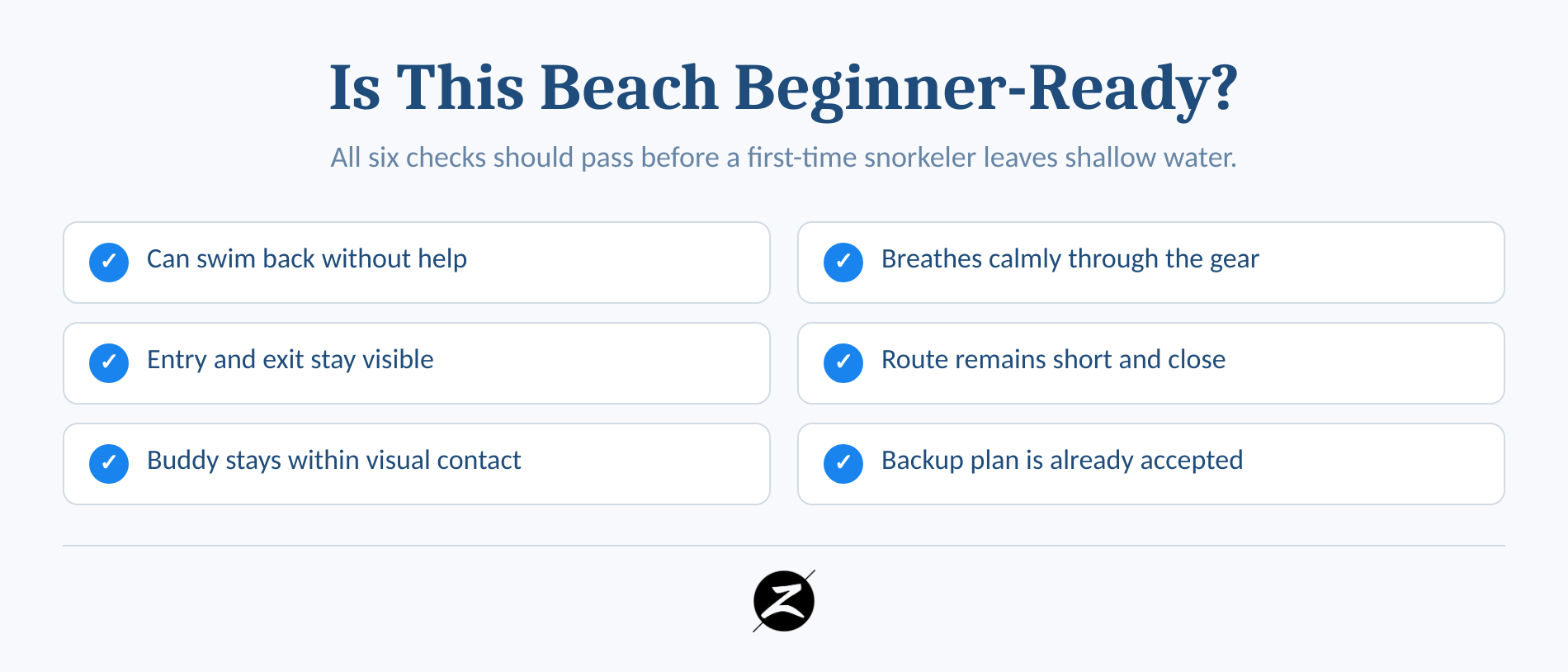
An easier snorkeling beach has a visible exit, a manageable sandy entry, a short route and conditions that allow calm breathing. Shallow water by itself is not enough, especially when coral, rocks, current or shorebreak prevents a swimmer from standing safely.
Beginner-friendly means manageable from entry through exit, not simply shallow.
Hawaiʻi Ocean Safety's June 2026 guidance says all snorkelers should be experienced ocean swimmers. A state snorkeling-safety brochure is even more direct for non-swimmers: stay out of the water, including when flotation is available.
That guidance creates an important distinction between independent snorkeling and structured instruction. Zephyr Maui's guided support for first-time snorkelers and non-swimmers begins with flotation, gear fitting, mask seal, breathing, body position and shallow-water confidence work while a guide remains present.
A guided beginner experience does not establish that independent snorkeling is appropriate for a non-swimmer. Guests should read the activity requirements, disclose medical or water-confidence concerns before booking and follow the guide's participation decision at the shoreline.
For a first-time snorkeler who can already swim, use this six-part check:
- The swimmer can return to shore without being towed or pushed.
- The mask and snorkel feel comfortable before leaving standing depth.
- The entry and exit remain visible throughout the route.
- The reef objective is close enough to turn around early.
- A buddy stays in close visual contact rather than swimming ahead.
- The group has a land-based backup activity if the water is unsuitable.
A beginner-friendly snorkel requires swimming ability, calm equipment use and a clear return to shore.
When should you snorkel near Kīhei?
Morning is usually the best window for independent snorkeling near Kīhei because wind and surface chop often increase later in the day. Morning is not a guarantee, so high surf, current, shorebreak, poor visibility or anxiety should still cancel the entry.
Hawaiʻi Ocean Safety's 2026 snorkeling page recommends morning hours because conditions and visibility are often better. The same page tells snorkelers to avoid high winds, heavy shorebreak, high surf and strong currents, and to consult lifeguards where available.
Rainfall matters even when the sky above Kīhei is clear. The Hawaiʻi Department of Health explains that runoff can reach coastal water through streams and drains, so do not enter brown, cloudy or turbid water and always check the live advisory dashboard.
Kīhei snorkeling is possible during much of the year, but season alone is a poor decision tool. A calm winter morning may suit a conservative route, while a windy summer afternoon may not; south swells, local wind and runoff can change the answer.
A scheduled guided activity may operate at a different time because it uses a specific itinerary and an on-site assessment. Visitors should still review participation requirements and ask how conditions affect the route rather than assuming a reservation overrides the ocean.
Morning is usually the best window, but a bad morning is still a no-go.
How do you choose a beach on the morning of your snorkel?
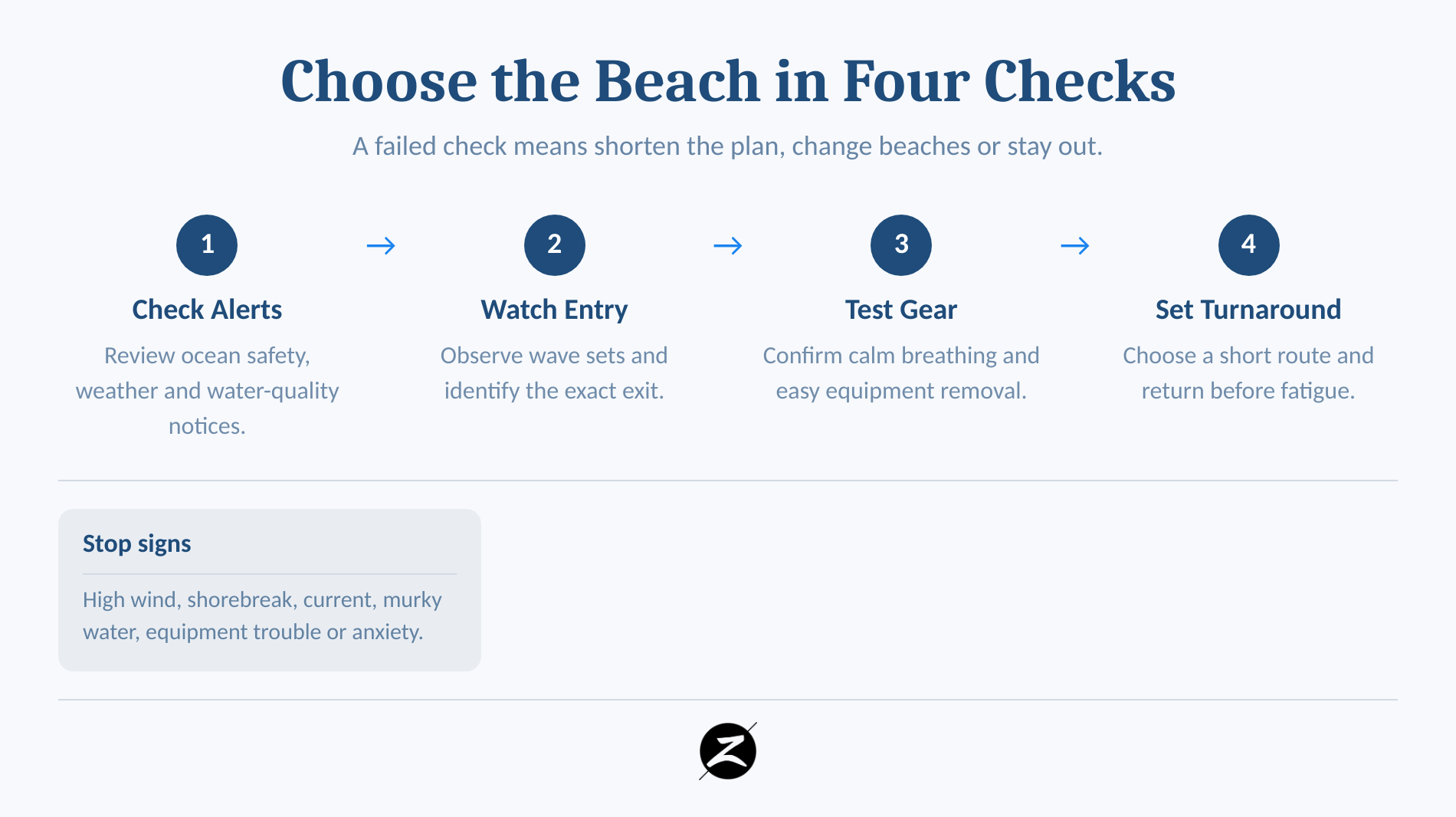
Use the same four checks every time: live alerts, the entry, the equipment and the return plan. If one check fails, shorten the plan, change beaches or stay out rather than searching for a reason to continue.
1. Check live information before driving
Open the state ocean-safety page, the water-quality advisory dashboard and the day's weather or surf information. Treat warnings, closures and brown-water advisories as reasons to change the plan, not obstacles to work around.
2. Watch the entry before unpacking
Observe several complete wave sets. Identify where everyone will enter, where everyone will exit and what rocks, reef, swimmers or breaking waves could complicate the return.
3. Test the equipment close to shore
A swimmer should be able to breathe calmly, clear the snorkel, adjust the mask and remove the equipment without assistance. Fix leaking or uncomfortable equipment before moving beyond easy standing depth.
4. Set the route and turnaround point
Choose a short out-and-back route with a visible exit. Turn around while everyone still feels comfortable, because fatigue, wind and distance usually become harder on the return rather than easier.
Hawaiʻi's Division of Boating and Ocean Recreation states that snorkeling is an underwater activity requiring a red-and-white diver's flag. Review the current Hawaiʻi diver-flag rules before entering; ocean divers must remain within the required distance of the flag, and the flag should not be displayed when nobody is in the water.
Work example: A couple staying near Kamaʻole III includes one confident ocean swimmer and one capable pool swimmer who has never used a snorkel. If the beach is calm, the lifeguard has no additional warning and both people can use the gear comfortably in shallow water, the couple might choose a short route close to shore.
If waves begin breaking across the exit or the newer snorkeler cannot settle their breathing, driving to unguarded Ulua in search of more fish would not solve the actual problem. The better choice is structured instruction or a beach-and-sightseeing day without independent snorkeling.
Check alerts, watch the water, test the gear and set the turnaround before anyone commits.
Where can you snorkel near Kīhei for free?
Public beach access at the Kamaʻole parks, Keawakapu and Ulua-Mōkapu lets visitors assess snorkeling without buying a tour ticket. Free access does not mean free parking in every possible lot, included equipment, lifeguard coverage or guaranteed reef conditions.
Use designated public access and obey posted parking rules, park hours and warning signs. Do not cross private resort property when a marked public route is available, and never leave valuables visible in a parked vehicle.
Independent snorkeling may still involve the cost of correctly fitted equipment and a lawful dive flag. Equipment should be comfortable to breathe through, easy to remove and tested before the swimmer leaves shallow water.
The largest hidden cost is pressure to salvage the day. If a family has driven across the island, paid for gear or promised children a turtle sighting, those sunk costs still do not justify entering unsuitable water.
Free beach access does not remove the need for proper equipment, a buddy, a dive flag and conservative judgment.
How do you protect turtles and coral while snorkeling?
Keep at least 10 feet away from sea turtles on land and in the water, and never touch, chase or feed them. Stay horizontal above the reef, control the fins and stand only on sand where standing is safe and permitted.
NOAA's 2026 Hawaiʻi marine wildlife guidance identifies 10 feet as the recommended minimum viewing distance for sea turtles. If a turtle approaches, remain calm and create space without blocking its route to the surface or shore.
Sea turtles are wild animals, not scheduled attractions. A beach or tour can offer an opportunity to explore suitable habitat, but nobody can honestly guarantee where a turtle, octopus or particular fish will be during a specific visit.
Hawaiʻi DLNR's coral-reef guidance explains that coral is living, fragile tissue that can be damaged by contact. Avoid standing on coral, watch the fins during turns and do not remove shells, rocks, plants or marine life.
The best wildlife encounter is one that leaves the animal and reef undisturbed.
When is a guided snorkel better than going alone?
A guided snorkel is the better choice when someone needs equipment instruction, close confidence support, local route guidance or help combining snorkeling with a wider South Maui experience. Independent snorkeling remains more appropriate for capable ocean swimmers who can evaluate conditions, manage their gear and return without assistance.
Consider guided support when:
- A first-time snorkeler can swim but has never breathed through a snorkel.
- A non-swimmer wants to ask whether a structured shallow-water activity is appropriate.
- Someone becomes anxious when the face enters the water.
- The group does not know how to identify a conservative entry, exit or turnaround point.
- Different swimming abilities make it difficult to keep the group together.
- Visitors want local interpretation and photography rather than spending the outing managing equipment.
Guides cannot make unsuitable ocean conditions disappear, and a booking should never be treated as a wildlife guarantee. A responsible experience still depends on participation requirements, an on-site assessment and the guide's instructions.
Want to combine a guided snorkel with South Maui sightseeing? Review the itinerary and participation details for our Wailea Wildlife Experience. The current experience combines a guided reef snorkel, beach stops and a coastal drive toward La Perouse, while wildlife sightings remain dependent on nature and conditions.
Choose a guide when instruction, confidence or local route support matters more than independence.
What else do visitors ask about Kīhei snorkeling?
The short answers below address the questions most often associated with snorkeling in Kīhei and Maui. Each answer assumes that the swimmer checks current conditions and is willing to stay out when the entry is unsuitable.
Is there good snorkeling in Kihei Maui?
Yes. Kīhei has convenient snorkeling from Kamaʻole Beach Parks I, II and III, while Keawakapu and Ulua-Mōkapu just south usually offer more reef-focused routes. Good snorkeling still depends on calm water, clear visibility, swimming ability and a safe entry and exit on the day you go.
Where is the easiest place to snorkel in Maui?
There is no universally easiest Maui snorkeling beach. For visitors staying in Kīhei, the lifeguarded Kamaʻole parks offer straightforward facilities and sandy access, while Ulua-Mōkapu is a common next step for confident swimmers who want more reef. The easiest choice is the one the least-confident swimmer can exit independently.
Where is the best snorkeling spot off the beach in Maui?
Near Kīhei, Ulua-Mōkapu is a strong all-around shore option for confident newer snorkelers when conditions are calm. Makena Landing can suit capable swimmers seeking a more compact, reef-oriented entry farther south, but neither location is best every day and an easy-looking shoreline can still develop wind, surge or poor visibility.
Where to snorkel in Maui for free?
Public beach access at Kamaʻole, Keawakapu and Ulua-Mōkapu does not require a snorkel-tour ticket. Use designated parking and access, obey posted hours and signs, and bring lawful safety equipment. Free access does not guarantee free parking everywhere, calm water, good visibility or wildlife sightings.
No single beach or schedule overrides swimming ability and same-day conditions.
What should you do before leaving your hotel?
Choose one preferred beach and one backup, then check live advisories before putting equipment in the car. Agree in advance that staying out is an acceptable result if the water, weather, equipment or least-confident swimmer does not pass the morning check.
Pack fitted equipment, a dive flag, drinking water and sun protection. At the beach, speak with the lifeguard where one is present, identify the exit before entering and keep the first route shorter than everyone thinks they can manage.
Choose the backup before you leave, and make staying out an acceptable outcome.