
In short
Kayaking in Maui is best planned around exposure, wind and ability, not a single “best” beach. For most visitors, a guided morning kayak-snorkel at Olowalu or a sheltered South Maui launch is the practical choice; experienced paddlers should go independently only after checking the exact forecast, launch, return leg and water quality.
Key takeaways
- Morning departures are common because Hawaiian trade winds are normally lightest early and can peak by mid-afternoon, but a morning booking is not a substitute for a same-day marine forecast. (weather.gov)
- Olowalu is a strong reef-focused choice because the coastline provides access to an extensive coral habitat, but conditions and runoff can still change the plan. (sanctuaries.noaa.gov)
- As of August 2026, Hawaii requires one wearable, USCG-approved personal flotation device for every person in a kayak; children 12 and under must wear one offshore. (dlnr.hawaii.gov)
- NOAA recommends staying at least 10 feet from sea turtles, while federal law prohibits approaching a humpback whale within 100 yards in Hawaiian waters. (fisheries.noaa.gov)
- A guide adds the most value when the group is new to ocean paddling, plans to snorkel from the kayak or includes people with different water-confidence levels.
Table of contents
- Which part of Maui is best for kayaking?
- What conditions matter more than the name of the beach?
- Should you book a guided Maui kayaking tour or go independently?
- What happens on a Maui kayak and snorkel tour?
- Is Olowalu a good choice for kayaking and snorkeling?
- Can beginners kayak in Maui?
- What should you stay away from when kayaking in Maui?
- When can you see humpback whales from a kayak?
- What should you bring for kayaking in Maui?
- How do you choose the right Maui kayaking tour?
- What do visitors ask about kayaking in Maui?
The biggest planning mistake is treating Maui as one uniform shoreline. A beach may look protected from the road while wind, a reef edge or a difficult return leg creates a very different experience offshore. Start with what the least-confident person can manage, then choose the coastline and format.
Which part of Maui is best for kayaking?
Olowalu is a strong choice when reef snorkeling is the priority, while South Maui often suits visitors staying in Kīhei, Wailea or Makena who want a shorter transfer. Kāʻanapali and other resort coasts can be convenient, but no area is automatically beginner-safe because launch conditions change with wind and swell.
The useful question is not simply where to kayak Maui. Ask what the group wants to do after launching. A short sightseeing paddle, a kayak snorkeling Maui outing and a longer fitness paddle place different demands on the same shoreline.
Maui kayaking areas at a glance
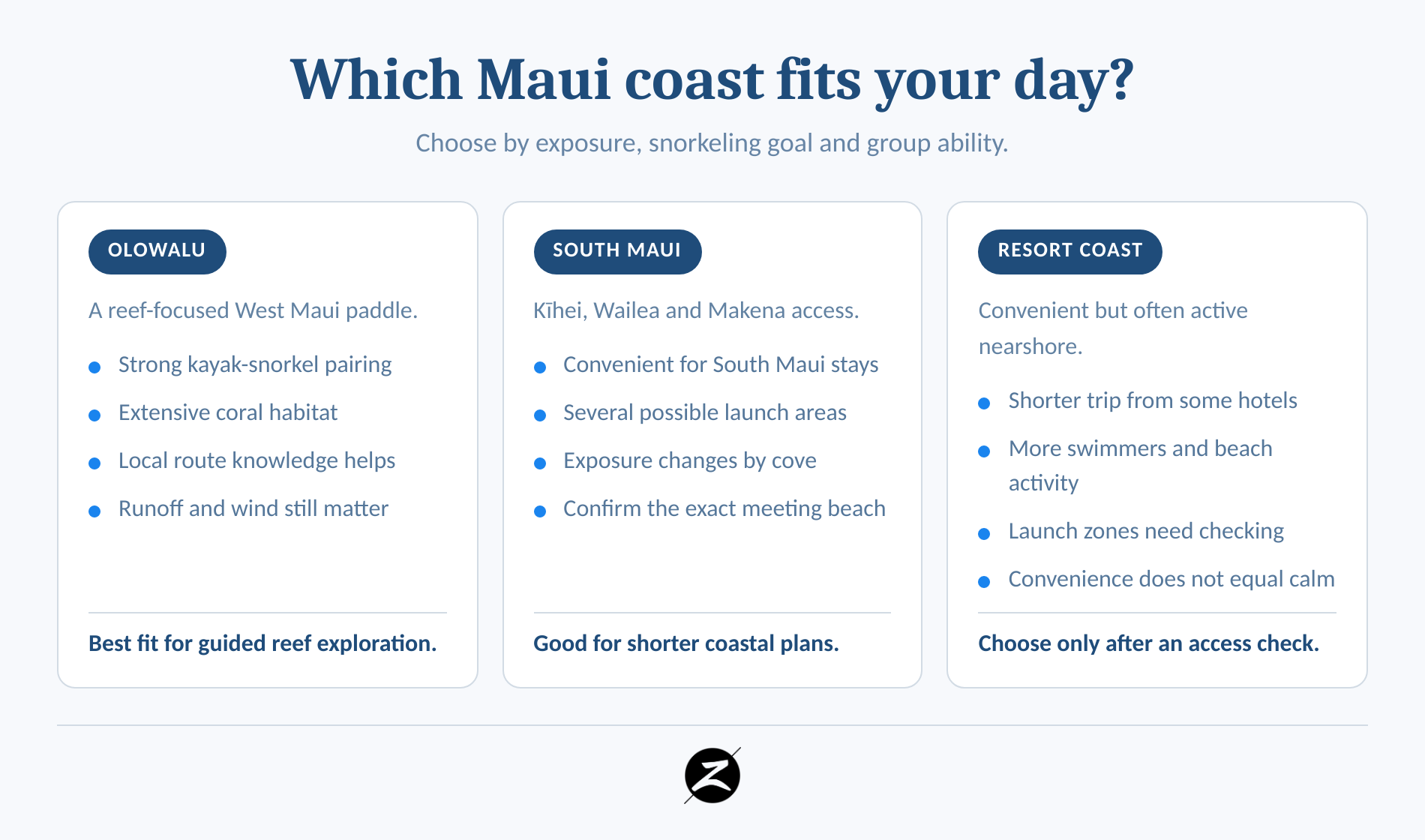
Olowalu: Choose Olowalu for a reef-centered experience and a natural kayak-and-snorkel pairing. NOAA describes Olowalu as an extensive coral reef habitat for fish, invertebrates, turtles, manta rays, reef sharks and seasonal humpback whales. Wildlife remains unpredictable, and the ecological value of the reef makes careful behavior essential. Read NOAA’s Olowalu reef overview. (sanctuaries.noaa.gov)
South Maui: Kīhei, Wailea and Makena put several coastal areas near major visitor accommodations. A protected-looking cove can be useful for a shorter paddle, but nearby points may receive more wind or swell. Confirm the exact launch rather than assuming conditions at one South Maui beach describe the next one.
Kāʻanapali and resort coasts: These areas can reduce driving for West Maui visitors, but active beaches may contain swimmers, surf zones, commercial activity and boat traffic. A convenient hotel location does not remove the need to identify the legal launch, landing route and vessel lanes.
More exposed shorelines: A scenic windward coastline is not a sensible default for a first ocean paddle. Visitors without local route knowledge should favor a known leeward launch, a guide or another activity when wind and shorebreak make the entry uncertain.
The best Maui kayaking area is the one that matches the weakest paddler, the day’s exposure and the group’s snorkeling goal.
What conditions matter more than the name of the beach?
The exact day matters more than a location’s general reputation or monthly averages. Start with official marine information, then judge the actual launch because wind, swell and runoff can affect Maui’s coastlines differently.
The National Weather Service Honolulu office publishes NOAA Hawaiian marine forecasts and alerts, including coastal-water forecasts, marine warnings, surf information and buoy observations. The forecast zone is the first filter, not the final verdict at a specific beach. (weather.gov)
A five-check go or no-go screen
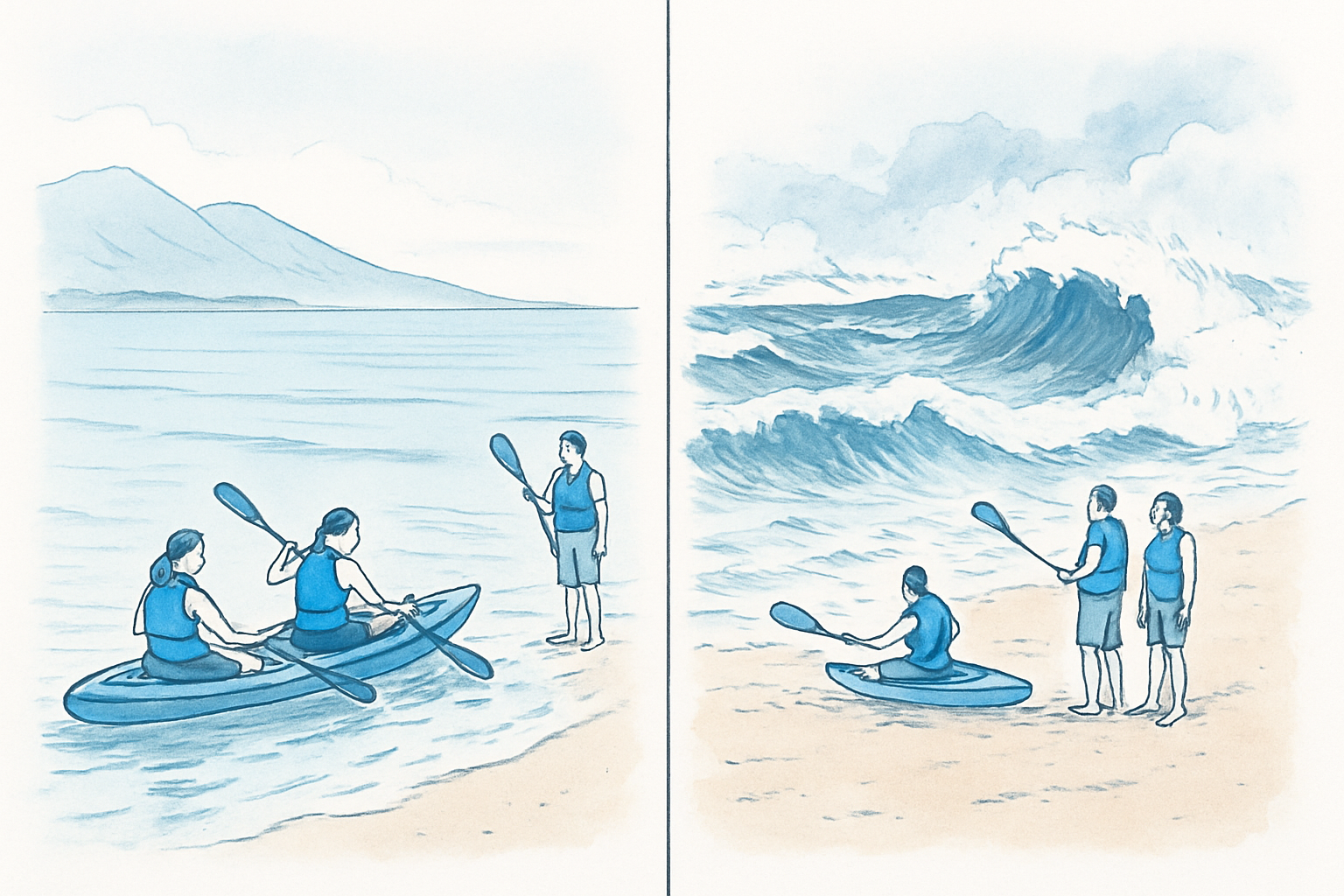
- Read the relevant marine zone. Check wind direction, expected speed, swell and active advisories. Do not rely on a generic weather-app icon for the nearest town.
- Watch the launch before unloading. Spend several minutes looking for whitecaps, breaking waves, fast lateral drift and paddlers struggling to hold a line.
- Identify the return leg. A helpful breeze on the way out can become a tiring headwind on the return. Know which direction becomes harder if the wind increases.
- Check the water itself. Brown, murky or debris-filled water after rain is a reason to stay out, even when the sky over the beach is clear.
- Use the weakest-person test. The decision should reflect the least experienced paddler or snorkeler, not the strongest person’s confidence.
Early departures are common for a reason. NOAA meteorological guidance notes that Hawaiian trade winds are normally lightest in the morning and often reach their peak by mid-afternoon. That pattern is useful for planning, but it does not override a front, active advisory, swell or poor conditions at the beach. (weather.gov)
A Small Craft Advisory is more than an inconvenience. The National Weather Service uses it for conditions considered potentially hazardous to small boats; an independent recreational kayak plan should not proceed simply because the water close to shore looks manageable. (weather.gov)
Rain introduces another decision. The Hawaii Department of Health advises people to avoid brown or turbid coastal water because runoff can carry pathogens, sewage, chemicals and debris. Check Hawaii water quality advisories and turn around if the water is visibly discolored, even when no sign is present. (health.hawaii.gov)
A forecast opens the decision, but the water at the launch makes the final call.
Should you book a guided Maui kayaking tour or go independently?
Book a guide when anyone is new to ocean kayaking, the outing includes snorkeling or the group has mixed swimming confidence. Independent paddling is better reserved for people who can assess coastal conditions, manage a capsize or re-entry and cancel without trying to rescue the vacation schedule.
Guided or independent: the practical split
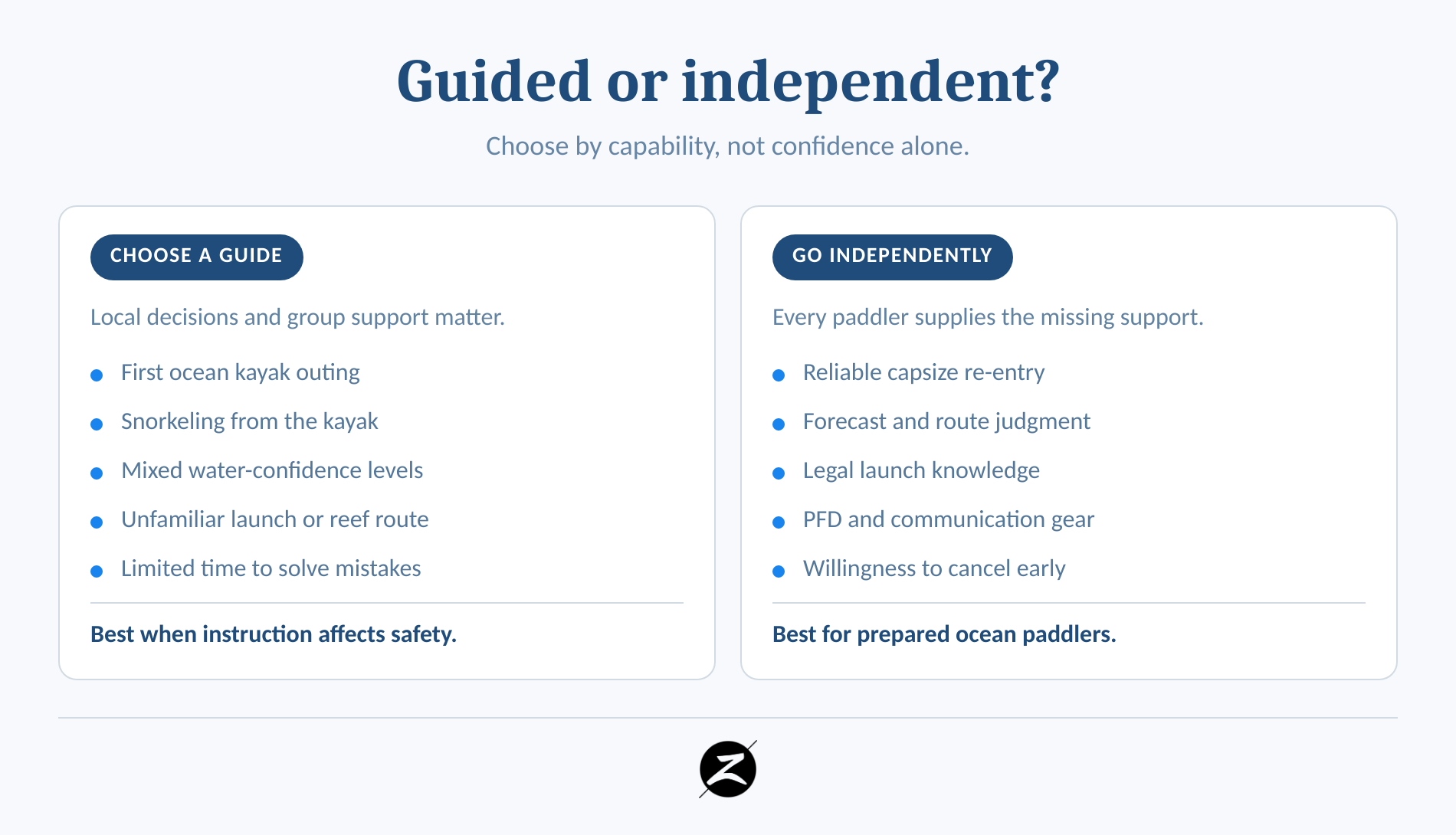
A guided Maui kayaking tour is the stronger choice when:
- The paddlers have lake or river experience but little ocean experience.
- The plan includes getting out of the kayak to snorkel and climbing back in offshore.
- The actual launch, reef route or landing is unfamiliar.
- Children or adults in the group require close instruction.
- The group wants interpretation of the reef, coastline and wildlife rules.
- Limited vacation time makes avoidable navigation mistakes especially costly.
An independent paddle is more reasonable when every participant can:
- Control the kayak in wind and moderate chop.
- Re-enter the craft after an unexpected capsize.
- Keep the kayak and paddle under control while assisting a partner.
- Identify a legal launch and an alternate landing.
- Carry the required PFDs and reliable communication.
- Read the forecast and turn back early without debate.
Worked example: A hypothetical couple is staying in Kīhei. One partner has paddled lakes but never the ocean; the other swims comfortably but becomes anxious about climbing back into a kayak. Their goal is reef snorkeling, not distance. A guided morning trip from a known launch is the better fit because route selection, water entry and re-entry matter more than the stronger partner’s fitness. If conditions deteriorate, they should accept relocation or cancellation rather than improvise at an unfamiliar beach.
A guide does not make rough water harmless. The guide’s value is local judgment, instruction, route adjustment and support before a manageable problem becomes an emergency.
Choose a guide when local judgment, water entry or group support matters more than paddling freedom.
What happens on a Maui kayak and snorkel tour?
A typical Maui kayak and snorkel outing combines a beach briefing, gear fitting, coastal paddle, guided water entry, reef snorkel and return to the launch. The guide should adapt the route and time in the water to the day’s conditions rather than force a fixed offshore target.
Search labels such as Maui kayak and snorkel, kayak and snorkel Maui, kayak snorkeling Maui and Maui kayaking and snorkeling tours usually describe this same basic format. The meaningful differences are the launch, group size, swimming expectations, paddle time and how the operator handles changing conditions.
From beach briefing to reef stop
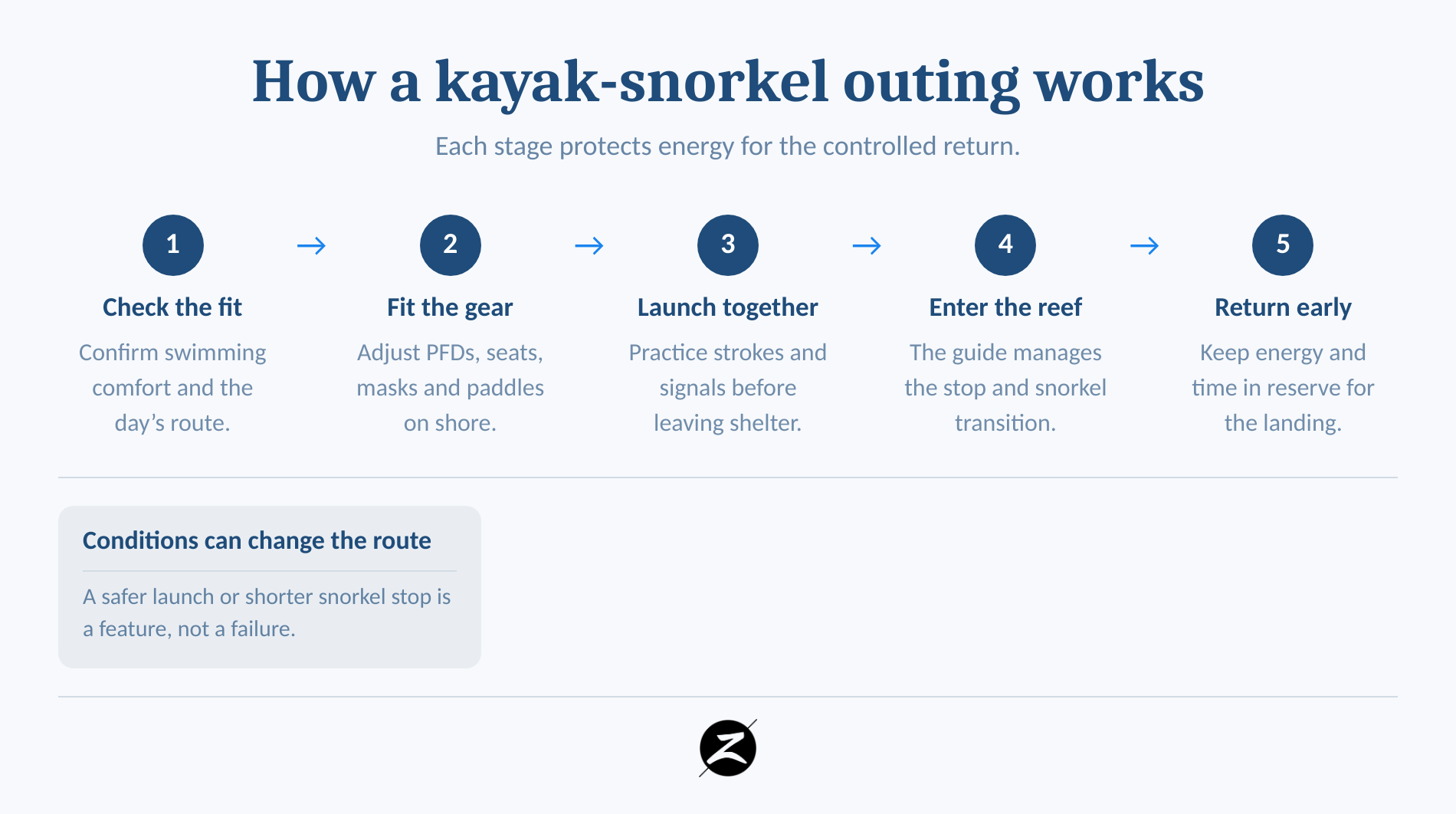
- Fit and briefing: The guide checks swimming comfort, fits PFDs and equipment, explains the route and reviews what to do after a capsize.
- Beach launch: Tandem partners learn a simple forward stroke, stopping method and the guide’s signals before leaving the protected area.
- Coastal paddle: The group stays together while the guide monitors wind, drift, traffic and the least-confident paddler.
- Snorkel transition: At a suitable reef area, the guide explains the water entry, manages the kayak and helps guests organize masks and fins.
- Return and landing: The route turns back with enough time and energy in reserve for a controlled landing.
Our Turtle Town Coastal Kayak & Snorkel starts from Olowalu and pairs guided coastal paddling with premium kayak and snorkel equipment, a guided reef stop and seasonal whale viewing when whales are present. Check the current booking page for operating details and inclusions because conditions and trip formats can change. (zephyrmaui.com)
No responsible route should depend on seeing a particular animal. Turtles, whales, manta rays and reef fish are wild, and the guide’s job is to protect the group and wildlife rather than manufacture an encounter.
A kayak-snorkel tour succeeds when the paddle, water entry and reef stop are treated as one connected activity.
Is Olowalu a good choice for kayaking and snorkeling?
Olowalu is a strong kayak-snorkel choice for visitors who want a reef-focused West Maui outing rather than a long open-water journey. Its extensive reef creates opportunities to paddle above shallow marine habitat and enter the water at a guide-selected location.
The size of the reef is part of Olowalu’s appeal, but it also creates responsibility. State and federal agencies describe Olowalu as ecologically significant, while Hawaii resource managers continue work addressing sediment, coral loss and other stresses. Treat the reef as habitat, not a platform. (sanctuaries.noaa.gov)
Do not stand on coral, push off a coral head or drag equipment across living reef. Hawaii law prohibits taking, breaking or damaging stony coral, and avoiding contact also protects paddlers and snorkelers from cuts. (dlnr.hawaii.gov)
Do not use the words Turtle Town as navigation instructions. Zephyr’s kayak product departs from Olowalu, so follow the meeting details and location information in the booking confirmation instead of driving to a South Maui beach based on the tour name. (zephyrmaui.com)
Olowalu rewards a reef-first plan, careful route choice and strict respect for coral and wildlife.
Can beginners kayak in Maui?
Yes, beginners can kayak in Maui when the launch, conditions and support match their actual skills. Beginner-friendly does not mean risk-free, and being a strong swimmer does not automatically make someone a capable ocean paddler.
Kayaking and snorkeling require two separate confidence checks. A first-time paddler may feel comfortable sitting in a stable tandem kayak but struggle with steering in wind. A competent paddler may become anxious when floating face-down, breathing through a snorkel or climbing back aboard from the water.
Ask these questions before booking:
- Is previous ocean kayaking experience required?
- How much swimming is expected?
- Does every guest have to enter the water?
- How is a guest helped back into the kayak?
- Are tandem kayaks used, and how are partners assigned?
- What happens if one person does not want to snorkel?
- What physical movements are required during launch and landing?
- Can the trip be shortened or changed if the group struggles?
A tandem kayak lets two people share propulsion, but it does not erase differences in balance, mobility or water confidence. Pairing the least-confident guest with the strongest partner can help, provided the guide agrees that both participants fit the day’s plan.
If a group wants guided reef time but not everyone wants the same amount of paddling, Zephyr’s land and sea activities show other ways to combine Maui’s coastline and ocean without treating a kayak trip as the only acceptable format.
A beginner-friendly plan supports both paddling skill and in-water confidence.
What should you stay away from when kayaking in Maui?
Stay away from launches, routes and wildlife interactions that require more skill than the group can demonstrate that day. The clearest warning signs are breaking shore entries, rising wind, brown water, exposed crossings and a return plan that depends on conditions staying unchanged.
Avoid these situations:
- An offshore destination chosen from a map: Distance is deceptive at sea, and a landmark can require an exposed crossing with no useful landing between points.
- A tailwind-only plan: If the wind helps the kayak leave shore, assume the return may be harder.
- Breaking surf beyond the group’s landing skill: Launching may feel easier than returning through the same shorebreak with tired paddlers.
- Brown or murky runoff water: Rain can affect the coast through streams and drains even when the beach itself is sunny. (health.hawaii.gov)
- Paddling alone: A partner can stabilize a kayak, call for help or remain with a person in the water.
- Unknown swim and vessel zones: Nearshore areas may separate swimmers, vessels and kayak ingress or egress.
- Chasing wildlife: Turning toward a whale, turtle or dolphin can violate required distances or amount to harassment.
- A schedule with no cancellation room: A flight, checkout or nonrefundable afternoon booking can pressure a group to continue when it should return.
Hawaii’s Division of Boating and Ocean Recreation maintains an Ocean Recreation Management Area map that identifies zones for activities such as swimming, boating and kayak ingress or egress. Check the actual launch rather than assuming every public-looking beach permits the same use. (dlnr.hawaii.gov)
The safest route is the one you can abandon early without arguing with the forecast, the clock or the group.
When can you see humpback whales from a kayak?
Humpback whale season in Hawaii generally runs from November through May, with the usual peak from January through March. A kayak may provide a quiet viewing platform when whales are present, but sightings are never guaranteed and paddlers cannot approach within 100 yards.
The NOAA sanctuary boating guide advises all boaters to stay vigilant during whale season because surfacing, breaching and tail movements can create collision risks. A kayak has less speed and maneuvering range than a powered vessel, making early observation and passive positioning especially important. (hawaiihumpbackwhale.noaa.gov)
Wildlife distances from a kayak
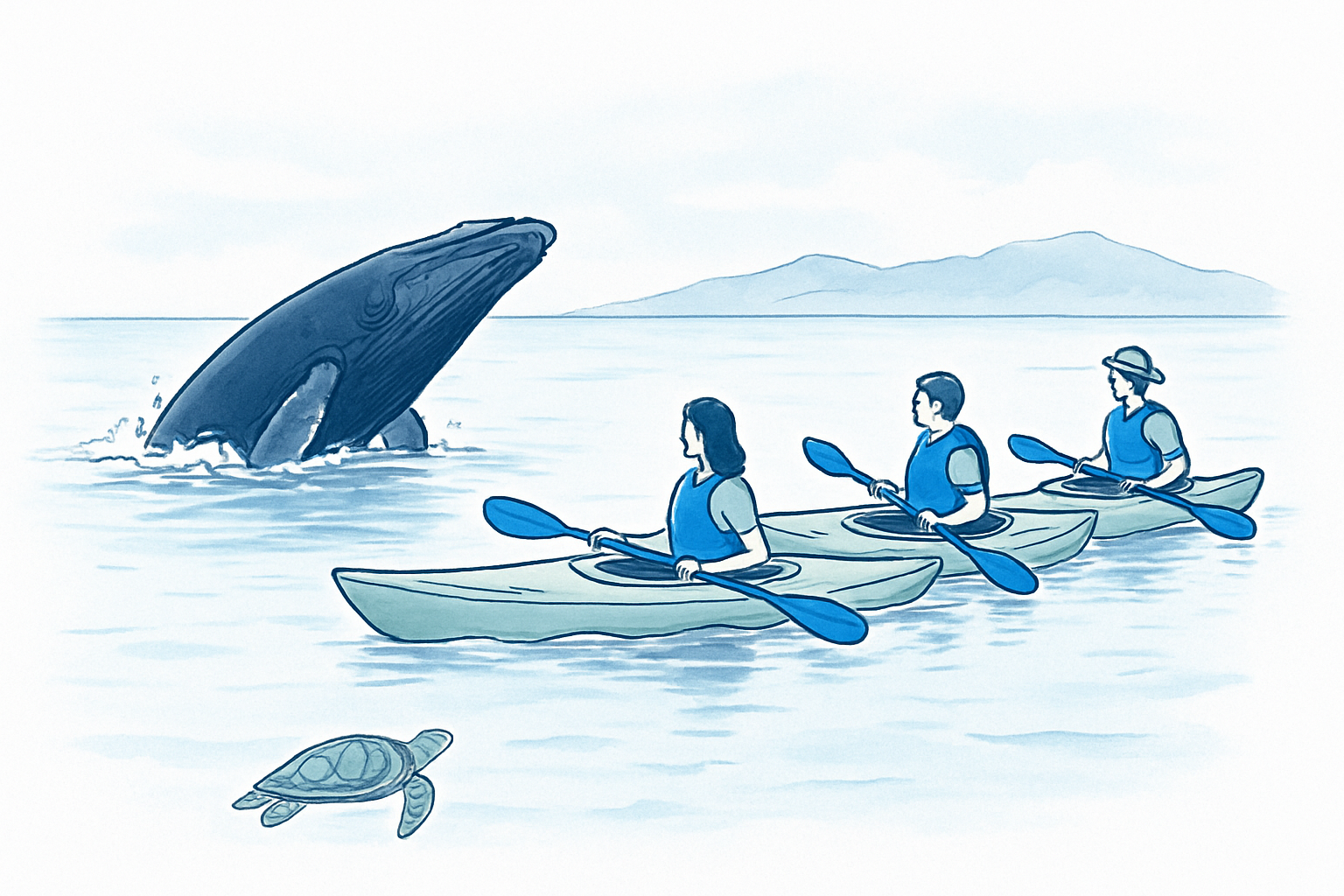
NOAA Fisheries’ Hawaii guidance, updated in February 2026, gives the following distances:
- Stay at least 10 feet from sea turtles on land and in the water.
- Stay at least 50 feet from Hawaiian monk seals and 150 feet from mothers with pups.
- Federal law prohibits approaching or remaining within 50 yards of spinner dolphins in Hawaii.
- Federal law prohibits approaching a humpback whale within 100 yards by kayak, boat, swimming, drone or any other means. (fisheries.noaa.gov)
If a humpback surfaces inside the 100-yard boundary, stop deliberate movement toward the animal and allow it to move away. Do not paddle ahead to intercept its direction, and do not enter the water to snorkel near whales.
Seasonal whale viewing can change the balance of a kayak-snorkel trip. More time may be spent observing from a legal distance and less time at a second snorkel stop, depending on the route, conditions and operator’s plan.
Whale season adds possibility, not permission to approach and not a guaranteed sighting.
What should you bring for kayaking in Maui?
Bring sun protection, drinking water and only the equipment that can be secured to the kayak. Confirm what the tour supplies before packing because guided outings may provide kayaks, paddles, PFDs, masks and fins while independent paddlers remain responsible for all required safety equipment.
As of August 2026, Hawaii personal flotation device requirements state that kayaks under 16 feet must carry one properly sized, wearable USCG-approved PFD for every person. Children 12 and under must wear a PFD while aboard a vessel operating or anchored offshore; adults should wear theirs rather than store it under other gear. (dlnr.hawaii.gov)
A practical packing list includes:
- A properly fitted PFD if one is not supplied
- UPF sun shirt or rash guard
- Secure hat and polarized sunglasses with a retainer
- Broad-spectrum mineral sunscreen
- More drinking water than expected for the paddle duration
- Waterproof phone case or other route-appropriate communication
- Small dry bag for keys and essential personal items
- Towel and dry clothing left at the landing point
- Snorkel mask and fins only if the operator does not supply them
- Any personal motion-sickness plan arranged before launching
Leave loose jewelry, unsecured cameras, glass containers and heavy bags on shore. Alcohol should wait until the group is finished with all paddling, swimming and driving.
The most important item is the PFD already on your body, followed by water, sun protection and reliable communication.
How do you choose the right Maui kayaking tour?
Choose a tour by its actual launch, swimming requirements, group support and cancellation process rather than by the broadest wildlife list. A suitable operator should be able to explain who the trip fits, what movements guests perform and how the route changes when conditions deteriorate.
Ask before booking:
- Where is the exact launch, and when are meeting instructions sent?
- How long is the total activity, and how much time is normally spent paddling?
- Is the kayak tandem or single, and how are partners assigned?
- What swimming and snorkeling ability is required?
- How does a guest enter the water and get back into the kayak?
- Are PFDs, snorkel equipment and dry storage supplied?
- What is the maximum group size per guide?
- What happens if the launch is unsafe or a participant cannot continue?
- During whale season, how is time divided between paddling, snorkeling and passive observation?
- Are photos or video included, optional or unavailable on the selected departure?
Read the current booking page rather than relying on an old directory price, review or cached itinerary. Tour times, inclusions, age policies and meeting points can change, while ocean conditions may require a route adjustment on the morning of the activity.
Ask what happens when wildlife is not present instead of assuming an animal sighting is part of the schedule. The answer should describe the experience, policy and alternative value without suggesting that wild animals can be controlled.
The right Maui kayaking tour explains fit, route flexibility and safety before it sells scenery.
What do visitors ask about kayaking in Maui?
These four questions reflect the broader concerns visitors have before choosing a coastline or booking a guide. Each answer starts with conditions and ability because those factors matter more than a beach’s popularity.
Can you go kayaking in Maui?
Yes. Maui has beach-launched coastal paddling in areas such as Olowalu and South Maui, plus guided trips that combine kayaking with snorkeling. The right launch changes with wind, swell, water quality and ability, so a familiar beach name never replaces a same-day conditions check or a guide’s local call.
What is one thing not to miss on Maui?
For an active ocean day, do not miss the contrast between paddling above the reef and entering the water to see it at eye level. Choose a calm, responsible kayak-snorkel experience rather than chasing a wildlife sighting; the quality comes from the setting, guide and conditions, not a promised animal encounter.
What to stay away from in Maui?
Stay away from brown or murky runoff water, breaking shore launches beyond your skill, exposed crossings, swim or vessel zones you do not understand, and any plan that relies on the wind remaining favorable. Also keep legal and recommended distances from protected wildlife, including humpback whales and sea turtles.
Where are the best kayaking locations in Hawaii?
Hawaii’s best kayaking locations depend on island, season and paddler experience. On Maui, Olowalu is a common reef-focused choice, while Kīhei, Wailea and Makena provide South Maui options. Across the state, the safest choice is not a famous name but a launch matched to the day’s wind, swell and access rules.
The repeated answer is simple: choose conditions and fit before choosing a famous name.
What should you do next?
Choose the shoreline only after choosing the standard your group needs: independent self-rescue competence or guided support. Keep the itinerary flexible enough to accept a location change or cancellation when the ocean says no.
If a guided Olowalu paddle and reef stop fits your group, ask about conditions and tour fit before locking the rest of the day. Zephyr can confirm the current meeting point, swimming expectations and whether the scheduled format suits the least-confident person in the group.
Bring the least-confident participant into that conversation; the right plan is the one that works for that person too.