
In short
Snorkeling at Makena Beach usually means choosing Makena Landing, not Big Beach. Makena Landing offers the more sensible shore-snorkeling setup when the cove is calm and the entry is manageable. Big Beach is exposed to powerful shorebreak and should never be treated as a default snorkel spot, even if the water looks inviting.
Key takeaways
- ⚠️ The official Mākena State Park page warns that Big Beach shorebreak can be very dangerous and describes swimming as a calm-seas activity.
- 🌊 Makena Landing is the better place to assess first for a shore snorkel, but a smaller cove is not a guarantee of safe water.
- 🥽 Hawaiʻi Ocean Safety's snorkeling guidance says snorkelers should be experienced ocean swimmers and should avoid high surf, high wind, heavy shorebreak and strong currents.
- 🐢 Sea turtles may be present, but sightings are never guaranteed; NOAA's 2026 guidance recommends staying at least 10 feet away on land and in the water.
- ✅ A current Makena snorkel report requires live official information and an on-site assessment on the same morning.
In this guide
- Should you snorkel at Big Beach or Makena Landing?
- Why is Big Beach a poor default for snorkeling?
- When does Makena Landing make more sense?
- How do you get a same-day Makena snorkel report?
- How should you behave around turtles and coral?
- Who should snorkel independently, and who should book a guide?
- What else do visitors ask about snorkeling in Makena?
- What should you do next?
Snorkeling at Makena Beach is confusing because Mākena can refer to the wider district, Oneloa or Big Beach inside Mākena State Park, or nearby Makena Landing. This guide treats Big Beach and Makena Landing as separate decisions because their entries and exposure are different. For a wider island comparison, see our guide to the best Maui beaches for snorkeling from shore.
Should you snorkel at Big Beach or Makena Landing?
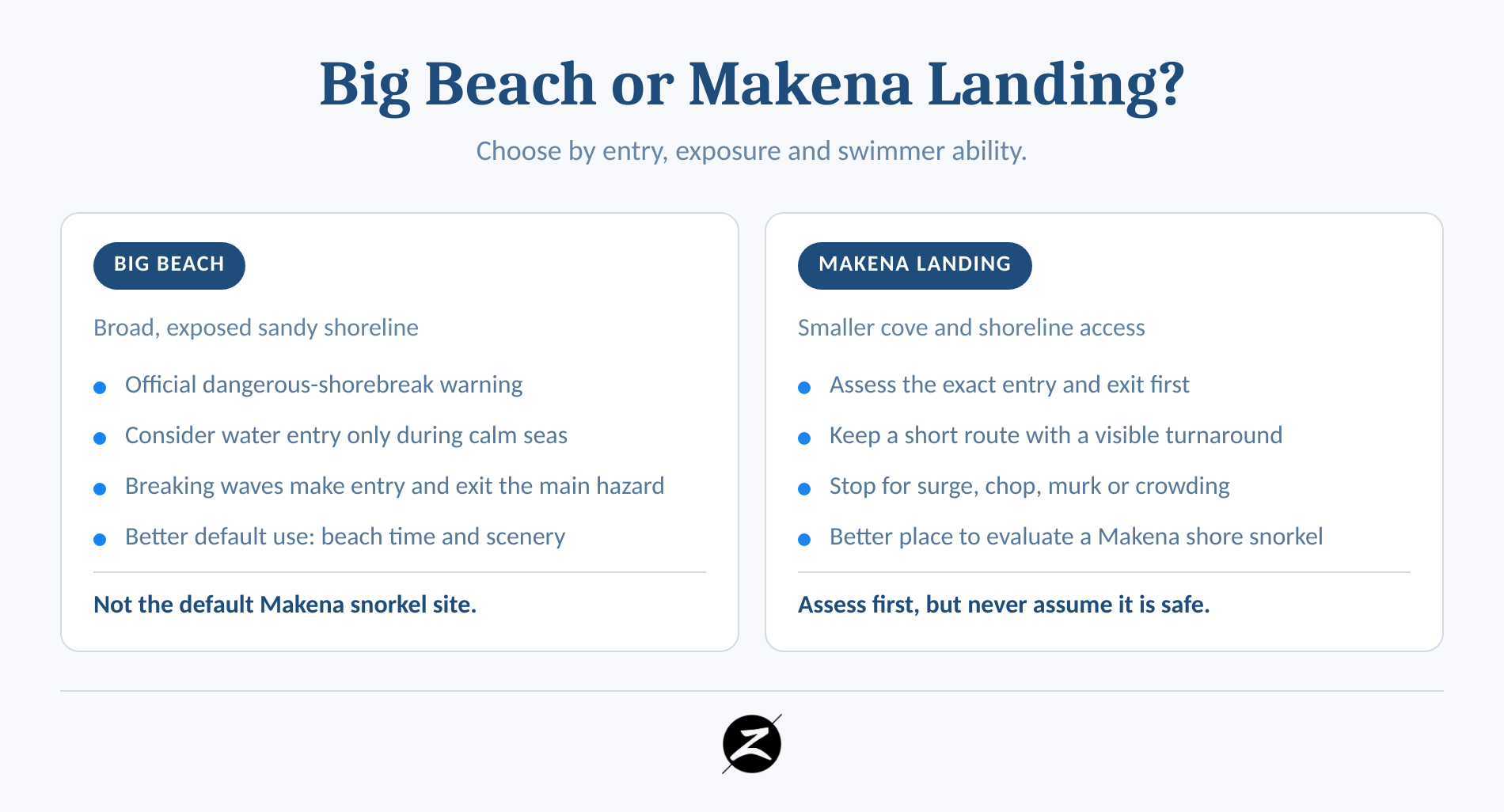
Most visitors choosing between the two should assess Makena Landing first and treat Big Beach as a beach visit, not a snorkeling plan. Neither location is automatically suitable, but Big Beach's official shorebreak warning makes it the weaker default.
| Decision factor | Big Beach | Makena Landing |
|---|---|---|
| Default plan | Beach time; swim only when the sea is calm | Assess for snorkeling if the entry and exit look manageable |
| Exposure | Broad sandy shoreline with potentially powerful shorebreak | Smaller cove setting that can still develop surge, chop or poor visibility |
| Stop sign | Waves breaking hard at the entry, warning signs or lifeguard caution | Unstable footing, repeated surge, murky water, crowding or a difficult exit |
| Route | Do not assume the beach name provides a safe snorkel route | Set a short out-and-back route with a visible exit and turnaround point |
| Best fit | Visitors prioritizing sand, scenery and beach time | Capable ocean swimmers evaluating Makena Landing snorkeling that morning |
Big Beach offers far more open sand, but sand does not make an ocean entry forgiving. The entry and exit can become the most difficult part of the snorkel before anyone reaches reef habitat.
Makena Landing presents a smaller area to evaluate. That can make it easier to identify an exit, choose a conservative route and turn around early, but the word landing does not mean protected pool. Watch what the water is doing rather than what other swimmers are doing.
Crowds are not proof that the conditions suit your group. Other people may know the site better, may be stronger swimmers or may simply be making a poor decision.
Choose Makena Landing as the place to assess first, but let the water decide whether anyone enters.
Why is Big Beach a poor default for snorkeling?
Big Beach is a poor default because shorebreak can turn a sandy entry into a high-impact hazard. The official park description limits swimming to calm seas and places a prominent shorebreak caution above its visitor information.
As of September 9, 2026, the official Mākena State Park page states plainly that shorebreak can be very dangerous. The warning matters even if the ocean looks calm during a temporary lull.
Wave sets arrive in groups. A person who enters between sets may face larger breaking waves when trying to return, particularly after fatigue has begun. Hawaiʻi Ocean Safety's shorebreak guidance advises staying out where dangerous shorebreak is present and notes that even wading can be hazardous.
Do not treat fins, a flotation belt or confidence in a swimming pool as solutions to breaking surf. Snorkeling equipment can add tasks at the exact moment a swimmer needs balance, awareness and a controlled exit.
If a lifeguard is present, ask about the entry before preparing equipment and follow every warning. If waves are breaking at the shoreline, keep the snorkel gear dry.
Big Beach is a beach to admire first and a snorkel site only under unusually calm, clearly manageable conditions.
When does Makena Landing make more sense?
Makena Landing makes more sense when the entry is calm, the exit stays visible and every participant can return without being towed or rescued. It is a better candidate than Big Beach, but it remains an ocean site rather than a beginner-proof swimming area.
Hawaiʻi Ocean Safety says people intending to snorkel should be experienced ocean swimmers. A smaller cove cannot replace the ability to float calmly, clear a snorkel, manage fins and return against unexpected resistance.
Before entering at Makena Landing:
- Identify the exact exit. Every swimmer should be able to point to it from the water.
- Keep the first route short. Do not follow distant swimmers, kayaks or guided groups as a substitute for planning.
- Watch the shared entry. Wait if other ocean users make the entry or exit difficult to read.
- Use a real buddy system. Stay close enough to notice equipment trouble, fatigue or anxiety.
- Turn back early. The halfway point should arrive before anyone feels tired.
The most useful meaning of more protected is less directly exposed than Big Beach. It does not mean immune to swell, surge, wind chop, runoff or rapidly changing visibility.
Makena Landing is the better candidate, not a condition-proof answer.
How do you get a same-day Makena snorkel report?
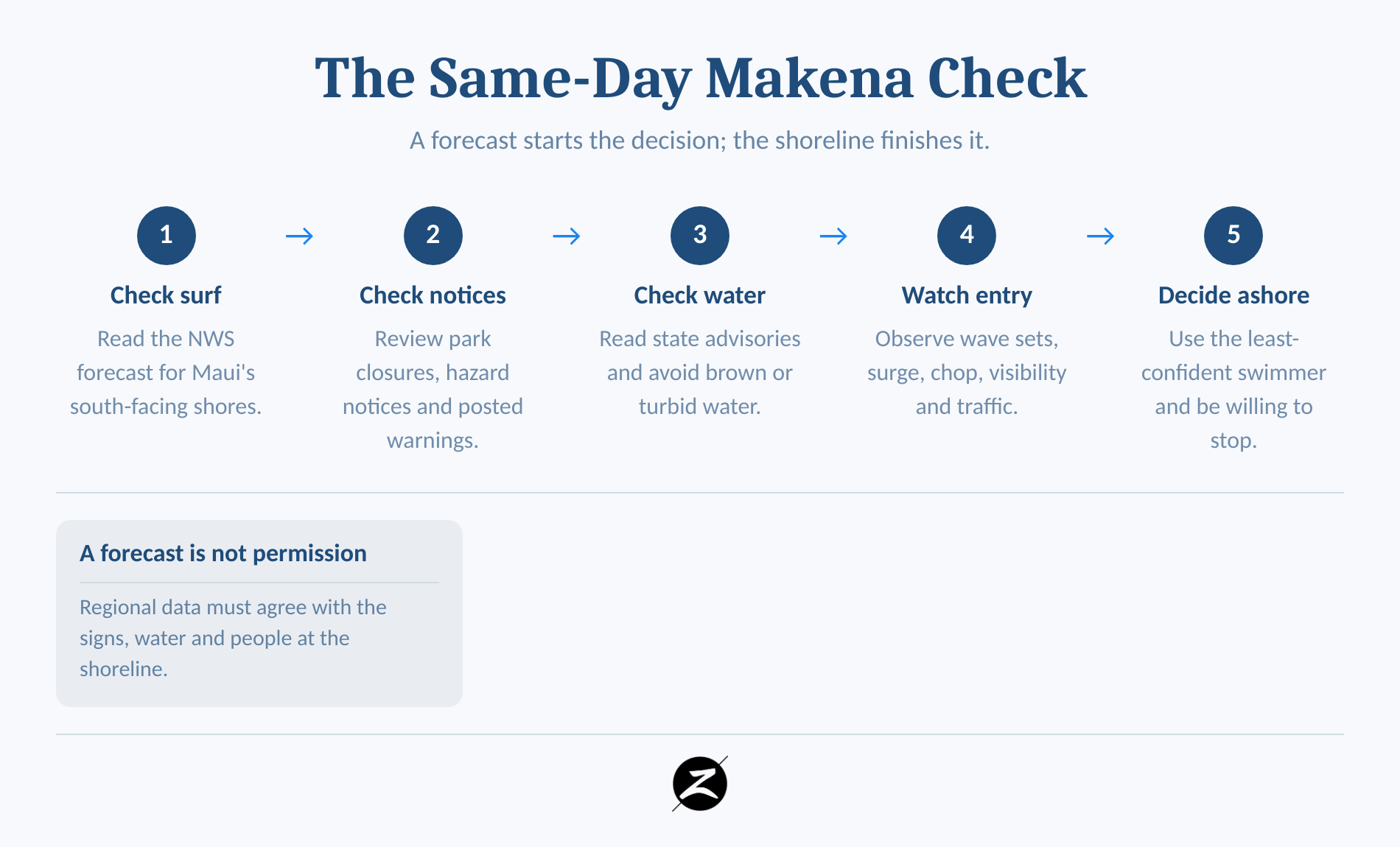
A reliable same-day report combines regional forecasts, current notices, water-quality information and direct observation at the shoreline. No website can declare Makena Landing safe for every swimmer from a regional forecast alone.
The following official source links were checked on September 9, 2026:
- Read the regional surf outlook. The National Weather Service surf forecast reports expected surf for Maui's north-, south-, east- and west-facing shores. Makena is affected by south-shore energy, but regional wave heights do not describe the exact entry at Makena Landing.
- Check park and hazard notices. Review Hawaiʻi State Parks health and safety notices for closures and changing hazards. Posted signs and official instructions at the beach control over an older article or saved screenshot.
- Check water quality after rain. The Hawaiʻi Department of Health water-quality page links to current advisories. Do not enter brown, cloudy or turbid water, even if the sky over Makena is sunny.
- Watch several complete wave sets. Look for repeated breaking waves, sideways or outward water movement, surge at the entry, persistent chop and poor visibility.
- Assess the people and equipment. The least-confident swimmer, a leaking mask, breathing discomfort or uncertainty about the exit can each turn a possible outing into a no-go decision.
A forecast is evidence, not permission. The plan should be cancelled or moved when any official warning, on-site condition or participant limitation does not fit.
A current Makena snorkel report comes from live alerts plus an on-site go/no-go decision.
How should you behave around turtles and coral?
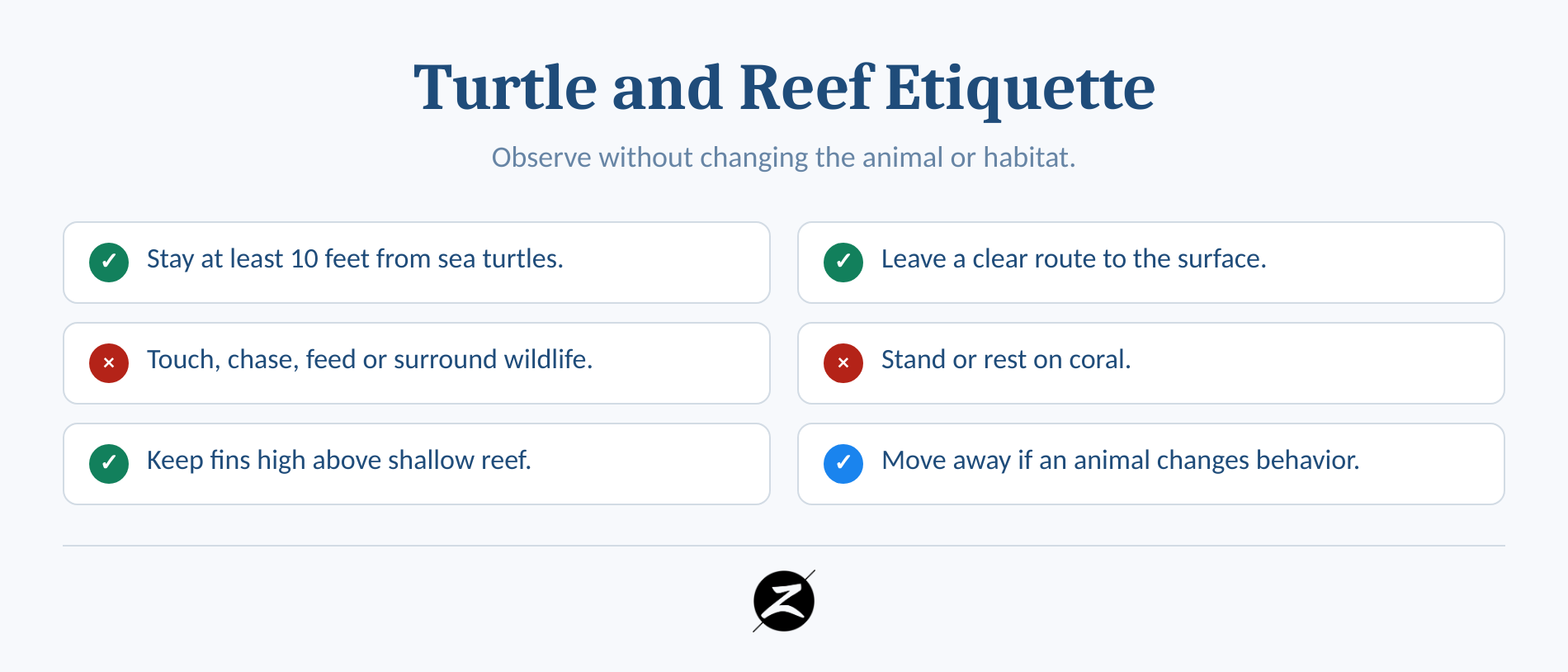
Give turtles room to choose their own direction and remain fully afloat above reef habitat. A wildlife sighting does not justify chasing, touching, surrounding or blocking an animal.
NOAA's 2026 Hawaiʻi wildlife-viewing guidance recommends staying at least 10 feet, or 3 meters, from sea turtles on land and in the water. Ten feet is a minimum viewing guideline, not a target distance for following a moving turtle.
If a turtle approaches, remain calm and give it a clear route. Do not swim above it when it needs to surface, and do not position several people around it for photographs.
Maui County Ocean Safety advises ocean users not to touch reefs. Keep fins high, avoid standing on coral and move around shallow habitat only when enough water exists to float without contact.
The best turtle encounter is one that does not change the turtle's behavior or damage the reef.
Who should snorkel independently, and who should book a guide?
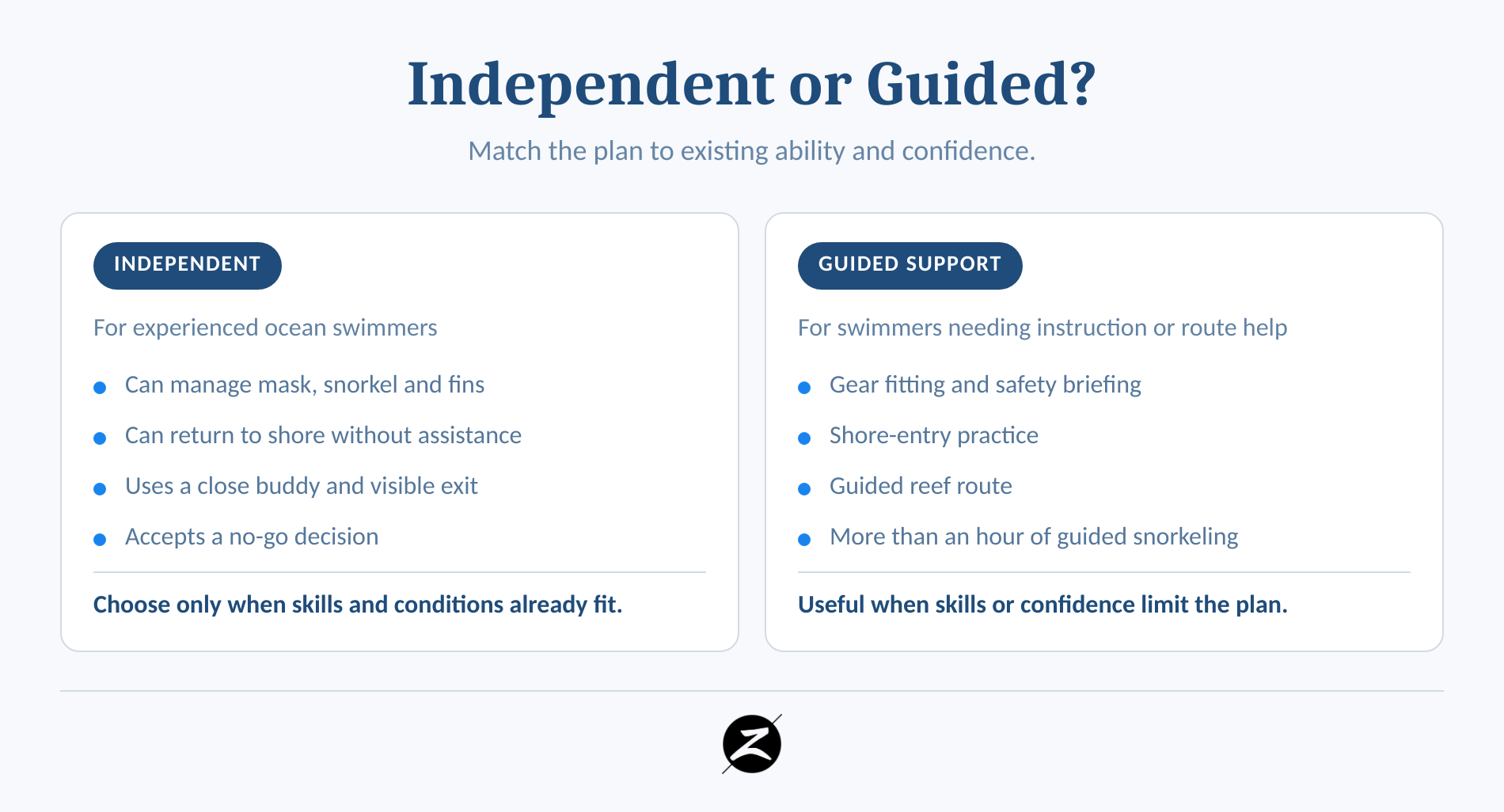
Independent shore snorkeling is for experienced ocean swimmers who can manage their equipment, stay with a buddy and return to shore without assistance. A guide is the better choice when gear skills, route selection, water confidence or mixed group abilities are the limiting factors.
Independent snorkeling may fit when every participant can:
- Swim confidently in the ocean rather than only in a pool.
- Breathe through a snorkel without panic.
- Clear or remove a flooded mask while staying afloat.
- Recognize fatigue and turn back before it becomes urgent.
- Stay oriented to the exit without following strangers.
- Accept a no-go decision without trying to salvage the itinerary.
What does the decision look like in a guide's work?
Consider a group that arrives to find repeating shorebreak at Big Beach. Makena Landing looks calmer, but one guest cannot clear a mask without standing and another becomes anxious when the bottom drops away.
The correct work decision is not to declare Makena Landing safe. A guide would need to reassess the guest's skills, shorten the objective, provide controlled practice within the participant requirements or cancel the water entry if the conditions and abilities do not align.
If Makena Landing does not fit the group, compare alternatives in our guide to best snorkeling in South Maui rather than forcing the original plan.
For swimmers who want support with gear fitting, a safety briefing, shore-entry practice and route choice, our Turtle Town Signature Snorkel includes more than an hour of guided reef snorkeling plus complimentary photos and video. We cannot promise a turtle sighting, and a guide cannot make unsuitable conditions suitable.
Choose independent snorkeling only when ability and conditions already fit; use guidance when skills or confidence are the limiting factor.
What else do visitors ask about snorkeling in Makena?
Makena snorkeling questions rarely have a permanent yes-or-no answer because beach names, water conditions and swimmer ability are separate variables. The following answers apply to shore snorkeling and still require a same-day assessment.
Is there good snorkeling at Makena Beach?
Yes, Makena-area snorkeling can be good when the water is calm, clear and manageable for the swimmer. The key distinction is location: Big Beach carries an official dangerous-shorebreak warning, while Makena Landing is the more sensible place to assess for a shore snorkel. Neither beach is suitable every day.
Are there sea turtles at Makena Beach?
Sea turtles may be seen around Makena's nearshore reef habitat, but no beach or tour can guarantee a sighting. NOAA's 2026 Hawaiʻi guidance recommends staying at least 10 feet, or 3 meters, from sea turtles on land and in the water and says never to touch, chase or feed them.
Which beach in Maui has the best snorkeling?
No Maui beach is best under every combination of swell, wind, runoff and swimmer ability. For many South Maui visitors, a calm sandy-entry beach may be a better starting point than Big Beach, while experienced swimmers may choose reef-focused sites. Pick for the least-confident swimmer and the actual morning conditions.
What is the current snorkel report for Makena Landing, Maui?
There is no reliable permanent snorkel report for Makena Landing because conditions change by the hour. Check the National Weather Service surf forecast, Hawaiʻi park notices and state water-quality advisories on the same morning, then watch for repeated wave sets, surge, chop, murky water and posted warnings before deciding.
Makena questions become easier when beach names, current conditions and swimmer ability are separated.
What should you do next?
Use Makena Landing as the first assessment point if shore snorkeling is the goal, and keep Big Beach as a beach-day option rather than a promised snorkel stop. Be willing to change locations or stay on shore when the entry, forecast or least-confident swimmer does not fit.
Check the live sources, look at the shoreline, and make the final decision before the fins go on.