
In short
Shark attacks in Maui are rare, but the risk is not zero. Hawaiʻi's official records show that some incidents involve bites to boards or kayaks rather than people. Reduce risk by choosing lifeguarded water, avoiding murky runoff and dawn or dusk, staying with others, and obeying every warning sign.
Key takeaways
- 🦈 As of August 30, 2026, the state incident list contains 23 Maui entries from January 2016 onward: 15 involved injury or death to a person, while eight involved equipment with no reported injury.
- 📊 Hawaiʻi officials report an average of about three or four shark bites per year statewide, not three or four per year on Maui.
- 📅 A 2026 peer-reviewed analysis found that 32 of 165 statewide unprovoked bites from 1995 through October 2024 occurred in October.
- 🌊 Posted warnings, murky runoff, stream mouths after rain, nearby fishing, poor visibility, isolation, and open wounds are reasons to stay out of the water.
- ✅ Guided snorkeling can add a briefing, buddy structure, equipment support, and nearby assistance, but it cannot remove the risks of a wild ocean.
Table of contents
- How common are shark attacks in Maui?
- Why has Maui recorded more shark bites than other islands?
- Is October really the highest-risk month?
- Which conditions should make you stay out of the water?
- What should you do if you see a shark while snorkeling?
- Does guided snorkeling remove shark risk?
- What do visitors ask about shark attacks in Maui?
- What should you do before your next Maui ocean day?
How common are shark attacks in Maui?
Maui shark bites are uncommon, and the official record is more nuanced than a raw incident count. The list includes injuries to people, bites to boards or kayaks with no injury, and some provoked incidents, so those categories should not be treated as the same risk.
As of August 30, 2026, a line-by-line count of the Hawaiʻi Department of Land and Natural Resources official incident list finds 23 Maui entries from January 2016 onward. Fifteen involved injury or death to a person, including two incidents identified as provoked, while eight involved a surfboard, paddleboard, hydrofoil, or kayak with no reported injury.
The annual counts were seven in 2016; zero in 2017 and 2018; three in each of 2019, 2020, and 2021; two in 2022; three in 2023; one in 2024; zero in 2025; and one through August 30, 2026. Those are incident-list entries, not 23 attacks on swimmers.
DLNR adds an event after the Division of Aquatic Resources completes its investigation. That delay can make the public list look incomplete immediately after an event, but a short delay is not evidence that Maui incidents are routinely hidden.
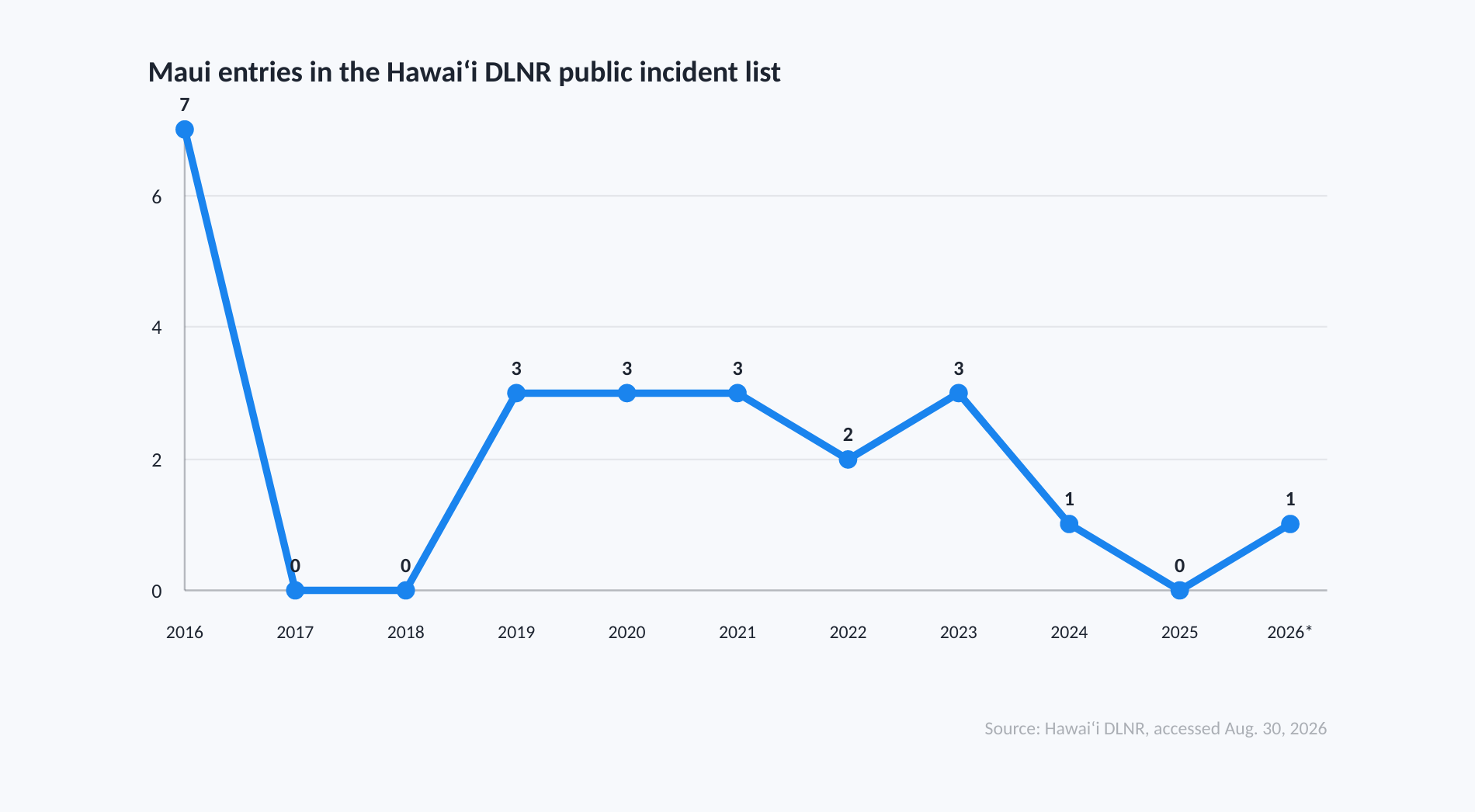
The most recent Maui entry was on May 16, 2026, one mile offshore of Olowalu. A tiger shark bit a kayak while the occupant was paddling, and no injury was reported. The list contains no Maui entries for 2025.
Statewide, the Hawaiʻi shark fact sheet reports about three or four bites per year. The state's close-encounters guidance describes the statewide chance of a bite as less than one in a million, with serious injury much less likely.
Neither statement supplies a precise Maui snorkeling probability. Researchers do not have a complete denominator showing how many people swim, snorkel, surf, paddle, or dive at every island and location, under every set of conditions.
Maui shark bites are uncommon, and the official incident list must be read carefully because it also includes equipment bites and provoked cases.
Why has Maui recorded more shark bites than other islands?
Maui has extensive habitat used by tiger sharks alongside heavily used ocean recreation areas. Researchers have also warned that differences in visitor numbers and water activities may explain part of the pattern, so habitat alone is not a complete answer.
A University of Hawaiʻi research team prepared a 2016 Maui tiger shark report for Hawaiʻi DLNR. From 1995 through 2015, its county-level table recorded 47 unprovoked bites in Maui County, compared with 21 in Honolulu County, 16 in Hawaiʻi County, and 13 in Kauaʻi County.
The same report measured 3,641 square kilometers of insular shelf habitat in Maui County, more than the 2,906 square kilometers listed for the other three counties combined. Tiger sharks prefer this broad shelf environment, and some frequently visited shark areas are adjacent to popular recreation sites.
The report did not prove that shark abundance caused the county difference. Its authors said they lacked comprehensive, island-by-island measurements of ocean recreation and could not rule out greater human exposure as the primary explanation.
A 2025 Scientific Reports study added six years of acoustic tracking data collected from 2013 to 2019. Maui-tagged tiger sharks were detected throughout the year, while some Oʻahu-tagged mature sharks moved seasonally to Maui. Olowalu showed the clearest annual pattern and evidence consistent with a diffuse winter mating aggregation.
That research tracked shark movements, not attacks on people. It does not show that every shark at Olowalu is feeding, that an encounter is likely, or that one recent incident can be attributed to mating behavior.
Maui's shark history reflects habitat and human ocean use, but current science cannot turn either factor into a beach-by-beach prediction.
Is October really the highest-risk month?
October has a documented statewide increase in unprovoked shark bites, but the absolute number remains small. The pattern applies to Hawaiʻi as a whole and should not be used as a precise forecast for a particular Maui beach, hour, or activity.
A 2026 Frontiers in Marine Science analysis examined 165 unprovoked bites recorded from January 1995 through October 2024. Thirty-two occurred in October, about 20 percent of the total, while 133 occurred across the other eleven months.
Confirmed tiger sharks accounted for 20 of the 32 October bites, or at least 63 percent. The analysis found no corresponding October increase in recreational water use, and sea-surface temperature anomalies did not explain the pattern.
The author proposed that seasonal tiger shark movements, giving birth, and increased postpartum feeding needs may contribute. That biological explanation is a supported hypothesis, not proof of what caused any individual encounter.
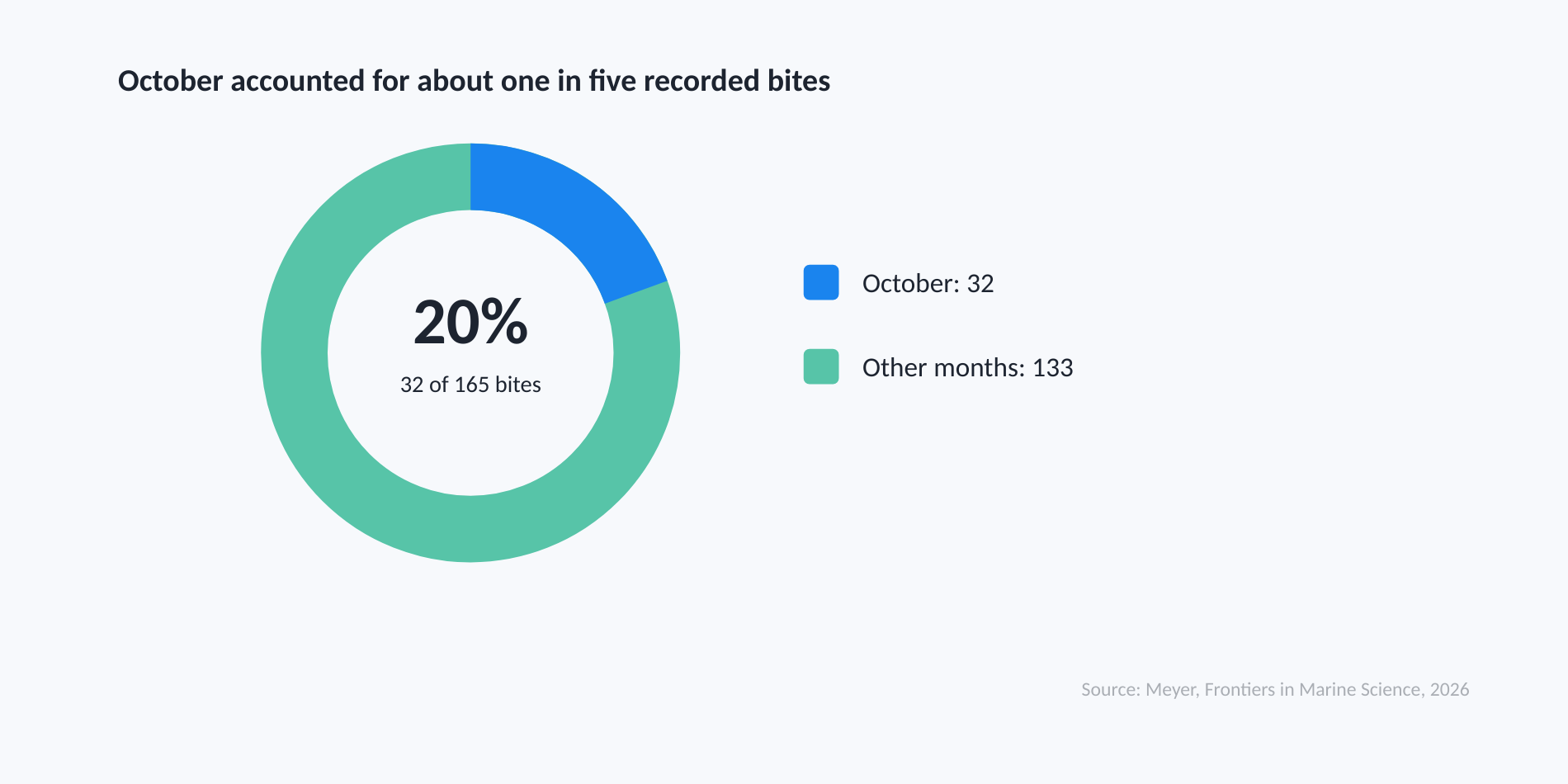
October is not a reason to assume that every water entry is dangerous, just as another month is not a guarantee of safety. Use the calendar as context, then make the actual decision from visibility, weather, warnings, lifeguard advice, and the group's ability.
October has a real statewide increase in recorded bites, yet the absolute risk remains low and the pattern is not a forecast for a specific swim.
Which conditions should make you stay out of the water?
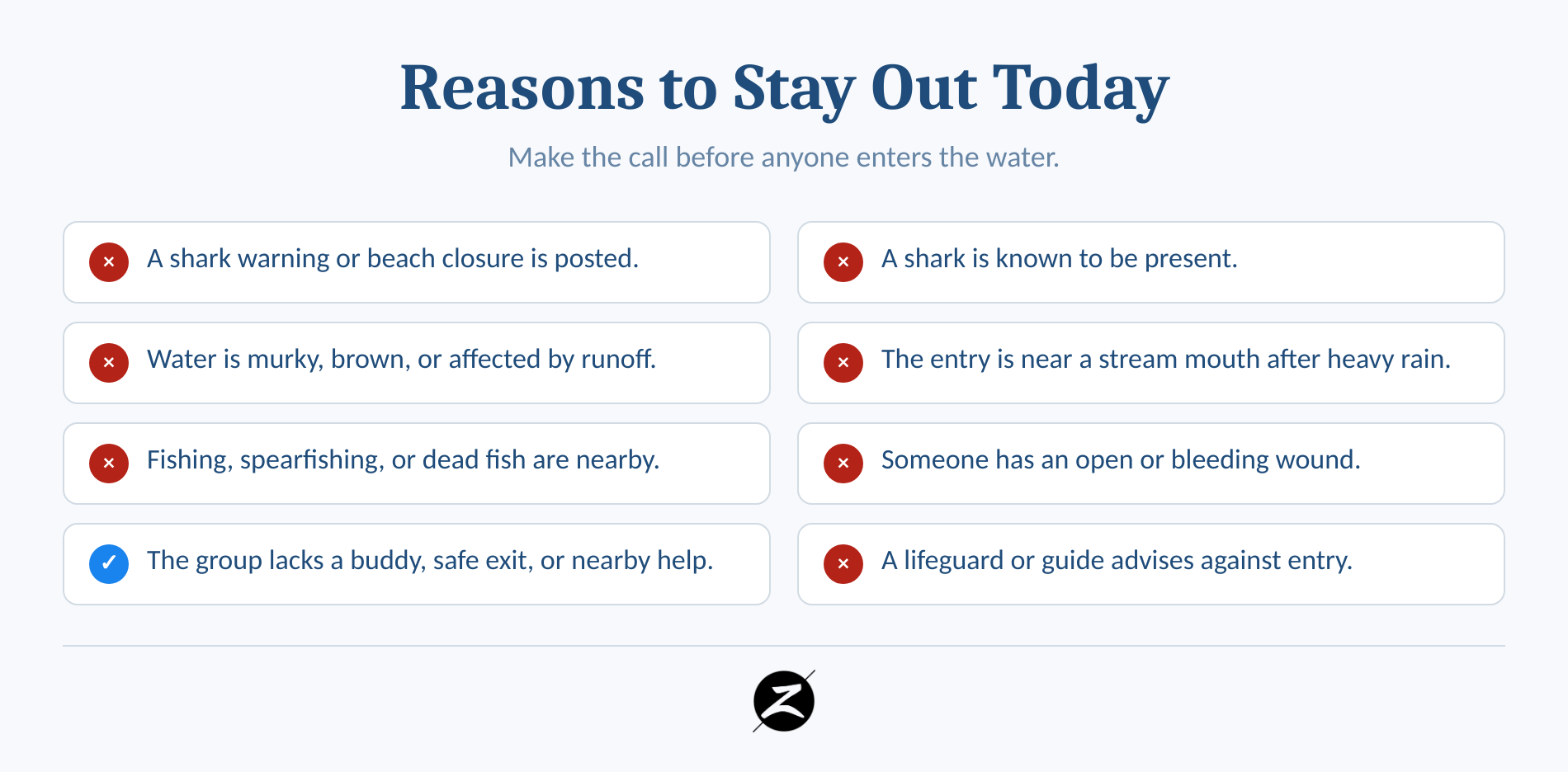
Stay out when a shark warning or beach closure is posted, a shark is known to be present, or a lifeguard tells people not to enter. Murky runoff, recent heavy rain near a stream mouth, nearby fishing activity, poor visibility, and being alone are additional reasons to change the plan.
The state's shark-safety guidance prioritizes several practical precautions:
- Obey warnings and sightings. Do not enter water where a shark is known to be present. Leave quickly and calmly if one is seen.
- Avoid murky water. Harbor entrances, stream mouths, channels, steep drop-offs, and runoff after heavy rain deserve particular caution.
- Choose the time carefully. DLNR advises avoiding dawn, dusk, and night, while noting that tiger shark bites can occur at any hour.
- Stay near help. Swim, surf, or dive with other people and avoid moving far from assistance.
- Separate recreation from fishing. Do not swim near fishing, spearfishing, dead animals, discarded fish parts, or a speared catch.
- Stay out with an open wound. Do not enter if bleeding.
- Watch wildlife behavior. Leave if fish or turtles begin moving erratically.
- Reduce avoidable signals. Minimize excessive splashing and leave shiny jewelry and strongly contrasting gear ashore when practical.
Before leaving for the beach, use the Hawaiʻi Ocean Safety portal to find current conditions and lifeguarded beaches. The live hazard rating is more useful for a day-of choice than a general statement about an entire Maui coast.
A practical decision example: overnight rain has left brown water crossing a South Maui entry, visibility is poor, and no lifeguard is present. The correct response is to wait or choose another suitable location, even if the ocean looks calm and the original schedule is inconvenient.
Trip planning should also account for entry method, swimming ability, and the activity itself. Zephyr's overview of ocean safety and activities shows the supported ocean formats available to different guests.
The safest decision is made before entry: skip water with warnings, poor visibility, runoff, isolation, or nearby fishing activity.
What should you do if you see a shark while snorkeling?
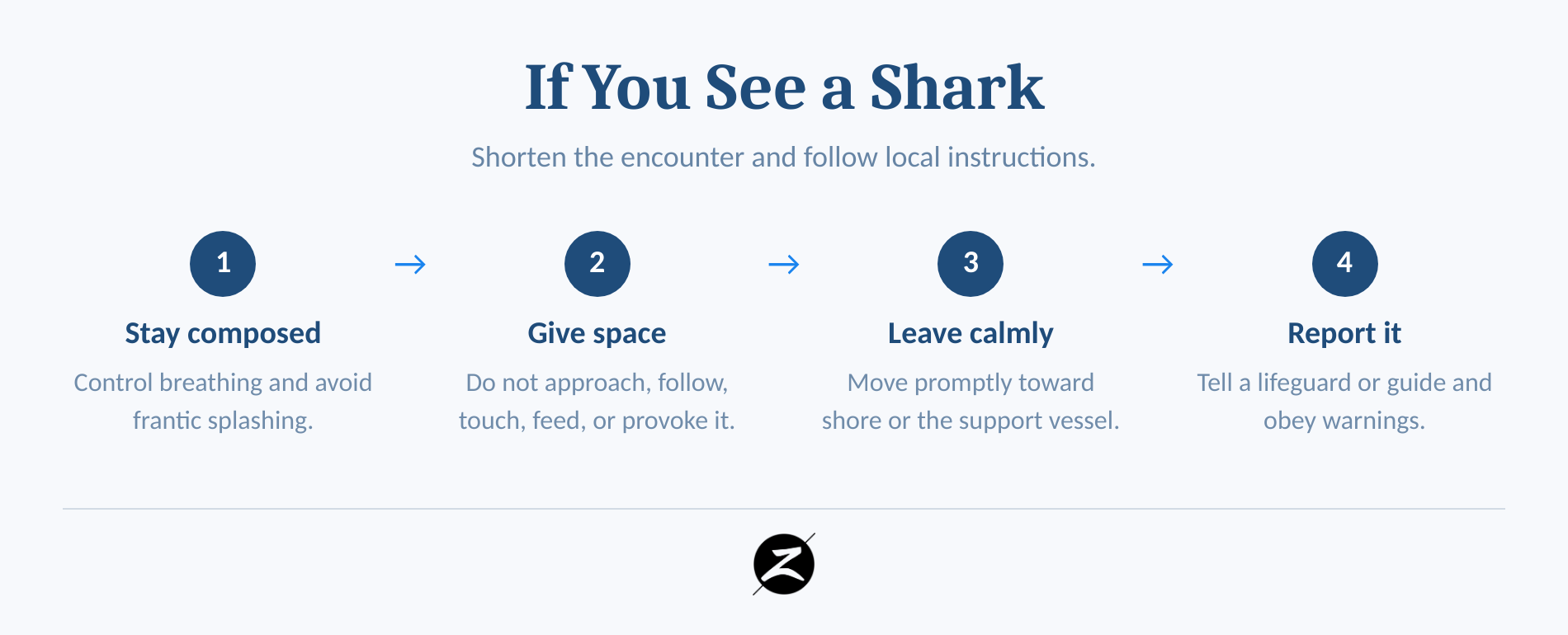
If a shark is seen, stay composed and leave the water quickly and calmly while minimizing frantic splashing. Do not approach, follow, touch, feed, photograph at close range, or otherwise provoke the shark.
The goal is not to identify the species or capture better footage. The goal is to shorten the encounter, keep the group together when possible, and reach the nearest safe exit or support vessel.
Once ashore, report the sighting to a lifeguard, guide, or other responsible safety official. Follow any warning signs or closure instructions, even if the shark is no longer visible. Maui County Ocean Safety guidance directs beach users to obey signs, use lifeguarded areas, avoid swimming alone, and call 911 for an emergency.
If a person is injured, call 911 immediately and follow the directions of lifeguards, emergency dispatchers, or trained medical responders.
If a shark is seen, do not investigate; leave the water quickly, calmly, and without provoking the animal.
Does guided snorkeling remove shark risk?
No guide, beach, or tour can guarantee that a shark will not be present or that an ocean activity will be risk-free. Guided snorkeling can still add useful layers of support, including a briefing, buddy structure, equipment assistance, an identified entry and exit, and another person watching conditions.
Hawaiʻi's safety guidance recommends entering the ocean with other people and staying near assistance. Those measures reduce isolation, but no controlled Maui study provides a number showing how much professional supervision changes shark-bite risk.
Our Turtle Town Signature Snorkel includes gear fitting, a safety briefing, shore-entry practice, more than an hour of guided reef snorkeling, and complimentary photos and video. Zephyr's safety FAQs provide additional booking and participation details without replacing day-of guidance from the guide or public safety officials.
Ready for guided support? Review our guided Turtle Town snorkeling experience and confirm that every guest meets the stated participation requirements. A guided tour adds preparation and attention, not a promise that wildlife or ocean conditions can be controlled.
Guided snorkeling can add assessment and support, but it cannot make a wild ocean risk-free.
What do visitors ask about shark attacks in Maui?
Visitors usually want a simple probability or a beach guaranteed to have no sharks. Neither answer exists, but the official record and current-condition checks support practical decisions that reduce avoidable exposure.
Are shark attacks common in Maui?
Shark attacks in Maui are uncommon. A precise per-swim Maui probability is not available because the number and type of ocean exposures are not fully measured. Hawaiʻi DLNR says shark bites average about three or four per year statewide, while serious and fatal bites are much rarer.
What month has the most shark attacks in Hawaii?
October has the strongest statewide pattern in the 1995 to 2024 research record. A 2026 peer-reviewed analysis found 32 of 165 unprovoked bites, about 20 percent, occurred in October. The finding applies to Hawaiʻi as a whole, not a guaranteed forecast for any Maui beach or day.
Is snorkeling in Maui safe from sharks?
No ocean activity is free of wildlife risk, and no beach or operator can guarantee that a shark will not be present. Snorkelers can reduce risk by using lifeguarded or professionally supervised water, staying with others, avoiding murky runoff and warning areas, and leaving promptly if a shark is seen.
What should you do if you see a shark while snorkeling?
If a shark is seen while snorkeling, stay composed, do not approach or harass it, and move toward shore or the support vessel quickly and calmly with minimal splashing. Keep the group together when possible, then tell a lifeguard or guide and follow any closure or warning instructions.
Do Maui people see sharks often?
Sharks live in Maui waters, but there is no complete public count of sightings, and visibility varies by species, location, depth, and conditions. A sighting does not mean a bite is likely. Leave the water calmly, tell a lifeguard or guide, and follow posted instructions.
The useful answer is consistent: treat Maui's ocean as wildlife habitat, check the exact conditions, and keep an exit close.
What should you do before your next Maui ocean day?
Check the exact beach on the day, not Maui in general. Ask the lifeguard or guide about visibility, runoff, warnings, entry, exit, and the least-confident swimmer before anyone puts on a mask.
Make the decision while still on land. If the water is murky, a warning is posted, or the group lacks a safe exit and nearby help, choose another time or place.
Before entering, check the exact beach, ask a lifeguard or guide, and be willing to change the plan.