
In short
The best Maui beach for shore snorkeling depends on swimming ability and same-day conditions. Ulua is the strongest all-around starting point for confident swimmers new to snorkeling, Maluaka and Makena Landing suit turtle-focused South Maui plans, Kapalua offers a sheltered West Maui bay, and Honolua is better reserved for experienced snorkelers on calm days. (mauicounty.gov)
- 🌊 Hawaiʻi's 2026 snorkeling-safety guidance says snorkelers should be experienced ocean swimmers and should avoid high surf, strong currents, heavy shorebreak and high wind. (oceansafety.hawaii.gov)
- 🥽 Ulua has parking, restrooms, showers and a sandy shoreline, but the County of Maui lists no lifeguard. (mauicounty.gov)
- 🐢 No beach guarantees turtles, and NOAA recommends staying at least 10 feet away from sea turtles on land and in the water. (fisheries.noaa.gov)
- 🧭 Choose a beach according to the least-confident swimmer, the entry and exit, and the water in front of you that morning.
- ⚠️ Big Beach is famous, but the official Mākena State Park page warns that its shorebreak can be very dangerous. It is not a default snorkeling beach. (dlnr.hawaii.gov)
In this guide
- Which Maui beach should you choose first?
- What makes a shore-snorkeling beach beginner-friendly?
- Which South Maui beaches are best?
- Which West Maui beaches are best?
- When should you skip snorkeling?
- How should you behave around turtles and coral?
- When is a guide the better choice?
- What else do visitors ask?
A beach name is not a forecast. Before using this Maui snorkeling guide to pick a location, check official warnings, look at the water for several minutes and be willing to change the plan. For a broader introduction to equipment and expectations, read our overview of snorkeling in Maui.
Which Maui beach should you choose first?
There is no single Maui beach that is best every day. Start with the beach nearest your lodging that matches the least-confident swimmer, then compare its entry, exposure and current conditions.
| Beach or area | Region | Best fit | Typical entry | Choose it when | Think twice when |
|---|---|---|---|---|---|
| Ulua Beach | South Maui | Confident swimmers new to snorkeling | Sandy | You want a short route to reef and shore facilities | Wind, waves or crowding make the entry stressful |
| Maluaka Beach | South Maui | Comfortable swimmers and mixed beach groups | Sandy with rocky ends | You want a beach day with reef exploration at the edges | You expect turtles directly in front of the sand |
| Makena Landing | South Maui | Supported beginners to intermediate swimmers | Compact cove | Reef access matters more than having a broad beach | Your group needs lots of open sand and simple footing |
| ʻĀhihi-Kīnaʻu | South Maui | Intermediate and experienced snorkelers | Rock and lava | The sea is calm and everyone can manage the footing | Anyone needs an easy sandy entry |
| Kapalua Bay | West Maui | Confident newer snorkelers | Sandy bay | The bay is calm and your group wants a full beach day | Swell or wind is entering the bay |
| Napili Bay | West Maui | Mixed groups | Sandy bay | The water is calm and clear near the bay's edges | Shorebreak or current is visible |
| Kahekili Beach | West Maui | Comfortable swimmers | Sand with quick depth | You want reef access without swimming around a lava point | The wind has roughened the surface |
| Honolua Bay | Northwest Maui | Experienced snorkelers | Cobble and rock | The bay is calm and visibility improves away from the center | Swell, runoff or murky water affects the bay |
| Olowalu | West Maui | Patient, reef-aware swimmers | Shallow reef flat | Water is clear and the group can float without standing | Anyone relies on standing for rest |
| Black Rock | West Maui | Experienced, conservative swimmers | Sand beside a lava point | Conditions are calm and you stay away from the exposed point | Current, shorebreak or crowds complicate the route |
The fit labels are editorial planning judgments, not official safety ratings. They assume calm water and a swimmer who can independently return to shore.
How does this comparison work in a real trip plan?
Consider a couple staying in Wailea. One person is a strong ocean swimmer who has never used a snorkel, while the other is uneasy in open water. Ulua might suit the strong swimmer on a calm morning, but Honolua would add a rocky entry and a longer route without solving the second person's confidence problem.
The better plan is to choose structured instruction for the uneasy participant, then schedule an independent Ulua visit only if both people can swim, use the equipment calmly and agree on a short route. A returning snorkeler staying near Kapalua might reverse the priorities: Honolua becomes a possible first choice on a calm day, with Kapalua Bay as the easier backup.
Choose the beach that fits the least-confident swimmer and the day's conditions, not the longest wildlife wish list.
What makes a shore-snorkeling beach beginner-friendly?
A beginner-friendly shore snorkel has a manageable entry and exit, a short route to the reef, room to turn back, and conditions that let the swimmer breathe calmly. Shallow water alone does not make a site suitable, especially when coral, shorebreak or current prevents standing and resting.
The best Maui snorkeling spots for beginners share five practical features:
- A visible exit. The swimmer can look up and immediately identify where to return.
- A forgiving entry. Sand is usually easier than loose cobble, sharp lava or shallow coral.
- A short objective. Interesting reef begins close enough that nobody feels pressured to swim farther.
- A realistic rest plan. A flotation device can support relaxed floating, but it does not replace swimming ability or a buddy.
- A backup beach. If the first site is rough, the day does not depend on forcing the original plan.
The Hawaiʻi Department of Health's 2026 guidance is more conservative than many vacation checklists. It says snorkeling is an ocean-swimming activity, advises snorkeling with a buddy and recommends going in the morning because conditions are often better, while still requiring a same-day assessment. (oceansafety.hawaii.gov)
Non-swimmers should not attempt independent shore snorkeling. Guests who need help with flotation, mask fit, breathing, body position and basic ocean awareness can consider our First Timers and Non-Swimmers Wailea experience, subject to the tour's participation requirements and the guide's assessment.
A beginner-friendly beach needs an easy exit, calm water and a short route, not merely shallow water.
Which South Maui beaches are best for snorkeling from shore?
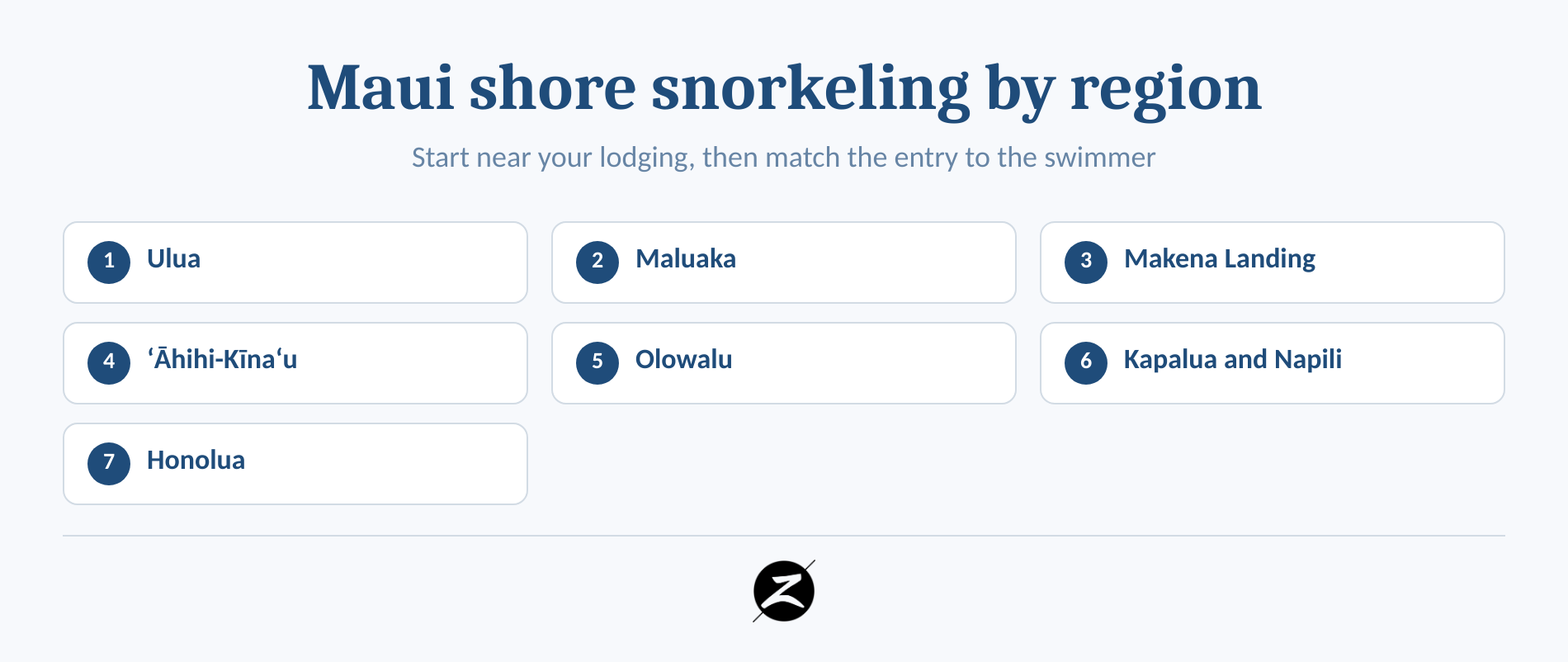
Ulua is the most practical all-around South Maui choice for confident swimmers new to snorkeling, while Maluaka and Makena Landing better suit turtle-focused plans. ʻĀhihi-Kīnaʻu offers a protected natural setting but requires more careful footing and strict attention to reserve rules.
Why start with Ulua Beach?
Ulua works well when a group wants a sandy beach, reef near a rocky end and useful shore facilities. As of September 2, 2026, the County of Maui facility page lists parking, public restrooms, showers and partial accessibility, but no lifeguard on duty. Check current parking signs when arriving because Maui parking programs and restrictions can change. (mauicounty.gov)
Ulua is not automatically calm. If waves are breaking across the entry or the surface has become choppy, the easy-looking sand does not outweigh the day's conditions.
When does Maluaka Beach make sense?
Maluaka is a good choice for comfortable swimmers whose group also wants a traditional beach day. The snorkeling objective is generally around reef and rock near the ends rather than across the open sandy center, so guests should not assume that swimming straight out will produce the best viewing.
Maluaka is often associated with the broader Turtle Town area, but Turtle Town is not a marked enclosure and turtles are not scheduled attractions. Choose Maluaka for the beach-and-reef combination, not for a promised sighting.
Is Makena Landing easier than Maluaka?
Makena Landing can offer a shorter-feeling route to protected coastal reef than a long swim from an open beach, but it is a compact shoreline access point rather than a spacious beach. Makena Landing suits swimmers who care more about entering near reef structure than spreading out on sand.
Compact does not mean effortless. Watch the entry for other ocean users, keep the route close enough for the group's ability and avoid following distant swimmers or boats as a substitute for planning.
Who should choose ʻĀhihi-Kīnaʻu?
ʻĀhihi-Kīnaʻu is best for reef-aware swimmers who can handle rock and lava footing, follow posted boundaries and accept that the reserve exists for conservation first. The reserve should not be treated as a casual roadside swimming stop.
As of September 2, 2026, the DLNR visitor page lists visiting hours of 5:30 a.m. to 7:30 p.m. and a day-use fee of $10 per car, payable by debit or credit card. Its anchialine pools are closed, and visitors should use the official activity map rather than entering whichever cove appears convenient. (dlnr.hawaii.gov)
The regulated-area rules prohibit removing, injuring or killing plants or animals and prohibit motorized vessels within the reserve waters. (dlnr.hawaii.gov)
Which famous South Maui beach should snorkelers skip?
Big Beach, officially Oneloa at Mākena State Park, is a striking beach but not a general snorkeling recommendation. The State Parks page explicitly warns that the shorebreak can be very dangerous, so choose it for scenery only when conditions and posted rules allow rather than assuming every famous beach is a snorkel beach. (dlnr.hawaii.gov)
South Maui offers the easiest concentration of shore options, but each site calls for a different confidence level.
Which West Maui beaches are best for snorkeling from shore?
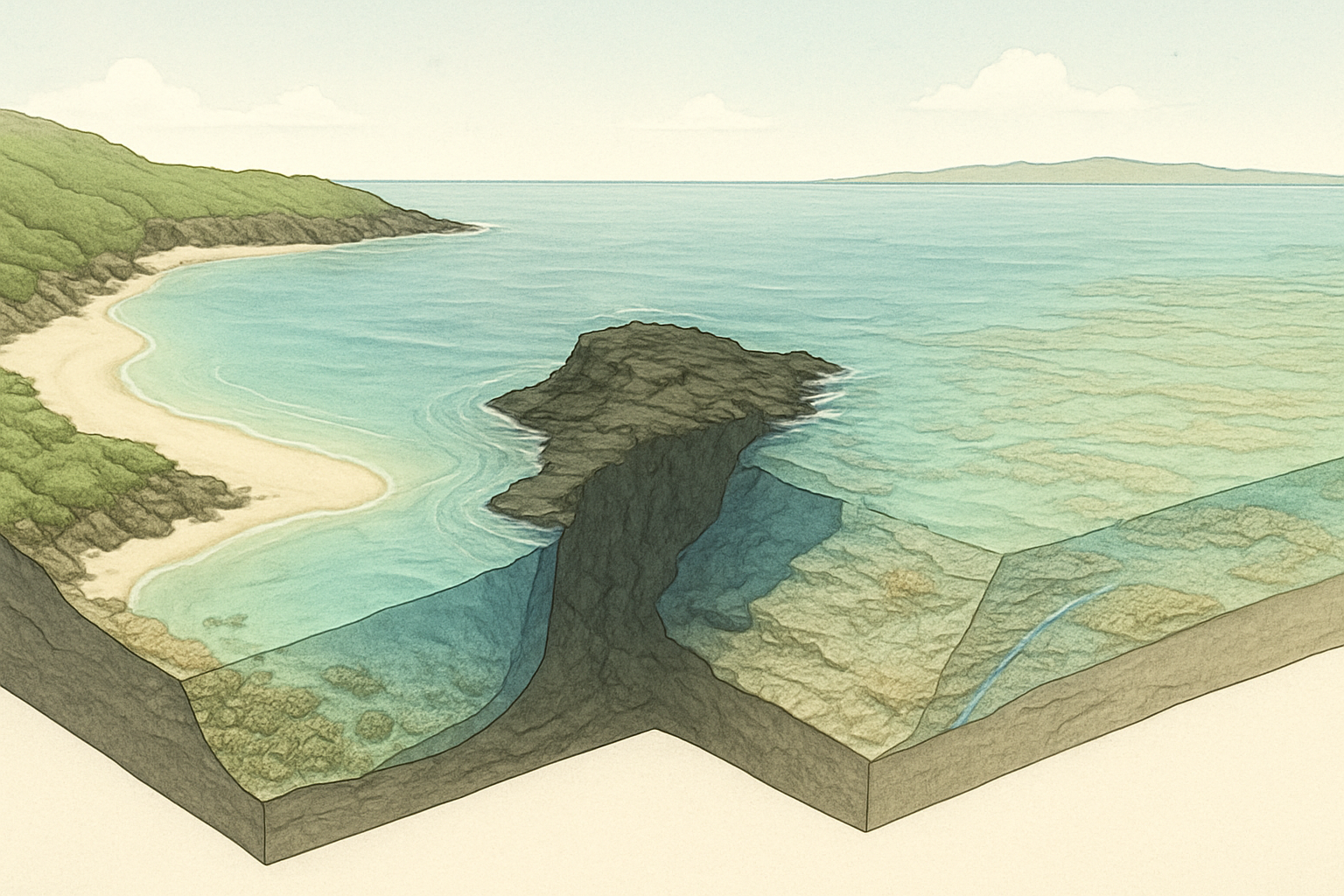
Kapalua Bay is the most approachable West Maui starting point for many confident swimmers, while Honolua and Olowalu offer broader reef experiences for people with stronger skills. Black Rock is famous, but its history and point-related hazards make it a poor default for beginners.
Before driving, use the Maui County shoreline access map to check public access, parking, restrooms and lifeguard information. The county notes that individual access conditions can change, so posted signs at the shoreline control. (mauishorelineaccess.net)
Is Kapalua Bay the easiest West Maui choice?
Kapalua Bay's crescent shape and sandy entry make it easier to understand than a rocky point or broad reef flat. Snorkelers can keep the route along one side of the bay and turn back before fatigue or distance becomes a problem.
A bay can still receive swell. If waves are pushing through the entry or visibility is poor, do not let the beach's reputation decide for you.
What is Napili Bay best for?
Napili is best for groups balancing snorkeling with swimming and time on the sand. Reef near the bay's edges can provide an objective without requiring the entire group to spend the day in the water.
Napili becomes less attractive when shorebreak or current is visible. Watch the water before gearing up and set a turnaround point while standing on shore.
Why do experienced snorkelers choose Honolua Bay?
Honolua appeals to experienced swimmers because the reef grows denser along the sides of the bay rather than directly across its silty center. The rocky shoreline, possible runoff and distance to the reef make it less suitable for someone still learning to breathe calmly through a snorkel.
Hawaiʻi's Division of Aquatic Resources says Honolua Stream can make the inshore water near the boat ramp murky. The official Honolua-Mokulēʻia Marine Life Conservation District description places dense coral growth along both sides in water about 10 to 40 feet deep, with especially abundant coral along the northeastern shoreline. (dar.hawaii.gov)
Those depths and distances are reasons to be conservative. Honolua is a calm-condition destination for capable swimmers, not a beach to enter because a fixed itinerary says it is next.
When is Kahekili a better choice than Black Rock?
Kahekili, often called Airport Beach, can be the more understandable West Maui choice for swimmers who prefer entering from open sand instead of navigating beside a prominent lava point. The reef is approached from the beach, allowing a simple out-and-back plan.
Kahekili can become windy and choppy, and the water may deepen quickly enough that resting by standing is not an option. It suits swimmers who are already comfortable floating and clearing a snorkel.
Is Olowalu good for beginners?
Olowalu can look calm and shallow, but that does not make the whole reef a beginner zone. Shallow coral creates a strong reason to float carefully, avoid standing and turn back before a swimmer is tempted to push across living reef.
The Nature Conservancy's Olowalu overview describes a 939-acre reef extending from Olowalu to Pāpalaua and identifies sediment, marine heatwaves and coastal change as ongoing pressures. The reef's ecological importance calls for especially conservative finning and route choices. (nature.org)
Should beginners snorkel at Black Rock?
Black Rock should not be a beginner's default. A sandy entry and many other swimmers can create a false sense that conditions around the point are simple.
A 2019 state injury-prevention letter reported 21 fatal drownings in the Puʻu Kekaʻa area from 2008 through 2017, with all but one victim being a visitor. The data cannot describe the exact risk on a particular day in 2026, but it establishes why the site deserves more caution than a popularity list usually provides. (oceansafety.hawaii.gov)
Do not swim around the point, follow cliff jumpers or assume a crowd means help will arrive quickly. If conditions are not plainly calm, choose a protected bay or stay out.
West Maui rewards flexible planning because a protected bay, exposed point and broad reef can behave very differently on the same day.
When should you skip snorkeling, even at a good beach?
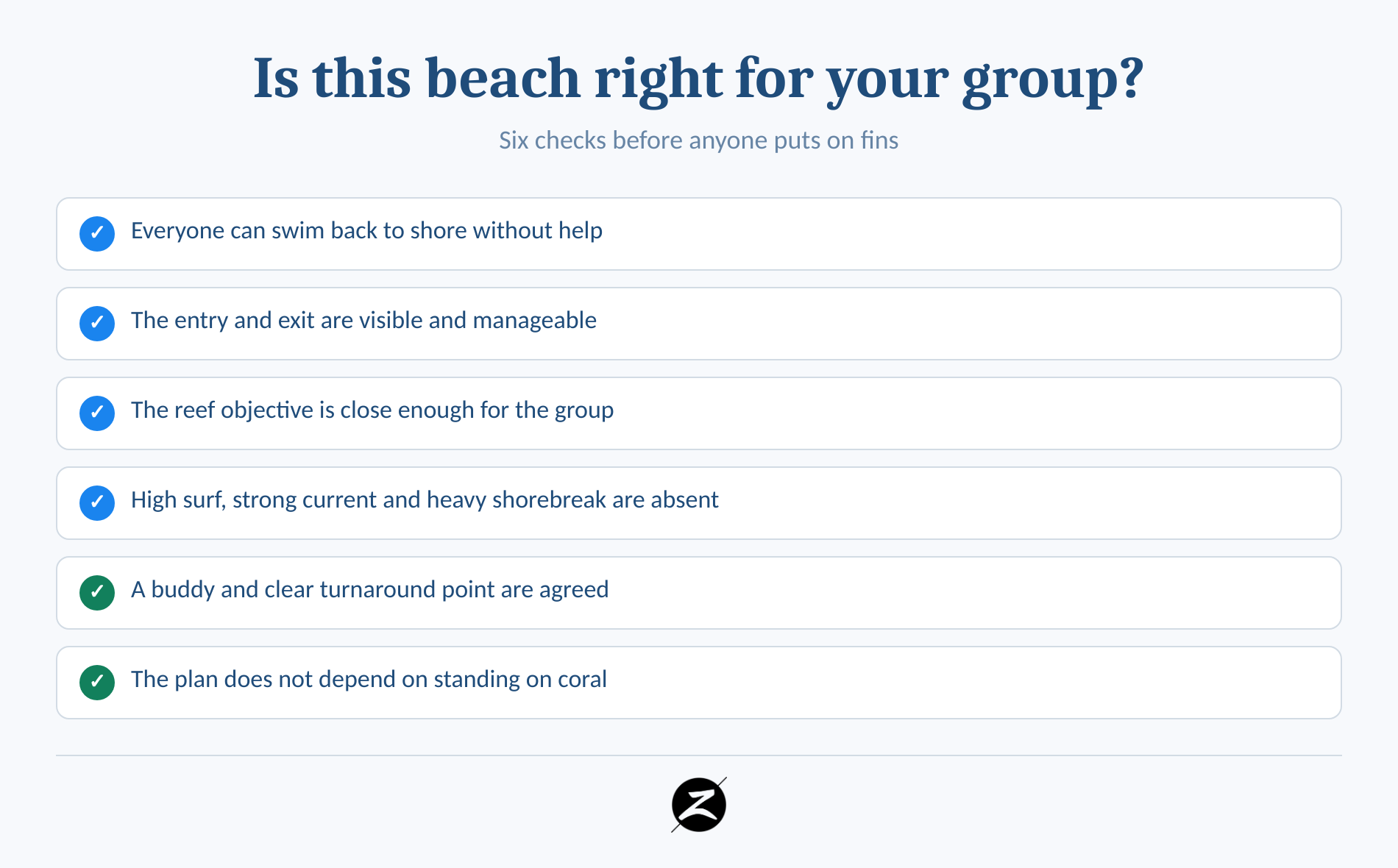
Skip snorkeling when high surf, strong current, heavy shorebreak, wind, murky runoff, fatigue, illness, equipment problems or anxiety make the plan harder than expected. A famous beach never outranks the water in front of you or the least-confident person's ability.
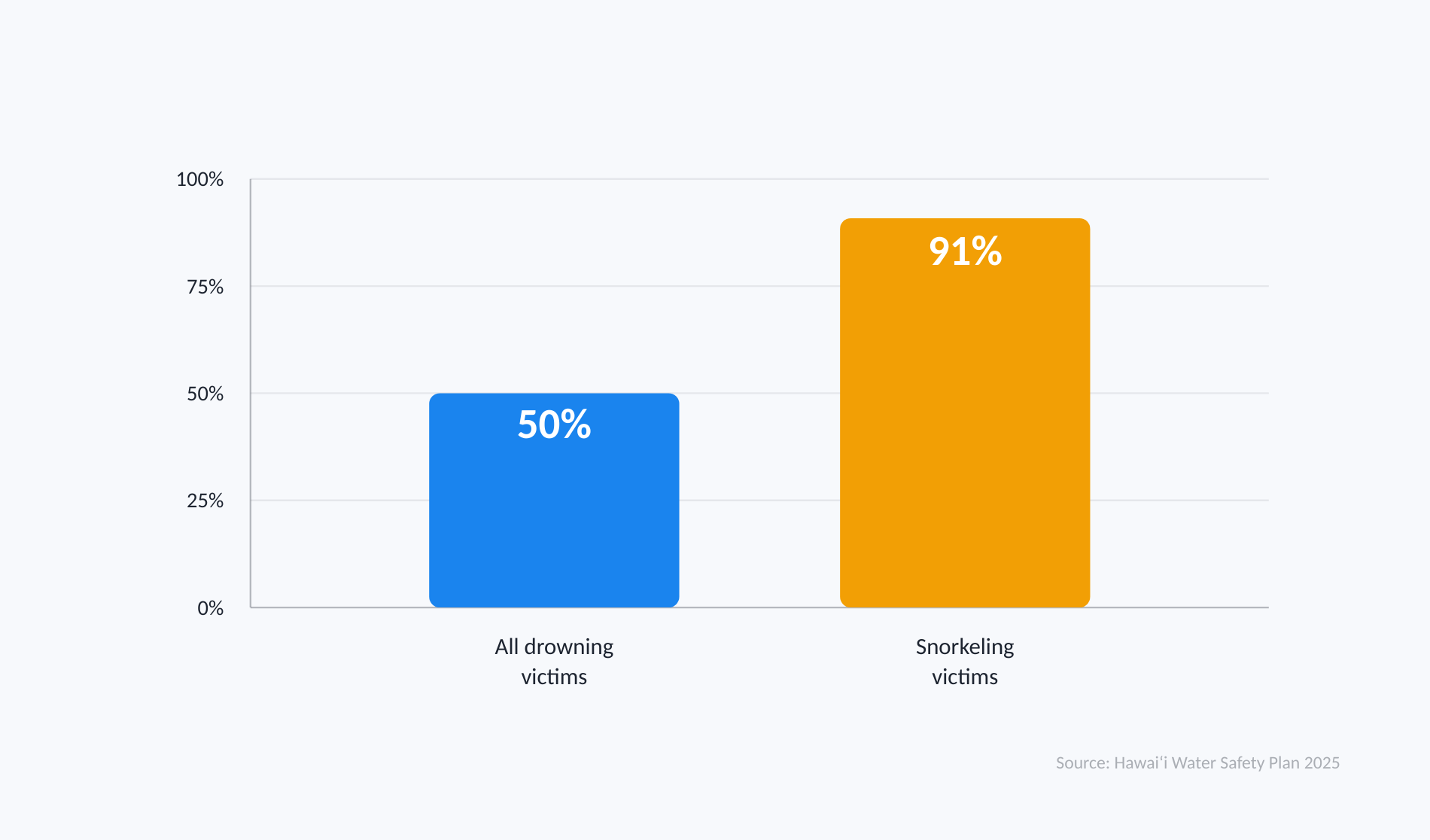
The Hawaiʻi Water Safety Plan 2025 reports that visitors represented 50% of drowning victims and 91% of snorkeling victims in the plan's data. Those figures do not mean every visitor snorkel is dangerous, but they show why vacation familiarity should not be confused with ocean familiarity. (health.hawaii.gov)
Use this go-or-no-go check before entering:
- Look for several minutes. Watch complete sets of waves rather than judging the water during a calm lull.
- Check official notices. Read warning signs and current water-quality advisories.
- Ask whether everyone can return without help. A flotation belt can reduce effort but cannot supply navigation, judgment or swimming skill.
- Test the equipment before committing. A leaking mask or uncomfortable breathing should be fixed on shore.
- Keep the first route short. Turn back while everyone still feels good rather than waiting for fatigue.
- Leave immediately if symptoms appear. Dizziness, disorientation, headache, panic or breathing discomfort are reasons to remove the equipment and exit safely.
After heavy rain, do not rely only on the sky above the beach. The Hawaiʻi Department of Health explains that runoff from inland rain can reach a sunny shoreline through streams and drains. Its Clean Water Branch guidance says to avoid brown, cloudy or turbid water and recommends checking current advisories before recreation. (health.hawaii.gov)
If the water, weather, body or access feels wrong, the correct snorkeling decision is not to enter.
How do you snorkel around turtles and coral without causing harm?
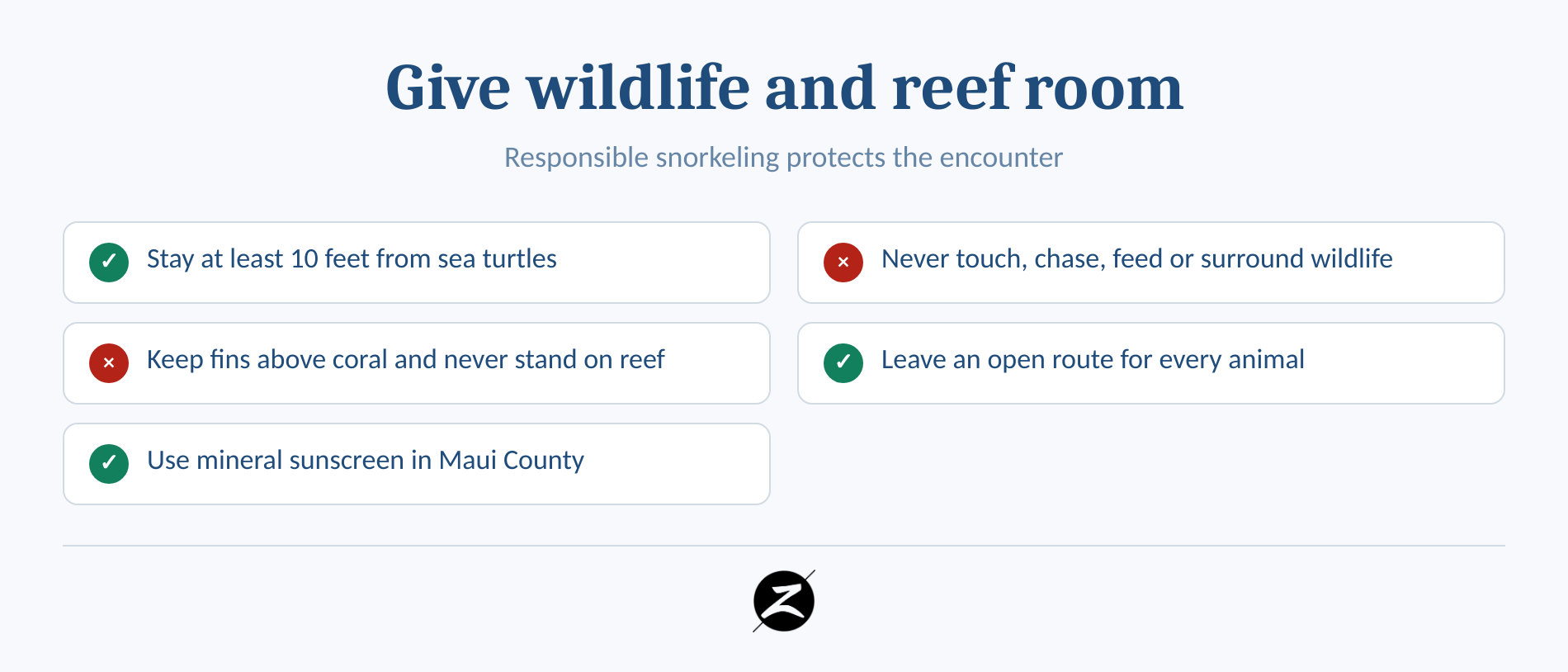
Stay far enough away that wildlife does not change direction, speed or behavior because of you, and remain fully afloat above coral. A close photograph is never worth chasing an animal, blocking its route or touching the reef.
NOAA's Hawaiʻi-specific guidance recommends remaining at least 10 feet from sea turtles on land and in the water. Ten feet is a minimum viewing guideline, not permission to follow a turtle at that distance. Never touch, chase or feed turtles, and move away if an animal appears disturbed. (fisheries.noaa.gov)
Coral is living habitat. Keep fins high, avoid kicking in narrow spaces and never stand on the reef to adjust equipment or rest. If the route is too shallow to cross without contact, choose another route.
Maui County has prohibited the sale, distribution and use of non-mineral sunscreen without a prescription since October 1, 2022. The County's environmental guidance identifies mineral sunscreen as the permitted option, while protective clothing and shade can reduce how much sunscreen enters the water. (mauicounty.gov)
The best wildlife encounter is one that does not change the animal's behavior or damage the reef.
When is a guided shore snorkel a better choice?
A guided shore snorkel is the better choice when a guest needs help with equipment, flotation, breathing technique, ocean confidence, reef etiquette or route selection. Guidance is also useful for mixed-ability groups that would otherwise separate in the water.
Choose support rather than independent snorkeling when:
- Someone cannot confidently swim back to shore without assistance.
- A participant has never used a mask, snorkel and fins together.
- The group includes both confident swimmers and anxious first-timers.
- Nobody in the group understands local entries, currents or changing conditions.
- The group wants instruction and photography without dividing attention between safety and a camera.
If you can swim and want support with gear fitting, a safety briefing, shore-entry practice and route choice, book our Turtle Town Signature Snorkel. The small-group experience includes more than an hour of guided reef snorkeling plus complimentary photos and video, according to Zephyr Adventures Maui's documented tour details.
A guide is most valuable when skills, confidence and route choice matter more than checking a beach off a list.
What else do visitors ask about Maui snorkeling beaches?
These common questions have no condition-proof answer, but each can be narrowed to a useful decision.
Which beach in Maui is best for snorkeling?
For many confident swimmers who are new to snorkeling, Ulua Beach is the best all-around starting point because it combines a sandy entry, reef near the rocky end, parking, restrooms and showers. Maui County lists no lifeguard there, so calm conditions, a buddy and the ability to swim in the ocean still matter.
Where is the best snorkeling spot off the beach in Maui?
The best off-the-beach spot depends on location and ability. Choose Ulua or Kapalua for a more approachable bay, Maluaka or Makena Landing for a South Maui turtle-focused plan, Honolua for experienced swimmers in calm water, and ʻĀhihi-Kīnaʻu for a regulated reserve experience with rocky access.
What beach in Maui has the most turtles?
No reliable official count identifies one Maui beach as having the most turtles. Maluaka, Makena-area reefs, Napili, Kapalua and Black Rock can all produce sightings, but wildlife moves. Treat every sighting as a bonus, stay at least 10 feet away, and never chase or surround a turtle.
Which Maui resort is best for snorkeling?
No Maui resort can guarantee the best snorkeling because surf, wind, runoff and visibility change. A resort near Ulua-Mōkapu, Kapalua Bay or Kā'anapali can make shore access convenient, but choose lodging for the whole trip and treat snorkeling quality as a same-day decision rather than a fixed amenity.
What is the simplest way to plan your snorkel day?
Choose one primary beach and one nearby backup, then decide only after looking at the water and checking official advisories that morning. If the least-confident person is uneasy, change the plan before the fins go on.