
In short
The best family activities in Maui are the ones matched to the least-confident person in the group. Choose by swimming ability, walking tolerance, weather exposure, drive time and available guide support. A balanced plan usually pairs one major activity with a flexible beach, aquarium, farm or coastal-walk backup rather than forcing everyone through the same itinerary.
Key takeaways
- 🌊 Hawaiʻi Ocean Safety's June 2026 guidance says snorkelers should be experienced ocean swimmers; flotation, instruction and a guide do not remove ocean risk. (oceansafety.hawaii.gov)
- Choose ocean activities for the least-confident participant, then confirm how that person can practice, pause or leave early.
- 📅 Nonresidents need advance reservations for ʻĪao Valley and Waiʻānapanapa, while Haleakalā sunrise access from 3:00 to 7:00 a.m. requires a separate vehicle reservation. (dlnr.hawaii.gov)
- A practical family schedule uses one major activity per day, with shorter optional plans that can disappear without ruining the itinerary.
- 🐋 Hawaiʻi's humpback whale season generally runs from November through May, with the usual peak from January through March. (hawaiihumpbackwhale.noaa.gov)
Table of contents
- Which Maui activities fit your family at a glance?
- Which activities work for toddlers, non-swimmers or anyone who needs an easy exit?
- What can families do on Maui without getting in the ocean?
- Which activities suit confident swimmers and active teens?
- Which scenic Maui days work for mixed ages?
- How should a multigenerational family build the itinerary?
- What should you check before leaving the hotel?
- What else do families ask about Maui?
- What should you book first?
Most lists of family-friendly activities in Maui begin with famous attraction names. That is backwards. Start with the person who has the narrowest comfort range, then find the activities that still work for everyone else.
Age is only one filter. A confident eight-year-old swimmer, an anxious teenager, a non-swimming parent and a grandparent who avoids uneven paths may each need a different version of the same Maui day.
Which Maui activities fit your family at a glance?
Start by removing activities that do not fit the least-confident person's water skills, mobility or tolerance for long drives. The remaining choices can be ranked by weather exposure, guide support and how easily the family can stop early.
| Activity | Best fit | Water confidence | Effort | Weather sensitivity | Support |
|---|---|---|---|---|---|
| 1. Supported beginner snorkel | First-timers who meet current rules | Beginner format | Low to medium | High | High |
| 2. Guided reef snorkel | School-age children, teens and adults | Confident ocean swimmer | Medium | High | High |
| 3. Lifeguarded beach morning | Toddlers to grandparents | Water optional | Low | High | Lifeguard, not personal supervision |
| 4. Coastal walk and sunset | Most ages with a suitable route | None | Low | Medium | Self-guided |
| 5. Māʻalaea aquarium visit | Toddlers, non-swimmers and rainy-day plans | None | Low | Low | On-site staff |
| 6. Upcountry farm visit | Toddlers and school-age children | None | Low to medium | Medium | Guided or self-guided |
| 7. Cultural evening | School-age children and mixed-age groups | None | Low | Low to medium | Hosted |
| 8. ʻĪao Valley visit | Most ages able to manage the chosen route | None | Low to medium | High | Self-guided |
| 9. Hosmer Grove nature loop | School-age children and active adults | None | Low to medium | High | Self-guided |
| 10. Haleakalā summit sunset | Older children, teens and adults | None | Low walking, long drive | Very high | Self-guided |
| 11. Short Road to Hāna day | Children who tolerate winding roads | None | High driving load | Very high | Self-guided or guided |
| 12. Waiʻānapanapa visit | School-age children and active adults | Swimming optional | Medium | High | Timed reservation |
| 13. Guided kayak and snorkel | Participants meeting current skill rules | Confident swimmer | Medium to high | Very high | High |
| 14. Guided sea-scooter snorkel | Confident swimmers seeking more activity | Confident swimmer | Medium | High | High |
| 15. Shore-based whale watching | All ages during the season | None | Low | Medium | Self-guided |
The table describes activity fit, not guaranteed conditions. Tour rules, trail access, weather and individual readiness can change, so verify each activity before paying or driving.
For a toddler, the best fit may be an aquarium, farm and short coastal walk. For a family with older confident swimmers, a guided reef snorkel or kayak outing may become the main event. A multigenerational group may choose one shared land day and one split morning rather than searching for a single activity that asks everyone to do the same thing.
Choose by the person with the narrowest comfort range, then use weather and guide support to break ties.
Which activities work for toddlers, non-swimmers or anyone who needs an easy exit?
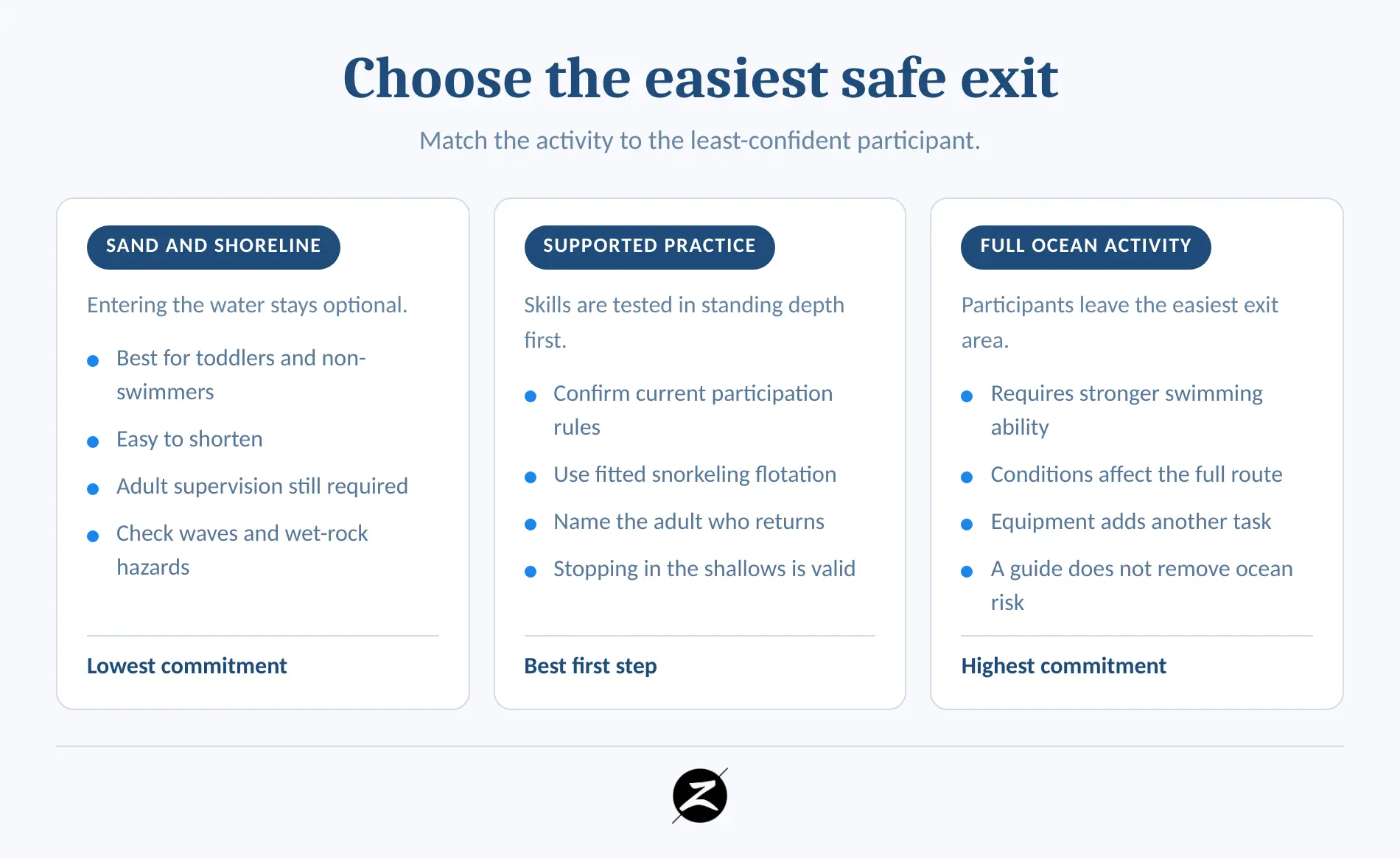
Prioritize activities that can be shortened without trapping the family in a fixed route or pressuring someone to continue. A visible stopping point, nearby shore and clear supervision plan matter more than an attraction's popularity.
1. Supported beginner snorkeling
A beginner format should begin with equipment fitting, dry instruction and standing-depth practice before anyone moves toward a reef. Parents need to ask what happens if a participant remains uncomfortable after the practice period.
Hawaiʻi Ocean Safety's June 2026 snorkeling guidance says snorkelers should be experienced ocean swimmers. At Zephyr Maui, our beginner format provides flotation, standing-depth confidence building and guided instruction in breathing, mask seal and body position, but those measures do not remove ocean risk or override the state's advice. (oceansafety.hawaii.gov)
A non-swimmer label should trigger more questions, not fewer. Ask how deep the participant may go, whether remaining in the shallows is allowed, who returns if a child stops and whether the rest of the family can continue with appropriate supervision.
The more detailed guide to family snorkeling in Maui explains why minimum age, swimming ability, group size, flotation and the exit procedure should all be checked separately.
2. A lifeguarded beach morning
A beach morning lets one child play in sand while another swims, but the ocean remains an active hazard even at the shoreline. Hawaiʻi Ocean Safety advises families to choose a lifeguarded beach, keep a responsible adult focused on children near the water and avoid treating the lifeguard as a babysitter. (oceansafety.hawaii.gov)
Choose the beach on the morning of the visit, not months earlier. Check whether it is open, read posted warnings and ask the lifeguard about current hazards before anyone enters.
Freshness note for September 2026: as of September 19, Maui County's most recent storm notice still listed Kamaʻole Beach Parks I, II and III plus Keawakapu Beach Parks I and II as closed after coastal flooding. Do not assume a beach is open because an older guide says it is; check Maui County's storm-closure page and current conditions before leaving. (mauicounty.gov)
3. A coastal walk and sunset
A coastal walk works for families who want ocean scenery without committing to swimming. Choose a short segment with an obvious turnaround point rather than assuming every member can complete the full path.
For a baby or one-year-old, plan around shade, heat and the surface your stroller can actually handle. For an older relative, identify benches, restrooms and the distance back to the vehicle before starting. Sunset can be the optional part of the day, not another reservation everyone must endure.
An easy-exit activity is one the family can shorten without pressure, unsafe improvisation or losing the whole day.
What can families do on Maui without getting in the ocean?

Maui offers enough land-based activities to fill several days when a child is recovering, a parent does not swim or ocean conditions are poor. The strongest options still connect the family with Maui's marine life, agriculture, culture or volcanic landscape.
4. A Māʻalaea aquarium visit
An aquarium is useful when the family wants to see reef animals without depending on visibility, waves or anyone's swimming ability. It also gives children context for fish, coral, turtles and sharks before a later beach or snorkel day.
The Māʻalaea aquarium's current visitor page describes an average visit of about two hours, stroller-friendly pathways and a mix of indoor and outdoor exhibits. That makes the visit easier to place around naps or uncertain weather than a full-day excursion. (mauioceancenter.com)
If the family is asking whether an aquarium is worth the price, consider what problem it solves. Its value is higher when the group includes a toddler, a non-swimmer, someone avoiding the sun or a child who learns best by seeing marine life before entering the ocean.
5. An Upcountry farm visit
A farm visit changes the pace after several beach days. Depending on the chosen farm and current tour, children may see crops, flowers or animals while adults learn how elevation and volcanic soils shape agriculture on Maui.
Hawaiʻi's official Maui farm-tour guide identifies Kula and Upcountry as the center of options including produce, lavender and dairy experiences. Verify the operator's current schedule, minimum age, walking surface and animal-contact rules rather than arriving without a reservation. (gohawaii.com)
6. A cultural evening
A cultural program or lūʻau can work for mixed swimming abilities and limited mobility because participation is primarily seated. The tradeoff is timing: a long evening may be difficult for toddlers, jet-lagged children or relatives who need an early meal.
Ask what the program teaches, who presents the cultural material, how long the event lasts and whether the seating and meal arrangements fit the group. Choose the experience for its interpretation and family fit, not merely the size of the production.
7. ʻĪao Valley State Monument
ʻĪao Valley offers a green, mountainous contrast to Maui's beaches and drier southern coast. It can fit a half day, but rain, wet surfaces and the chosen walking route still matter for small children and anyone with limited mobility.
The Hawaiʻi Division of State Parks says advance entry and parking reservations are required for out-of-state visitors. Check the official ʻĪao Valley page for current hours, fees and closures before building the rest of the day around the reservation. (dlnr.hawaii.gov)
Maui still offers a full family day when swimming is off the table.
Which activities suit confident swimmers and active teens?
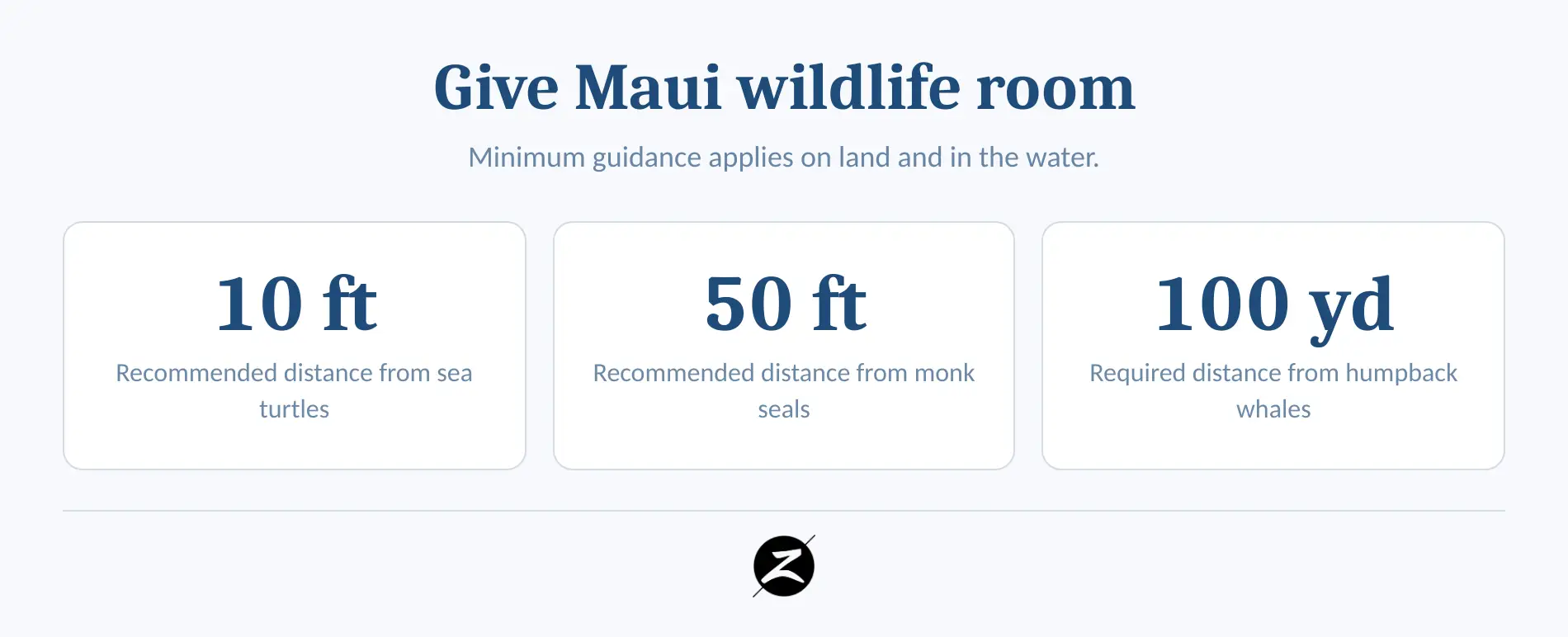
Confident participants can consider longer reef swims, kayaking or powered sea-scooter snorkeling, but equipment does not replace judgment or honest swimming ability. NOAA recommends at least 10 feet from sea turtles and 50 feet from monk seals, while federal law prohibits approaching within 100 yards of humpback whales in Hawaiʻi. (fisheries.noaa.gov)
8. A guided reef snorkel for swimmers
A standard guided reef snorkel suits someone who can already swim in the ocean, remain calm with a mask and snorkel, follow signals and return under their own effort. A good pool swimmer without ocean experience may still need a beginner session first.
Anyone new to the equipment should review these first-time ocean experiences before selecting a longer or more demanding format. Ask about entry conditions, group size, flotation, exposure protection and what happens if the water changes after check-in.
Wildlife is never guaranteed. Prepare children to watch without touching, chasing, feeding or blocking an animal, following NOAA's Hawaiʻi wildlife guidance. (fisheries.noaa.gov)
9. A guided kayak and snorkel
Kayaking adds paddling, balance, launch conditions and time away from shore to the snorkeling decision. It can suit active school-age children, teens and adults who meet the operator's current age and ability rules, but it is not simply a beach snorkel with a different seat.
Confirm how long the group paddles, whether every participant must snorkel, how partners are assigned and what happens if the wind rises. Zephyr Maui's coastal kayak format combines a guided paddle with a reef snorkel and lists a small-group structure, but current participation rules should be checked for the specific departure. (zephyrmaui.com)
10. A guided sea-scooter snorkel
A sea scooter helps propel a snorkeler through the water, but it should not be treated as a substitute for swimming ability. The participant still needs to manage a mask and snorkel, control direction, follow the guide and respond calmly if the device stops or must be released.
This format is better for confident older children, teens and adults who want to cover more reef than they would during a conventional swim. Parents should ask about training time, speed controls, flotation, supervision and the current minimum age before booking.
Advanced equipment adds options for capable participants, but it never replaces swimming ability, instruction or current-condition judgment.
Which scenic Maui days work for mixed ages?
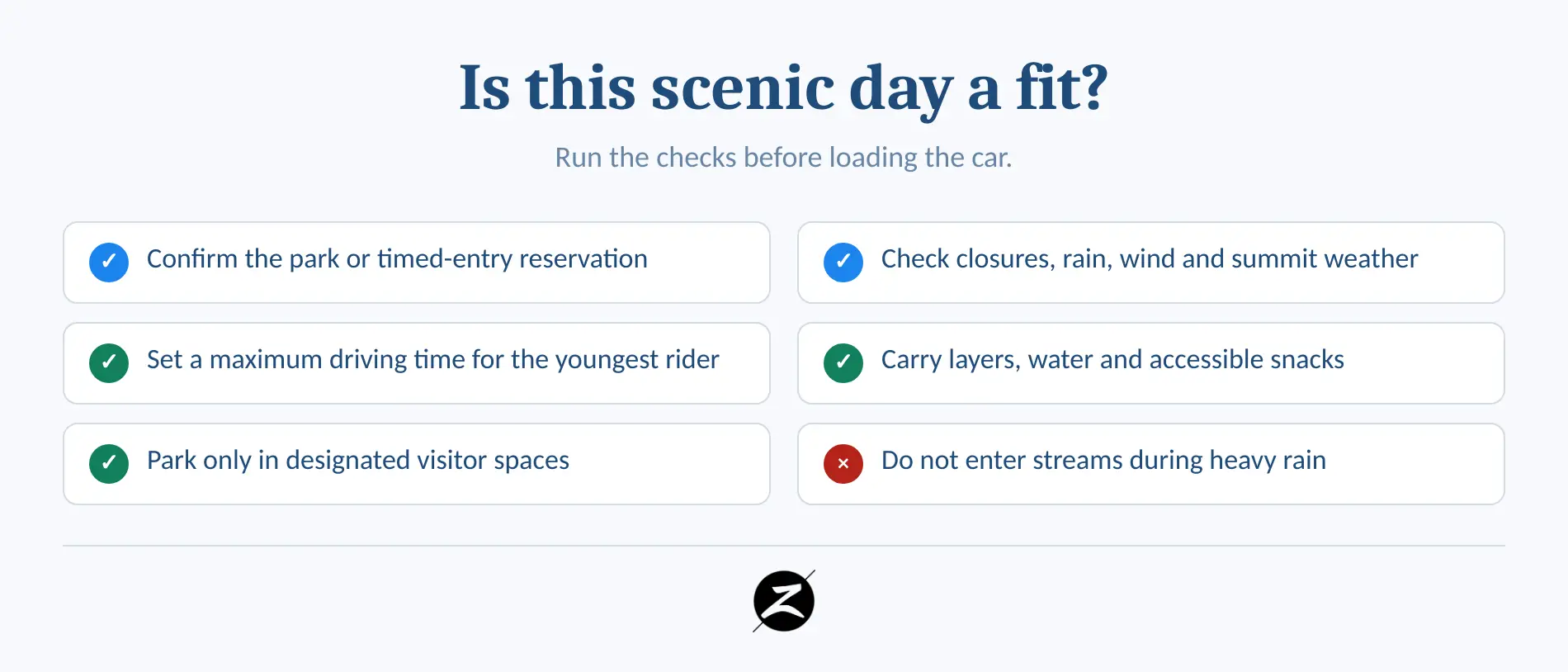
Scenic drives and short walks can include more of the family than an ocean activity, but they create different limits involving altitude, motion sickness, rain and reservation times. Plan the drive and stopping options as carefully as the attraction itself.
11. The Hosmer Grove nature loop
Hosmer Grove provides a shorter Haleakalā National Park walk without requiring a descent into the crater. The National Park Service trail listing describes the loop as 0.54 mile with about 50 feet of elevation change. (nps.gov)
Short does not mean suitable for every person. The elevation, cool or wet weather and trail surface can still affect toddlers, older relatives and anyone with health or mobility concerns. Stay on the marked trail and keep the walk optional.
12. Haleakalā summit at sunset
Haleakalā's summit reaches 10,023 feet, creating colder, windier conditions than families experience at the coast. The long drive, elevation and return after dark may matter more to young children than the amount of walking.
The National Park Service sunrise page says sunrise entry from 3:00 to 7:00 a.m. requires an advance reservation and warns that conditions around dawn and dusk may be wet, windy and below freezing. The park's sunrise FAQ says a sunrise reservation is not required for sunset. (nps.gov)
Sunset removes the reservation and pre-dawn wake-up, but not the weather or driving demands. Pack layers, check current park alerts and be willing to replace the summit with a lower-elevation plan.
13. A shorter Road to Hāna itinerary
The Road to Hāna does not need to be an endurance test. Families can choose a small number of legal, welcoming stops and turn around before children, drivers or older relatives become exhausted.
Hawaiʻi's official Hāna visitor guidance describes a 52-mile road from Kahului that can take two to four hours because of narrow bridges and hairpin turns. Its code of conduct tells visitors to use designated parking, avoid private property and stay out of streams during heavy rain or flash-flood conditions. (gohawaii.com)
A guided road tour may reduce the driver's workload, but every family should still assess motion sickness, car-seat time and whether the children enjoy driving days. A half route that everyone enjoys is better than reaching a distant stop with an exhausted group.
14. A reserved Waiʻānapanapa visit
Waiʻānapanapa can be a planned scenic stop rather than a swimming day. Uneven terrain, stairs, waves and a fixed reservation window make it a better fit for families who can arrive on time and adapt their beach expectations.
The official Waiʻānapanapa reservation system allows reservations up to 30 days ahead and warns that visitors arriving more than 30 minutes into their period may be denied access or parking. Nonresident visitors without a reservation are turned away. (gostateparks.hawaii.gov)
15. Shore-based whale watching in season
Shore-based whale watching is a low-effort option for babies, non-swimmers and multigenerational groups. Bring binoculars, choose a safe lookout away from wet rocks and treat every sighting as a possibility rather than a promised performance.
NOAA's Hawaiʻi whale-season guidance says the season generally runs from November through May, with the usual peak from January through March. Whale watching from shore also avoids asking the family to commit to a boat ride or enter the water. (hawaiihumpbackwhale.noaa.gov)
A scenic Maui day succeeds when the drive, weather, reservation and walking load all fit the same family.
How should a multigenerational family build the itinerary?
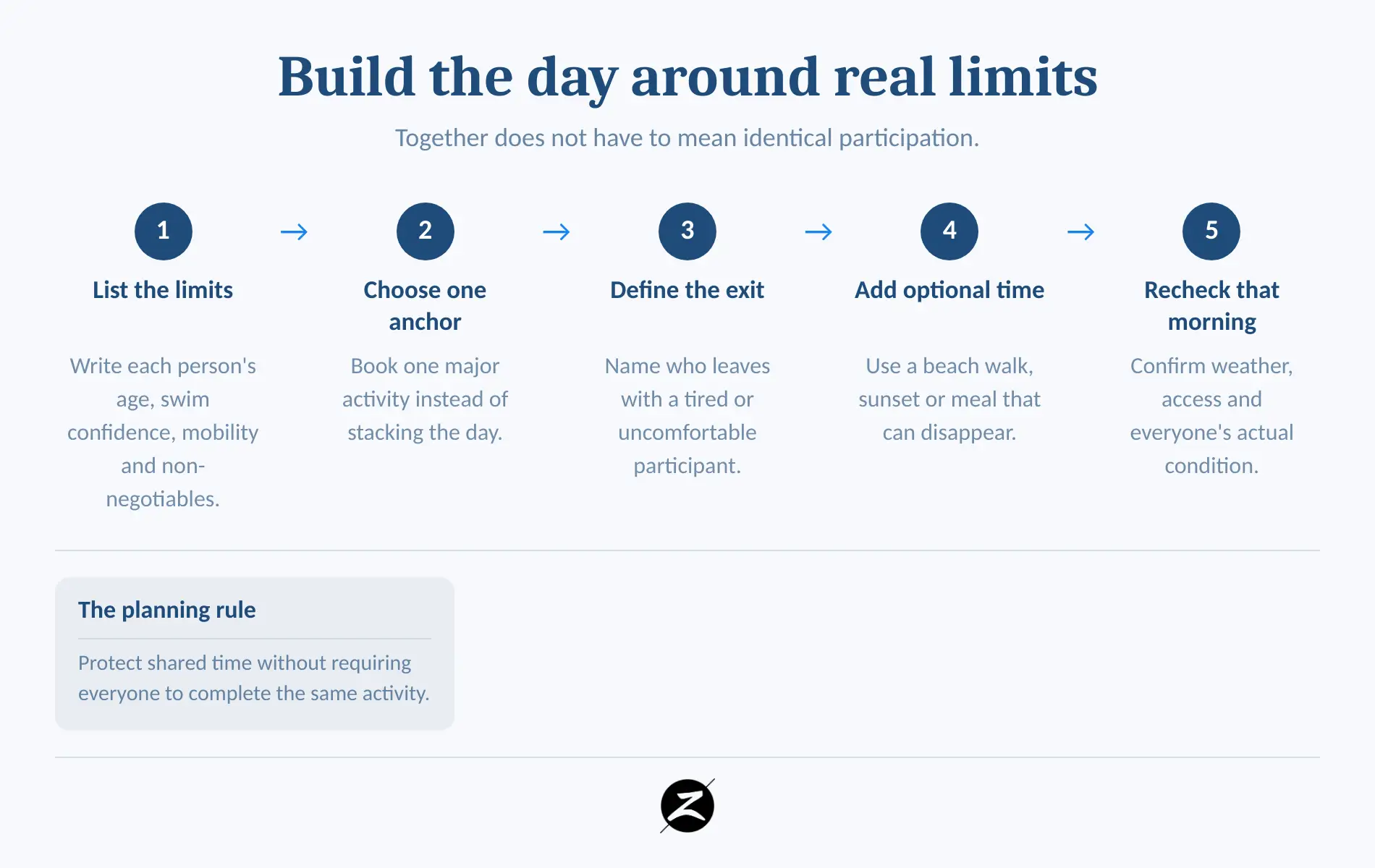
Plan shared time first, then allow different participation levels inside the same day. The goal is not to make grandparents, toddlers and teens complete identical activities, but to give everyone a clear role and a comfortable stopping option.
Worked example: two children, two parents and two grandparents
Consider a hypothetical family with an eight-year-old first-time snorkeler, a confident fifteen-year-old swimmer, two parents, a non-swimming grandparent and a grandparent who prefers short walks. This is not a customer case study. It is an example of how to use the filters.
- Day one: The main booking is a supported beginner snorkel. The eight-year-old starts in standing depth, the teenager follows the guide's swimmer plan and the non-swimming grandparent remains on shore. Everyone knows before check-in who returns if the younger child stops.
- Day two: The family reserves ʻĪao Valley as the major activity. An aquarium remains the weather backup, not a second mandatory attraction.
- Day three: The group visits an Upcountry farm. A short nature walk is optional if energy and weather align, while the evening stays unscheduled.
- Day four: The group splits for one morning. The teenager and one parent choose a higher-effort guided water activity, while the grandparents, younger child and second parent take a coastal walk and meet the others for lunch.
This structure protects shared meals and afternoons without requiring every person to accept the same physical or water challenge. It also follows the practical rule of one major activity per day, language that appears repeatedly in real family itinerary discussions because naps, jet lag and weather consume more time than a map suggests.
Multigenerational trips work better when together time is protected without requiring identical participation.
What should you check before leaving the hotel?
Recheck access, weather and the family's condition on the morning of every outdoor activity. A reservation proves that a place was available when booked, not that the road, ocean or participants are ready today.
- Park and beach status: Review the managing agency's closure page, not an old blog post or saved map pin.
- Ocean conditions: Read posted warnings, use current beach information and speak with a lifeguard where one is present.
- The honest ability check: Tell guides which participants are non-swimmers, pool swimmers, first-time ocean swimmers or experienced snorkelers. Those are different categories.
- The exit plan: Decide which adult returns with a child and whether the remaining supervision arrangement still works.
- Food and clothing: Carry water, sun protection, dry clothing and layers for elevation. Keep snacks accessible rather than buried under beach gear.
- Phone setup: Download essential directions before driving into areas with uncertain reception. If the family plans to use a travel eSIM for maps or messages, verify the iPhone's carrier-lock status before leaving home; that check does not guarantee coverage on Maui. (esim-trading.com)
- Permission to cancel: A child who is tired, frightened or unable to tolerate equipment is giving useful information, not ruining the vacation.
The morning check matters more than the months-old plan.
What else do families ask about Maui?
The following answers address the questions families most often ask before choosing activities. Each answer is a planning rule rather than a guarantee about weather, wildlife or one universally best location.
Is Maui a good place to take kids?
Yes, Maui can work well for children when the itinerary matches their ages, water confidence and tolerance for driving. The island offers beaches, short walks, an aquarium, farms, cultural programs and guided activities. The main mistake is treating every famous stop as suitable for every child or packing too many into one day.
What free activities are there for kids in Maui?
Free family activities include beach play when conditions are appropriate, coastal walks, sunset viewing, picnics, short public-park visits and seasonal whale watching from shore. Parking or reservations may still cost money at some locations, and closures can change access, so check the managing agency's current page before driving.
What is one thing not to miss on Maui?
Do not miss Maui's contrast between coast and upland landscapes. For many families, the strongest single day combines one manageable ocean or shoreline activity in the morning with an Upcountry, ʻĪao Valley or Haleakalā stop later. That variety feels more distinctly Maui than trying to complete the longest possible activity list.
What is the best family friendly resort in Maui?
There is no single best family-friendly resort for every group. Choose the area first: Wailea and Kīhei suit South Maui activities, Kā'anapali and Kapalua suit West Maui plans, and a condo can help families needing kitchens or separate bedrooms. Compare pool supervision, beach access, laundry, parking and sleeping layout before brand name.
The best answer changes with the family's ages, abilities, base area and the conditions that day.
What should you book first?
Book the activity with the tightest participation rules or reservation window first, not the activity with the loudest marketing. For families with mixed water confidence, that usually means clarifying the ocean plan before filling the itinerary with easy land-based backups.
If the group includes a first-timer or non-swimmer who meets current participation requirements, review supported snorkeling for beginners and non-swimmers and send us each participant's age, swimming ability and ocean experience before reserving. We can explain the current format and support without promising weather, wildlife or a particular outcome.
Choose the booking that protects the least-confident person, then let the rest of the itinerary stay flexible.