
In short
Maui eco tours are worth booking when an operator can explain how it limits reef contact, protects wildlife space, adjusts to ocean conditions, and teaches guests before they enter the water. Compare group size, guide support, activity type, and written practices, not an “eco” label alone.
Key takeaways
- 🪸 A meaningful eco-tour claim names practical actions, such as a reef briefing, sand-entry plan, wildlife-distance policy, and a response when conditions change.
- 🐢 NOAA recommends at least 10 feet from sea turtles in Hawaiʻi, while humpback whales and spinner dolphins have enforceable approach-distance rules.
- 🌊 The right tour format depends on your comfort in the water and the support your group needs, not on a promise of a particular wildlife sighting.
- A Maui County sunscreen rule focuses on mineral active ingredients, so front-label “reef safe” marketing is not enough on its own.
Table of contents
- How can I tell if “eco” is more than a label?
- What wildlife distance should a Maui eco tour follow?
- Which Maui eco tour format fits my group?
- What should I ask before I pay for a tour?
- What else do travelers ask before booking Maui eco tours?
- What is the next step if a tour passes this check?
How can I tell if “eco” is more than a label?
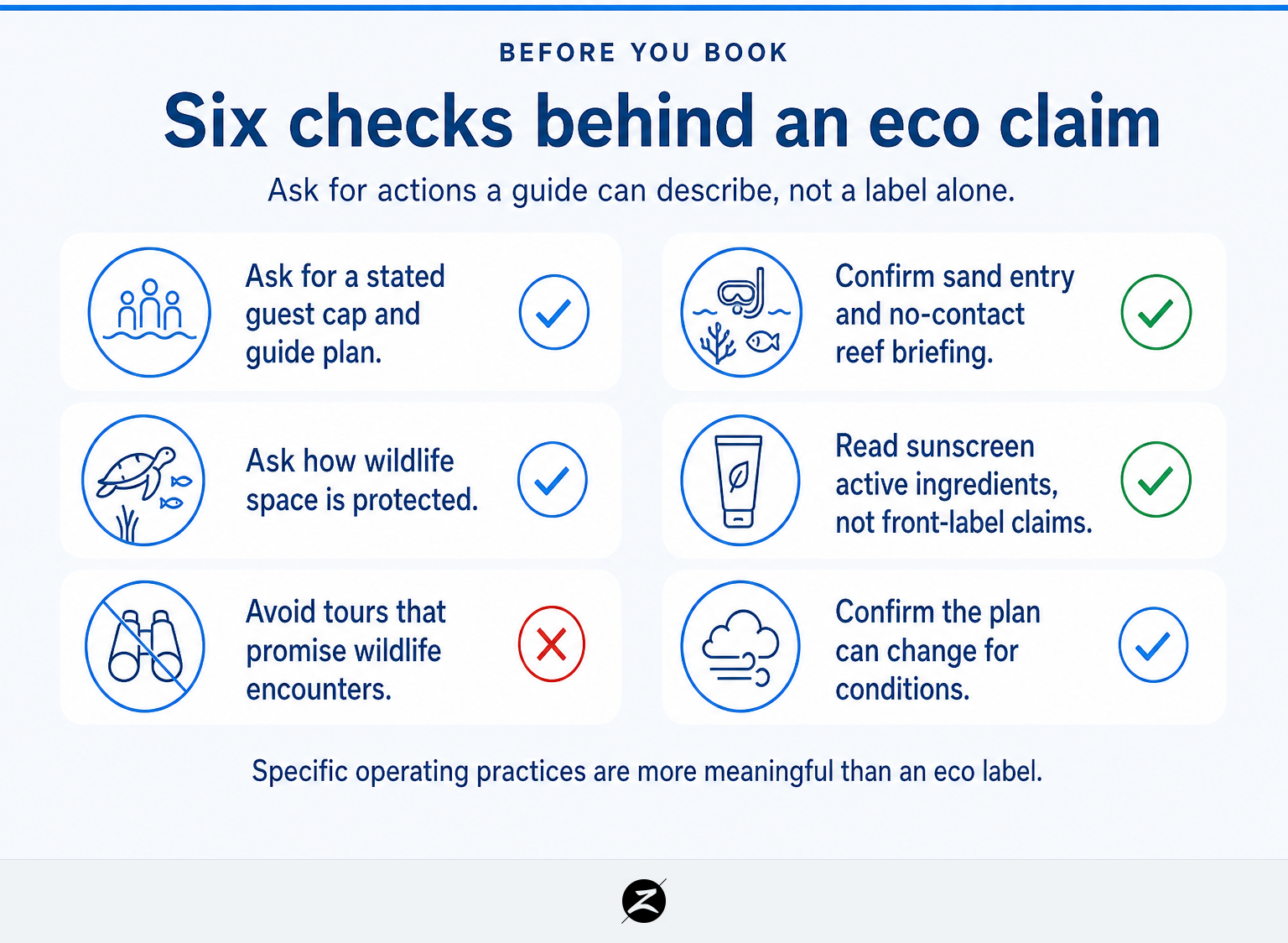
A useful eco-tour claim is specific enough to check before you book. The operator should be able to describe how guides prevent reef contact, respond to wildlife encounters, and change plans when the ocean is not suitable.
Start with five questions.
- What is the maximum group size, and how many guides are in the water? A small group is not a conservation policy by itself, but a stated cap gives you something concrete to compare.
- What is the reef-contact plan? Look for a briefing that covers entering over sand, floating horizontally, keeping fins clear of coral, and moving back to sand before standing or adjusting gear.
- What happens when a turtle, seal, dolphin, or whale appears? A credible answer is about giving the animal space and never chasing, touching, feeding, or blocking its route.
- What sunscreen guidance do guests receive? Maui County Code Chapter 20.42 prohibits the sale, distribution, and use of non-mineral sunscreen without a prescription. The code defines mineral sunscreen by zinc oxide or titanium dioxide active ingredients. Read the Maui County sunscreen code. (library.municode.com)
- What changes if wind, surf, visibility, or a participant’s comfort level changes? A responsible operator should be willing to alter the route, shorten the in-water portion, or stop rather than force the original plan.
Do not rely on the phrase “reef safe” alone. Hawaiʻi DLNR has cautioned that no agency regulates that marketing term, so read active ingredients and ask what the guide actually does in the water. DLNR’s sunscreen guidance explains why label-reading matters. (dlnr.hawaii.gov)
A real eco-tour standard is a set of repeatable choices before, during, and after guests enter the water.
What wildlife distance should a Maui eco tour follow?
A good Maui eco tour treats wildlife distance as part of the experience, not as an obstacle to a close-up photo. Guides should tell guests which distances are recommendations and which restrictions are enforceable in Hawaiʻi.
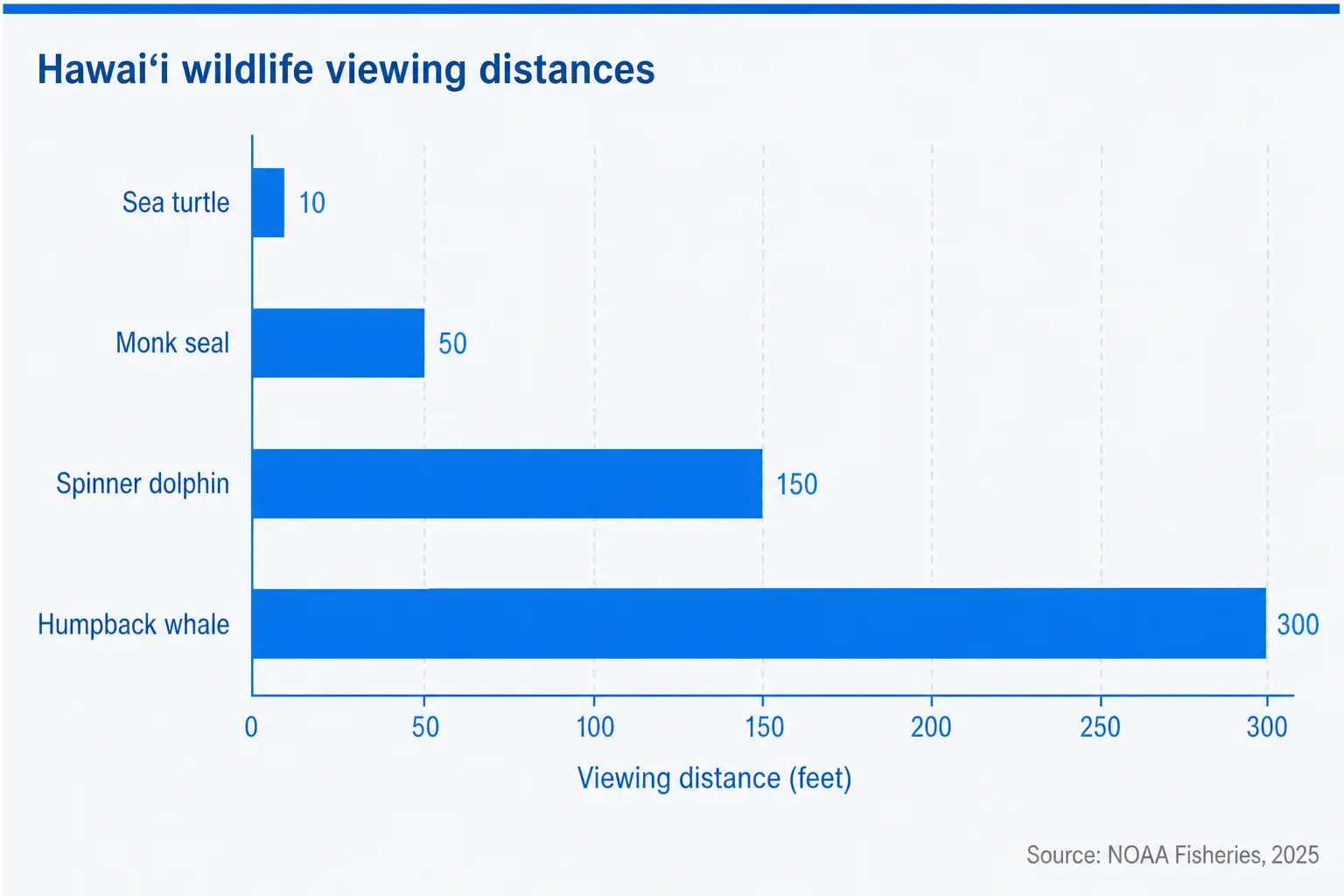
NOAA Fisheries recommends at least 10 feet from sea turtles and 50 feet from monk seals. In Hawaiʻi, federal rules prohibit approaching or remaining within 50 yards of spinner dolphins and prohibit approaching humpback whales within 100 yards, including by kayak, boat, drone, swimming, or another means. NOAA Fisheries’ Hawaiʻi viewing guidance sets out those distances and the difference between recommendations and legal restrictions. (fisheries.noaa.gov)
The practical test is simple: an operator should never advertise a close encounter as the goal. If wildlife approaches the group, guests should stay calm, avoid pursuit, and leave the animal a clear path away.
Reef care matters at the same scale. Hawaiʻi DLNR advises visitors not to stand on, touch, or kick coral because even fin contact can damage it. DLNR coral-reef guidance also advises keeping chemicals and trash out of the ocean. (dar.hawaii.gov)
Wildlife viewing is responsible when the animal, not the guest, controls the distance and direction of the encounter.
Which Maui eco tour format fits my group?
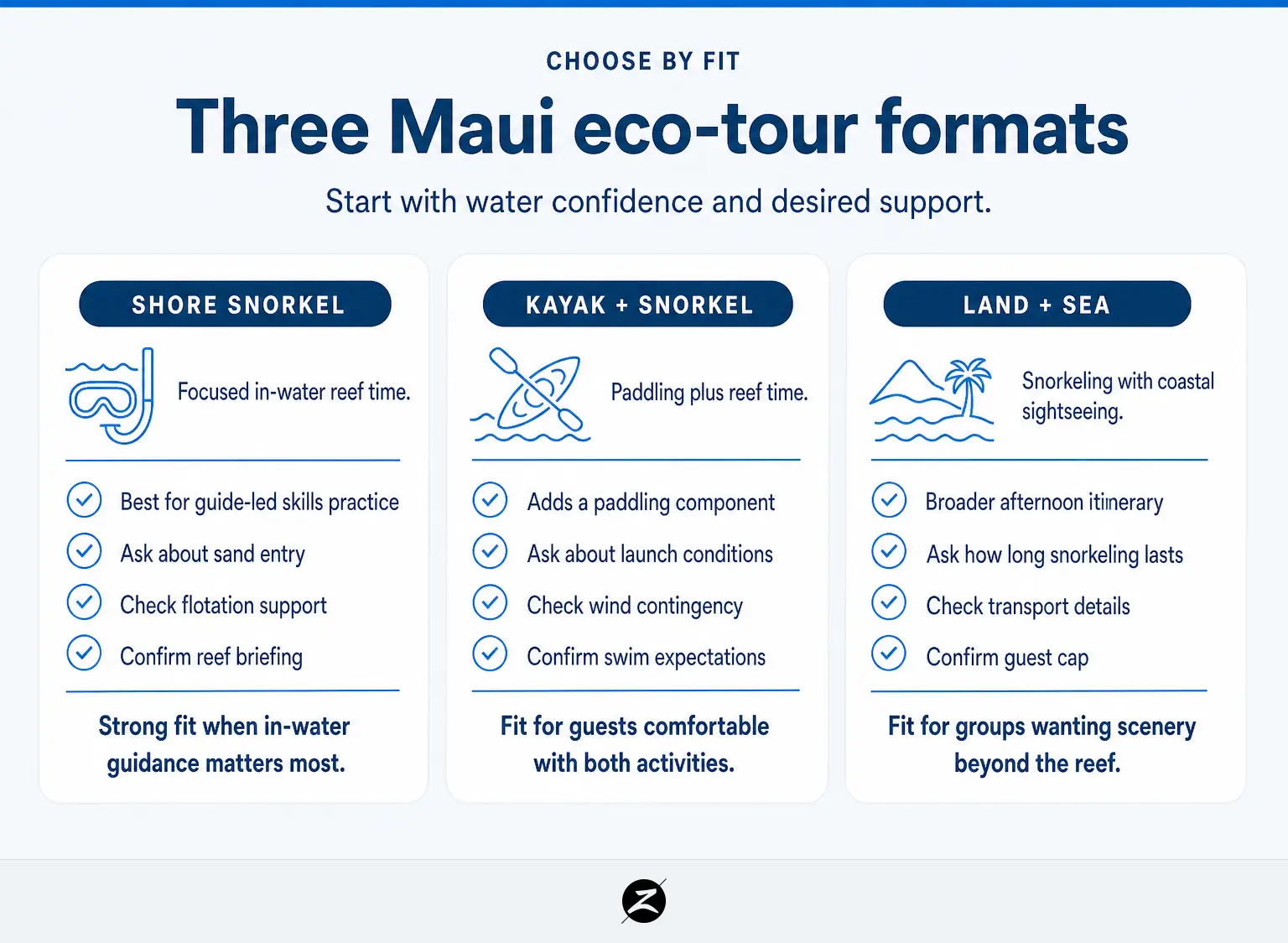
There is no single right Maui eco tour format. Choose the format that matches your group’s confidence, desired pace, and need for in-water instruction before you compare scenery or hoped-for wildlife.
Shore snorkeling suits visitors who want a focused reef experience and value a briefing, gear fitting, flotation support, and a guide nearby in the water. It can be the clearest fit for a first-time snorkeler when the operator practices skills over sand before moving toward reef habitat.
Kayak and snorkel suits visitors who want paddling as part of the outing and are comfortable managing both activities. Ask where the launch occurs, how the group handles changing wind, and whether the snorkeling portion is appropriate for the least confident participant.
Land-and-sea experiences fit visitors who want snorkeling plus coastline, beach stops, or scenic driving in the same afternoon. The tradeoff is that the outing is broader than a dedicated reef session, so confirm how much time is actually reserved for the guided snorkel.
Here is a worked example. A family with one confident swimmer, one first-time snorkeler, and two adults who mainly want coastal scenery should not choose an itinerary only because it promises turtles. They should favor a small group, a stated in-water support plan, and a format where the less confident swimmer can practice without being rushed. For more options beyond the water, see our guide to family activities in maui.
The best format is the one that gives the least confident person enough support while keeping the group’s reef behavior controlled.
What should I ask before I pay for a tour?
Ask for operational details that a booking page, guide, or customer-service team can answer plainly. If the response stays vague, compare another option rather than trying to infer a conservation standard from photos or branding.
Use this short pre-booking script:
- “What is the guest cap on my departure, and how many guides will be with us?”
- “How do you brief guests to avoid touching coral or standing on the reef?”
- “What is your policy when turtles, dolphins, seals, or whales appear?”
- “Which active sunscreen ingredients do you ask guests to use?”
- “What happens if wind, surf, visibility, or water confidence makes the original plan unsuitable?”
- “Which costs, gear, age limits, swimming expectations, and cancellation terms should I review before I reserve?”
A guide should be willing to say that an encounter is never guaranteed. Wildlife is not a scheduled prop, and an honest operator will describe the habitat without promising a turtle, whale, dolphin, or octopus on a particular trip.
Before any reef outing, it also helps to understand why sand entries, horizontal body position, and fin control matter. Our Maui reefs and reef stewardship guide explains those decisions in more detail.
A transparent tour operator makes safety, wildlife space, and reef protection easy to understand before money changes hands.
What else do travelers ask before booking Maui eco tours?
The broad questions below are useful only when they lead back to fit, conditions, and responsible conduct. A high-profile activity is not automatically the right choice for every traveler or every ocean day.
What are the best tours to take in Maui?
The best tour to take in Maui is the one whose activity, support level, and current conditions fit your group. A reef-conscious choice has a clear wildlife policy, a guide-led safety briefing, and a realistic plan for wind or surf. Do not choose by an eco label or a wildlife promise alone.
What is one thing not to miss on Maui?
One thing not to miss on Maui is the chance to see coastal and reef habitat responsibly. Choose a tour that gives coral room, keeps wildlife encounters unforced, and matches the least confident person in your group. A careful in-water experience is more valuable than trying to cover every attraction.
What month is the best time to visit Maui?
There is no single best month for a Maui eco tour because ocean conditions vary by day, shore, and activity. Seasonal wildlife can influence what may be seen, but it never overrides weather, surf, wind, visibility, posted rules, or the comfort level of the people entering the water.
The right booking decision stays the same in every month: review conditions, choose appropriate support, and let wildlife and reef protection set the limits.
What is the next step if a tour passes this check?
Match the checklist to the experience you actually want. If your group wants a South Maui afternoon that combines a guided snorkel, beach stops, golden-hour scenery, and a coastal drive, our Wailea Wildlife Experience is currently listed for 2 to 10 guests and ages 7 and up, with a guide briefing before the in-water portion. Review the current trip details and availability before booking. (zephyrmaui.com)
Book the tour whose practices you can understand before you arrive, then bring the same standard into the water: give wildlife space, stay off coral, and be ready to change plans when conditions call for it.