
In short
Maui reefs line much of the island’s shallow coast, with notable systems off South Maui, Olowalu and Molokini. To visit responsibly, enter over sand, float horizontally, keep fins above coral, never touch or take marine life, give turtles at least 10 feet, and use only mineral sunscreen allowed under Maui County law.
Key takeaways
- The 2019 U.S. Geological Survey report mapped four major reef tracts around Maui island, but their acreage is not a score for snorkeling quality or safety.
- The Maui County mineral-only sunscreen law has prohibited non-mineral sunscreen use without a prescription since October 1, 2022.
- NOAA recommends at least 10 feet between people and sea turtles in Hawaiʻi, on land and in the water.
- Hawaiʻi reef regulations prohibit taking, breaking or damaging stony coral, while state law also restricts removing dead coral and coral rubble from shorelines.
- A suitable Maui reef is one that matches the swimmer’s ability, posted access rules and current ocean conditions, not simply the closest location on a map.
Table of contents
- Are there coral reefs in Maui?
- Where can I go snorkeling in Maui with a reef?
- Which South Maui reef visit fits my comfort level?
- How do I snorkel without damaging coral?
- What lives on Maui’s reefs?
- What should I be careful of in Maui?
- Why are Maui’s reefs under pressure?
- Is it illegal to bring coral back from Hawaii?
- What are the most common questions about Maui reefs?
- What is the next step for a low-impact reef visit?
Maui’s reefs are living coastal systems, not underwater scenery arranged for visitors. Coral distribution is patchy, access and water conditions change, and a responsible choice begins before the mask goes on: know the rules, choose a sand entry and be willing to stay out.
Are there coral reefs in Maui?
Yes. Maui has major shallow reef tracts around Kīhei, Olowalu, West Maui and Kahului, plus smaller well-known reef areas such as Molokini and ʻĀhihi-Kīnaʻu. The USGS describes these reefs as connected coastal tracts rather than isolated attractions at individual beaches.
The USGS map labels the four major Maui tracts at approximately 3,235 acres for Kahului, 1,538 acres for Kīhei, 812 acres for Olowalu and 215 acres for West Maui. Those figures show scale, not the amount of reef that is safe, accessible or attractive for snorkeling on a given day.
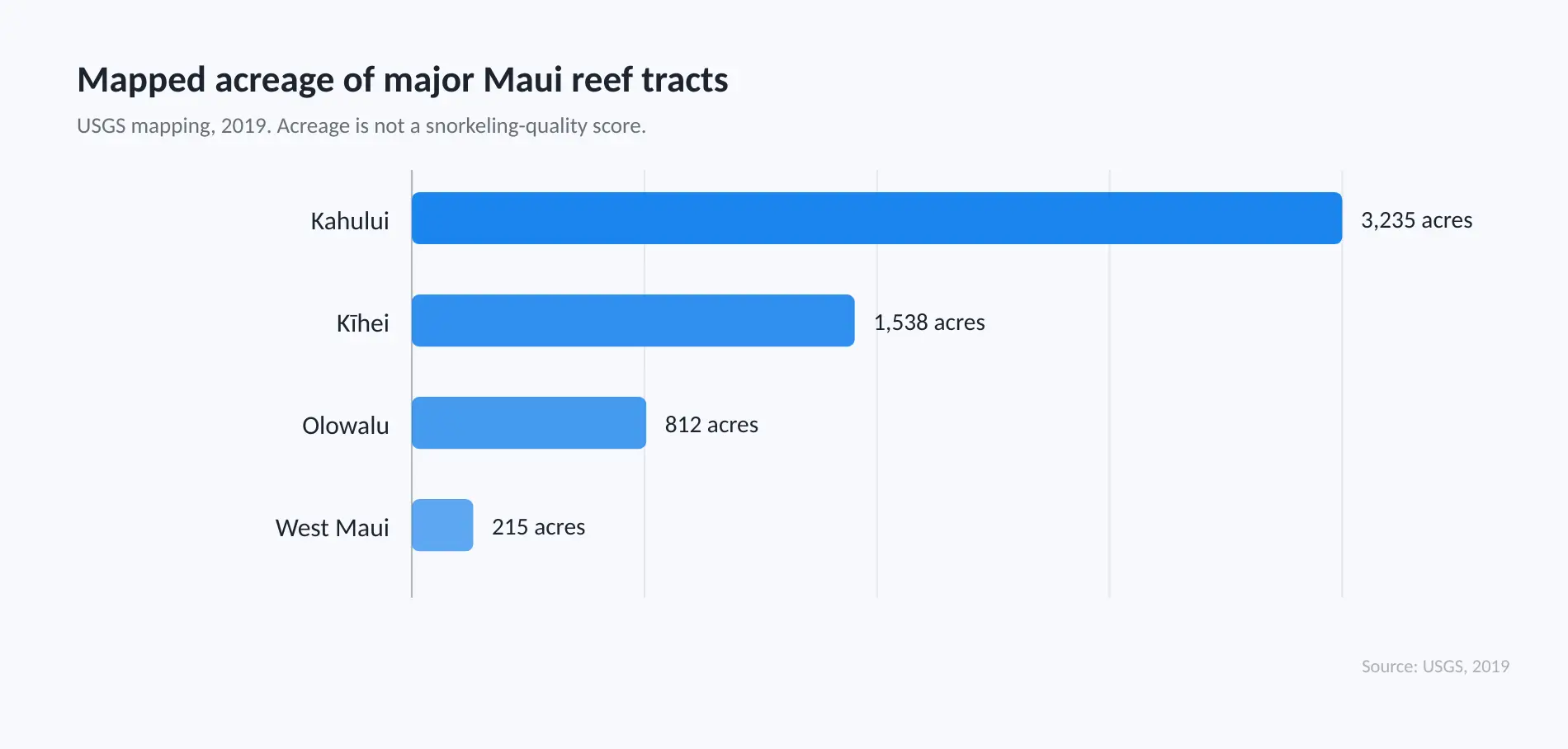
The USGS excluded Molokini and ʻĀhihi-Kīnaʻu from that major-tract comparison because they are much smaller, not because they lack ecological value. A map also cannot show today’s wind, surf, visibility, closures or safe sand channels.
Coral is not ordinary rock. Hawaiʻi DLNR’s coral and live rock rules explain that living polyps form the outer layer of a hard calcium-carbonate skeleton. A pale, rough surface can still be alive, and nearly any hard nearshore substrate may support attached marine life.
Maui’s reefs are broad living systems along the coast, not isolated attractions marked by a single pin.
Where can I go snorkeling in Maui with a reef?
South Maui, Olowalu, ʻĀhihi-Kīnaʻu and Molokini all provide ways to see reef habitat, but they are not interchangeable. Choose according to shore or boat access, swimming confidence, protection rules and the conditions present when you arrive.
| Area | Access pattern | Who it may suit | Non-negotiable caveat |
|---|---|---|---|
| Kīhei to Wailea | Shore access at suitable public beaches | Visitors seeking convenient South Maui access | Reef is patchy; identify a sand entry and reassess wind and surf |
| Mākena and Turtle Town coast | Shore or guided kayak, depending on the exact site | Wildlife-focused visitors who want reef habitat near South Maui | Exact entry routes change with conditions, and wildlife is never guaranteed |
| ʻĀhihi-Kīnaʻu Natural Area Reserve | Shore access only in posted open areas | Visitors prepared to follow reserve maps and uneven coastal access | Closed zones and no-take rules must be observed |
| Olowalu | Shore or kayak, depending on launch access and conditions | Visitors interested in a broad, shallow reef tract | Shallow coral makes route choice and fin control especially important |
| Molokini | Boat only | Visitors comparing an offshore protected reef with shore options | There is no shore access or visitor facility, and currents can strengthen outside the cove |
The current ʻĀhihi-Kīnaʻu reserve page lists visiting hours of 5:30 a.m. to 7:30 p.m. and a $10-per-car day-use fee, payable by card, as of September 14, 2026. Only posted open areas are available. State rules prohibit removing, injuring or killing plants or animals in the reserve’s shore waters, and motorized vessels are prohibited without an applicable exception or permit.
Molokini is a different type of visit. The state’s Molokini Shoal guidance describes a boat-only Marine Life Conservation District about three miles off southwest Maui. Taking or injuring marine life, altering coral or geological material, feeding wildlife and entering the seabird islet are prohibited.
For shore visitors staying in Kīhei or Wailea, the nearest beach is not automatically the right reef. Look for lawful public access, a sand entry, an easy exit and conditions suited to the least confident person in the group.
The right Maui reef is the one whose access, protection rules and day-of conditions match your ability.
Which South Maui reef visit fits my comfort level?
Choose the support level before choosing the wildlife you hope to see. A first-time snorkeler and a strong open-water swimmer may visit the same coastline, but they should not necessarily use the same entry, depth, equipment or level of supervision.
- First-time or low-confidence snorkelers: Start where mask fit, breathing, flotation and body position can be practiced over sand. A remote reserve or shallow coral shelf is not a suitable place to learn through trial and error.
- Comfortable shore snorkelers: Choose a visible sand channel, stay near a practical exit and use a buddy who remains within close visual contact. Comfort in a pool does not establish comfort in wind, surge or current.
- Experienced independent snorkelers: Experience does not override closures, parking rules, water-quality advisories or wildlife space. Read the site map and signs every time.
If support is more useful than independence, our guided Maui ocean activities include shore and kayak formats with equipment, briefings and in-water guidance rather than equipment-only access.
What does a low-impact Wailea plan look like?
Consider a four-person group in Wailea with two comfortable swimmers, one beginner and one person who has never used fins. This is a worked planning example, not a report about an actual guest.
- The group checks the water-quality advisory page, posted warnings and visible conditions before committing to an entry.
- The group identifies a sand channel and an exit that remains practical if the wind increases. If waves are breaking over the route, the plan changes.
- Masks, snorkels and flotation are adjusted before the reef. The beginner practices breathing and horizontal position over sand rather than standing among coral heads.
- The group crosses reef habitat slowly. If a swimmer becomes vertical or starts dropping fin tips, everyone moves back toward deeper water or sand to reset.
- If a turtle appears, the group stops pursuing a route toward the animal, keeps at least 10 feet away and leaves the turtle an unobstructed path.
Choose the entry and support level before choosing the wildlife you hope to see.
How do I snorkel without damaging coral?
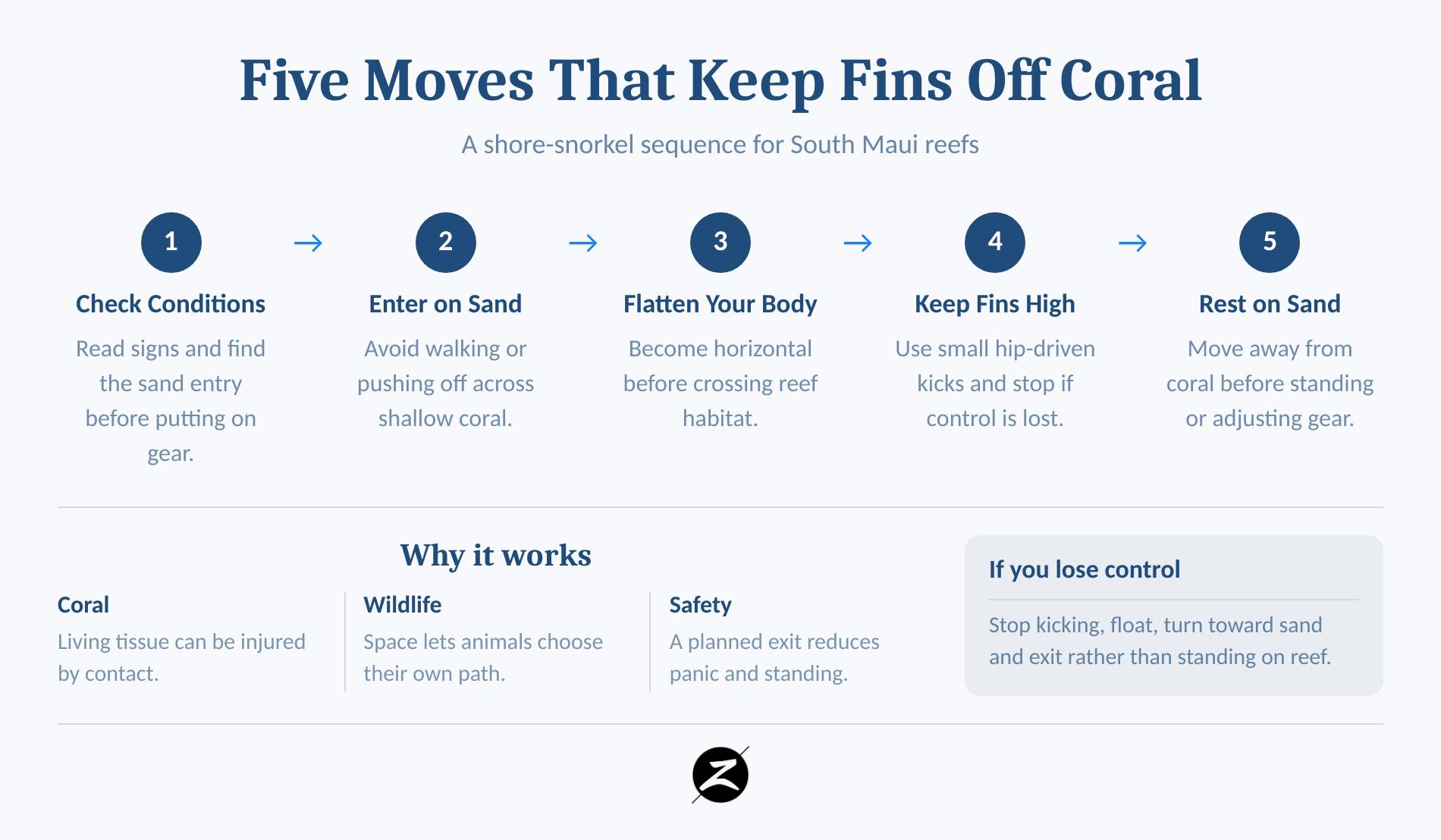
Enter and exit over sand, become horizontal before reaching coral, and keep your fins high with small controlled kicks. If you need to stand, adjust equipment or recover your breathing, return to sand rather than using the reef as a platform.
The sequence turns a general request to protect coral into specific decisions about entry, body position, fins and rest stops.
- Check before putting on gear. Read beach and reserve signs, look for breaking waves and confirm where sand, reef and the return route are located.
- Enter on sand. Carry fins to suitable water or put them on while supported over sand. Do not walk across shallow coral in fins.
- Set a horizontal position. Let flotation and breathing settle before moving over reef. A vertical posture sends knees and fin tips downward.
- Keep your fins up. Use small kicks from the hips and avoid rapid bicycle-style kicking. If a wave or another swimmer disrupts your position, stop kicking until control returns.
- Rest or exit over sand. Move away from coral before standing, clearing a mask or helping another swimmer. Leaving the water is a better choice than forcing the route.
Do not touch, hold, collect or feed reef animals. Hands can remove protective coatings from fish and invertebrates, while contact can injure coral tissue even when the skeleton appears solid.
How much space should I give turtles?
NOAA recommends a viewing distance of at least 10 feet, or 3 meters, from sea turtles in Hawaiʻi on land and in the water. NOAA also clarifies that this distance is guidance rather than an automatically enforceable boundary. Touching, chasing, feeding or otherwise harassing a protected turtle can still violate federal or state law.
If a turtle approaches, stay calm and avoid blocking its path to the surface, deeper water or a resting area. A camera zoom provides a closer view without requiring the swimmer to close the distance.
Which sunscreen can I use in Maui County?
Maui County Ordinance No. 5306 has prohibited the sale, distribution and use of non-mineral sunscreen without a prescription since October 1, 2022. The county advises choosing products whose active ingredients are non-nanotized zinc oxide or titanium dioxide rather than relying on a marketing phrase on the front label.
Sun-protective clothing, a rash guard, shade and avoiding peak sun exposure reduce the amount of sunscreen needed. No sunscreen replaces sensible sun protection, and no product makes physical contact with coral acceptable.
Good reef technique is simple: enter over sand, stay horizontal, keep fins high and leave everything where it is.
What lives on Maui’s reefs?
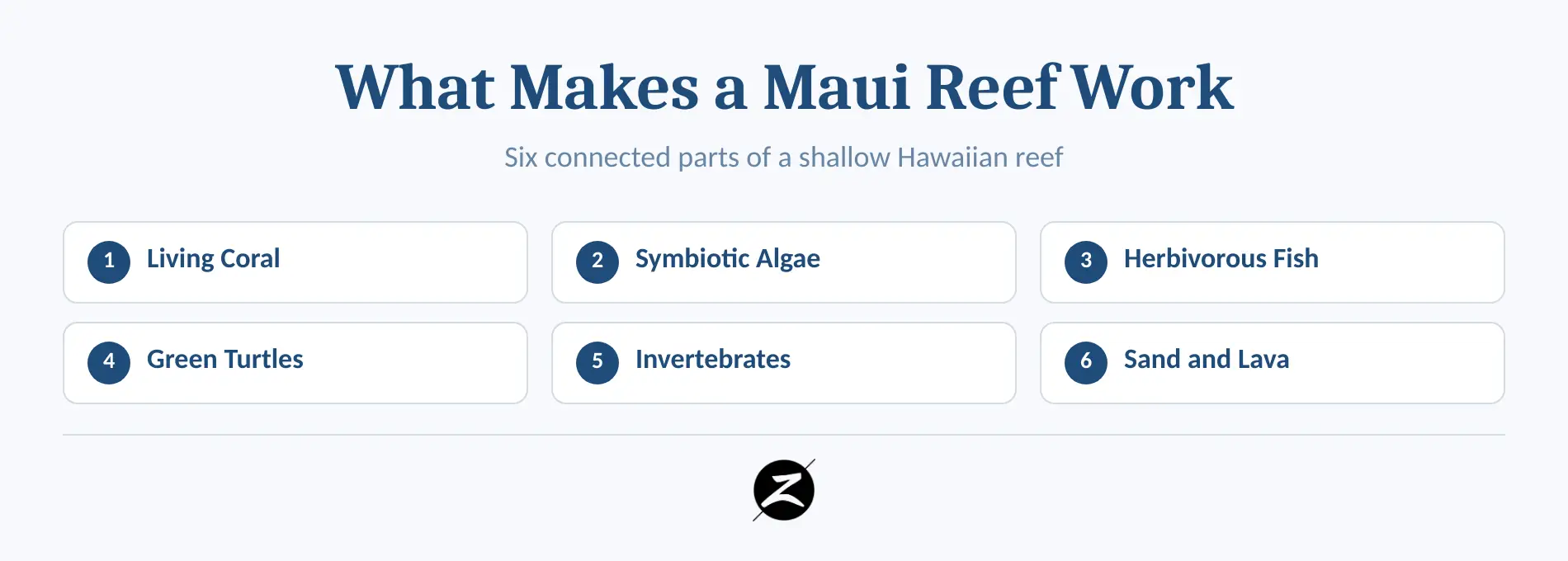
Maui’s reefs support living coral, algae, grazing fish, predators, invertebrates and green sea turtles within one connected food web. The exact community differs with depth, wave exposure, substrate, water quality and the condition of each reef.
The reef works as a community: coral creates structure, grazers control algae and many animals use the habitat for food or shelter.
Coral polyps are animals, while microscopic algae living in their tissue supply much of their energy through photosynthesis. Hawaiʻi DLNR pages use slightly different rounded estimates for coral diversity. The state’s coral nursery guidance says approximately 60 coral species occur in the main Hawaiian Islands and up to 20% are endemic, while another coral outplanting page says about 65 living coral species and roughly one-quarter endemic. Those estimates should not be averaged into false precision.
The nursery program also reports that many Hawaiian reef-building corals grow only about 1 to 2 centimeters per year. Slow growth is one reason a careless kick can cause damage that is not quickly replaced.
Common Hawaiian coral descriptions published by DLNR include lobe coral, finger coral, rose or cauliflower coral, lace coral and rice coral. Their shapes vary from massive mounds to fingers, plates and compact branches. Color alone is not a reliable test of whether a colony is alive.
Fish are not simply decoration around the coral. DLNR’s guide to reef herbivores explains that parrotfish, surgeonfish and other grazers remove algae, helping prevent coral surfaces from being overgrown. Readers who want species-level identification can continue to the maui fish snorkeling guide.
Green turtles are primarily herbivores. NOAA’s green turtle profile says their diet mainly consists of algae and seagrasses, although other food may be taken when available. Invertebrates occupying reef crevices, rubble and sand patches add another layer of life that can be missed when every swimmer is searching only for a turtle.
A Maui reef is a working community in which coral, algae, fish, turtles and invertebrates affect one another.
What should I be careful of in Maui?
Check surf, shore break, currents, wind, water quality, posted restrictions and the least confident swimmer before entering. A location that was manageable yesterday can be unsuitable today, and a famous snorkeling name is not a substitute for a same-day assessment.
- Shore break: Mākena State Park explicitly warns that its shore break can be very dangerous. A broad sandy beach is not automatically a safe snorkeling entry.
- Brown or turbid water: The Hawaiʻi Department of Health beach program advises people not to enter brown or turbid water, even when a Brown Water Advisory has not yet been issued. Check the live advisory viewer after rain and storms.
- Swimming alone: Maui County Ocean Safety advises using lifeguarded areas, never swimming alone, reading signs and asking a lifeguard about conditions where one is available.
- Overreliance on flotation: Flotation can support a suitable swimmer, but county guidance says to rely on swimming ability rather than treating a device as a replacement for it.
- Cuts and contact: Coral contact can injure the reef and the swimmer. The Department of Health advises staying off coral and avoiding ocean entry with open cuts or wounds.
- A difficult return: Do not travel farther from the entry than the group can comfortably swim back while accounting for wind, current and fatigue.
Conditions change faster than an evergreen beach list. Check official advisories and on-site signs on the day of the visit, and leave when the safest decision is unclear.
If conditions, water quality or your own comfort are doubtful, staying out protects both you and the reef.
Why are Maui’s reefs under pressure?
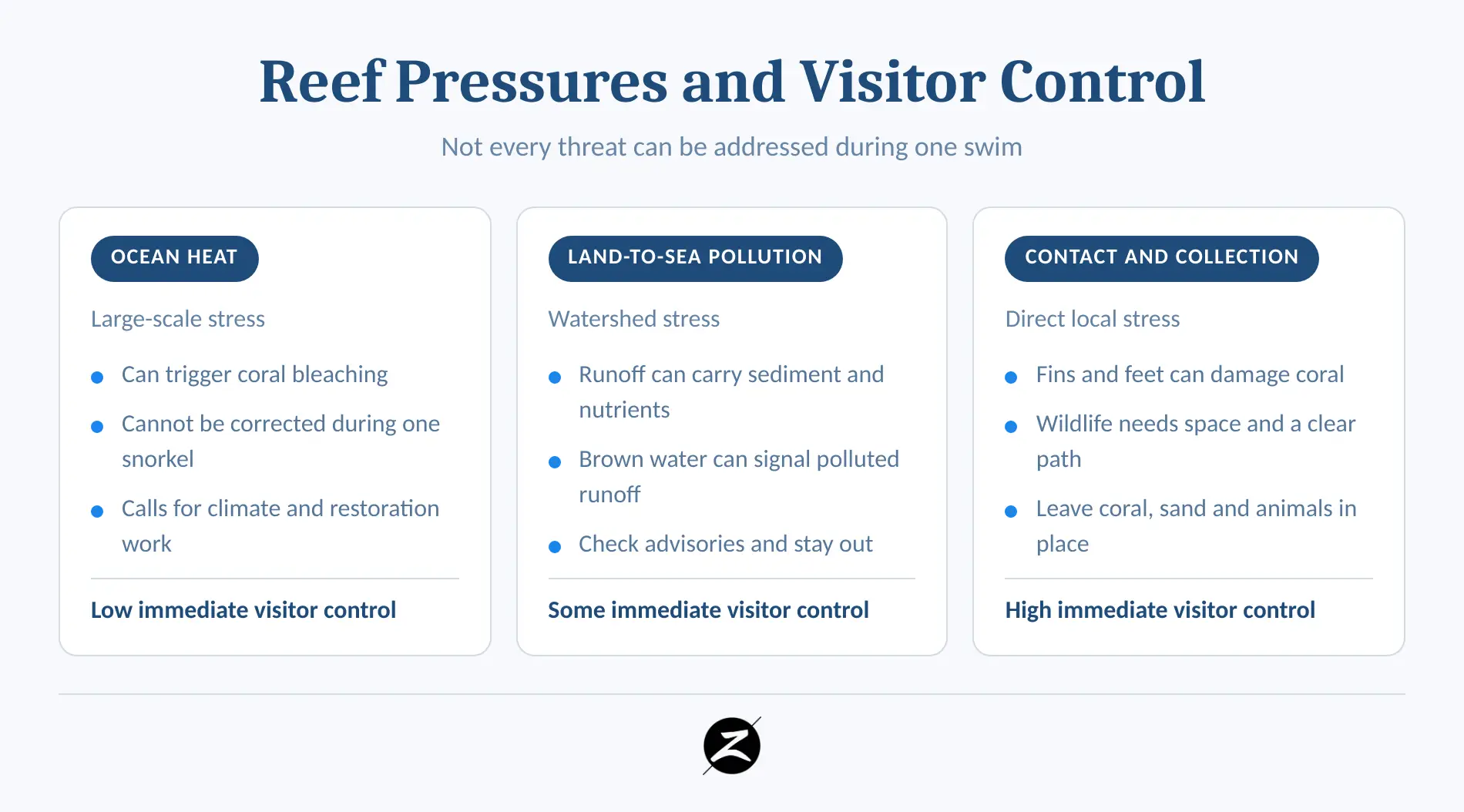
Maui’s reefs face global and local pressures, including warming water, bleaching, land-based pollution, fishing pressure and direct physical damage. Visitors cannot solve every threat during one swim, but they can prevent contact damage, avoid polluted water and support reef and watershed stewardship.
Different reef pressures require different responses, but direct contact and collection are immediately within a visitor’s control.
The 2019 USGS synthesis identifies climate change, land-based pollution and overfishing among the threats affecting Maui Nui reefs. Sediment and nutrient pollution can move from watersheds to nearshore water, while marine heat can cause coral to expel the algae that supply much of its energy.
Herbivorous fish add resilience by grazing algae and keeping surfaces available for coral settlement. Protecting coral without maintaining the wider reef community would miss part of the mechanism.
The most immediate visitor actions are straightforward: do not stand on coral, do not chase wildlife, do not remove natural material, use mineral sunscreen and stay out of brown water. Longer-term help can include supporting legitimate reef monitoring, watershed restoration and community stewardship rather than treating the reef only as an attraction.
Visitors cannot solve every reef threat, but they can avoid adding direct damage and support local stewardship.
Is it illegal to bring coral back from Hawaii?
Do not collect coral from Hawaiʻi’s water or shoreline. State rules prohibit taking, breaking or damaging stony coral, and Hawaiʻi law also prohibits removing dead coral or coral rubble from shoreline areas, subject to narrow exceptions.
The distinction between live and dead material does not create a visitor loophole. A white fragment on the beach may be coral rubble, while apparently bare hard material in the water may support living organisms.
HRS §205A-44 lists limited exceptions for matters such as inadvertent removal, authorized maintenance, emergencies and lawful cultural practices. Those exceptions do not amount to general permission to fill a bag with coral or sand.
If a coral product was legally purchased, retain its receipt and documentation. Collection, sale and transportation can involve different rules, so unusual cases should be directed to Hawaiʻi DLNR or the relevant transportation authority.
Leave coral, coral rubble and sand where they are, because a natural souvenir can also be an unlawful one.
What are the most common questions about Maui reefs?
The short answers below address the exact questions visitors commonly ask. Rules, access and conditions can change, so official sources and posted notices should be checked before entering the water or removing anything.
Are there coral reefs in Maui?
Yes. Maui has major shallow reef tracts around Kīhei, Olowalu, West Maui and Kahului, plus smaller but well-known reef areas such as Molokini and ʻĀhihi-Kīnaʻu. Coral distribution is patchy, so a sandy beach may have reef mainly along rocky points, lava edges or farther offshore.
What to be careful of in Maui?
Check surf, wind, currents, posted warnings and water-quality advisories before snorkeling. Never enter brown or turbid water, never snorkel alone, and do not rely on flotation to replace swimming ability. In the water, avoid coral contact and give wildlife space; if uncertain, stay out and choose a guided outing.
Where can I go snorkeling in Maui with a reef?
South Maui has accessible reef habitat around Wailea and the Mākena coast, while ʻĀhihi-Kīnaʻu offers protected reef access only in posted open areas. Olowalu is another major reef tract. Molokini is offshore and boat-only. Conditions, entry routes, parking and closures should be checked on the day.
Is it illegal to bring coral back from Hawaii?
Do not collect coral in Hawaiʻi. State rules prohibit taking, breaking or damaging stony coral, and state law also prohibits removing dead coral or coral rubble from shoreline areas, apart from narrow exceptions. Leave natural material in place and keep receipts or documentation for any legally purchased coral product.
The safest reef visit follows posted rules, respects swimmer limits and leaves every animal and piece of habitat where it was found.
What is the next step for a low-impact reef visit?
Choose your support level and check the day’s conditions before choosing a reef. If independent entry does not fit the least confident person in the group, use a guided format rather than forcing a popular location.
We offer the Wailea Wildlife Experience, which combines a guided sea-turtle snorkel with South Maui beach stops and a coastal drive toward La Perouse. Review the itinerary and current availability, then confirm that the swimming requirements and day-of conditions fit your group.
Choose a reef visit that is easy to change or stop when conditions, wildlife or the reef itself call for more space.