
In short
Maui snorkelers may see yellow tangs, butterflyfish, wrasses, parrotfish, goatfish, triggerfish, trumpetfish, moray eels, octopuses, rays, sea urchins, and Hawaiian green sea turtles. The exact mix changes with reef habitat, depth, water clarity, ocean conditions, and luck, so use body shape, markings, behavior, and location to identify what passes below. (dlnr.hawaii.gov)
- 🐠 A quick fish identification starts with silhouette and behavior, not color alone, because light and depth can change how colors appear underwater.
- 🐢 As of September 2026, NOAA Fisheries recommends staying at least 10 feet, or 3 meters, from sea turtles on land and in the water. (fisheries.noaa.gov)
- 🪸 Coral is living habitat, so snorkelers should float above it without standing, kicking, collecting, or resting equipment on the reef. (oceanservice.noaa.gov)
- A guide can help identify camouflaged animals and explain their behavior, but no responsible operator can guarantee a wild-animal sighting.
Table of contents
- What fish are easiest to recognize while snorkeling in Maui?
- How can I identify a fish before it swims away?
- What larger animals and reef creatures might appear?
- Where on the reef should I look for each animal?
- Which Maui reef animals should I give extra space?
- How can I watch reef life without disturbing it?
- What else do Maui snorkelers ask?
- Ready to put this Maui fish guide to use?
This Maui fish snorkeling guide is built for the few seconds when an unfamiliar animal crosses the reef and disappears. It is not an exhaustive species checklist. It gives you a practical way to recognize the Hawaiian coral reef animals most likely to stand out, then verify the identification later with a picture reference such as the downloadable Hawaiʻi DLNR shallow-reef field chart. (dlnr.hawaii.gov)
What fish are easiest to recognize while snorkeling in Maui?
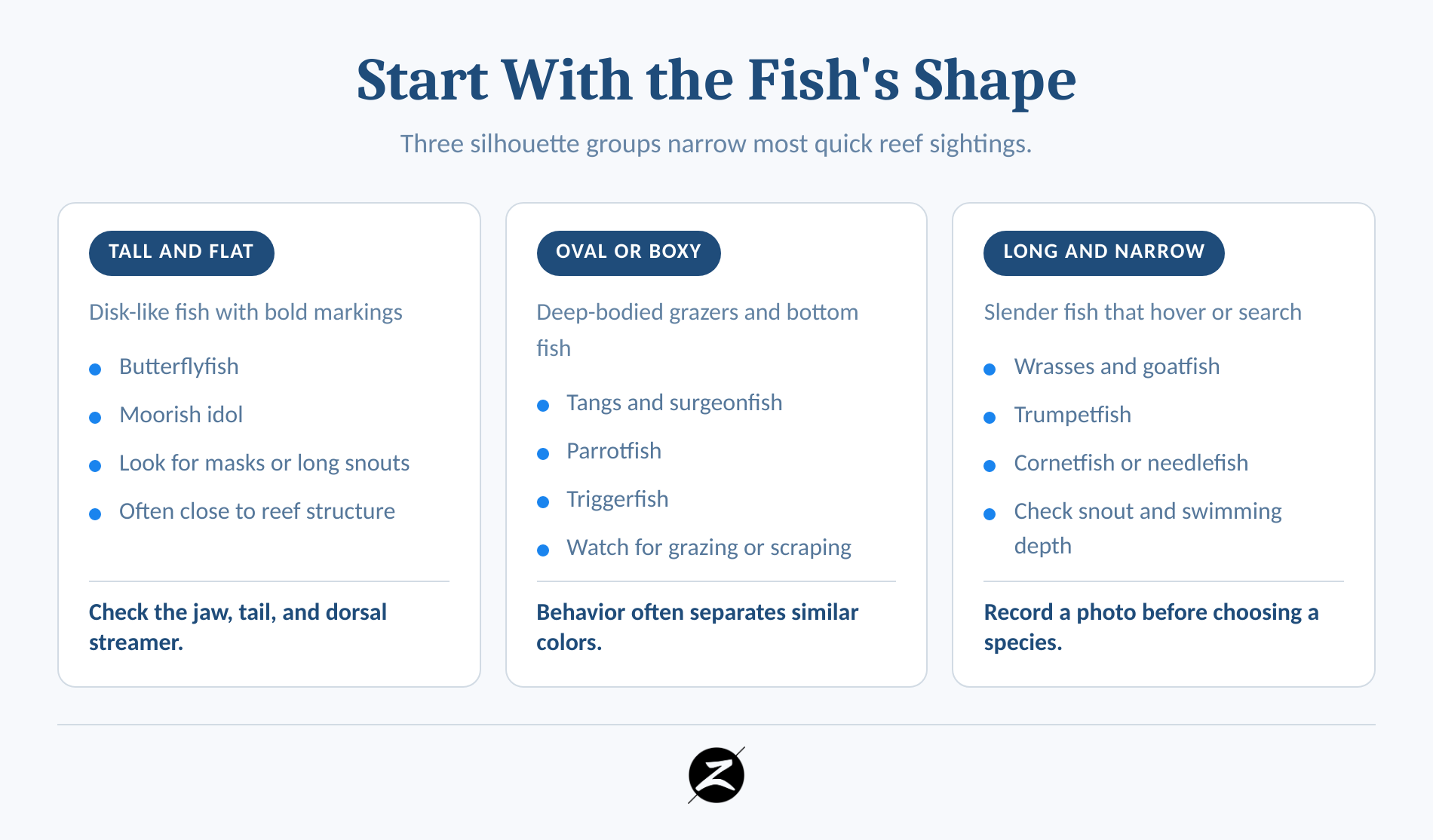
Start with six visually distinctive groups: tangs, butterflyfish, Moorish idols, parrotfish and wrasses, goatfish, and triggerfish. Long, narrow fish form another useful group, although an exact species identification may require a photograph.
Is the bright yellow or striped oval fish a tang?
A yellow tang has a deep, compressed body that can appear almost entirely yellow. Manini, also called convict tangs, have pale oval bodies crossed by dark vertical bars and are often seen grazing over rock or reef surfaces.
Tangs are surgeonfish, a family named for blade-like structures near the tail. The University of Hawaiʻi's Waikīkī Aquarium surgeonfish guide describes yellow tang as one of Hawaiʻi's easiest reef fish to recognize, while its manini profile notes the species' barred body and algae-grazing behavior. (waikikiaquarium.org)
Is the flat yellow fish a butterflyfish?
Butterflyfish usually have tall, thin bodies, small mouths, and bold combinations of yellow, white, and black. A longnose butterflyfish carries an obvious narrow snout. A raccoon butterflyfish has a dark mask across the eyes, while the endemic bluestripe butterflyfish has diagonal blue lines across a yellow body.
The Waikīkī Aquarium's butterflyfish guide is useful for comparing these patterns. The aquarium identifies the bluestripe butterflyfish as a species found only in the Hawaiian Islands. (waikikiaquarium.org)
Is the black, white, and yellow fish with a streamer a Moorish idol?
A Moorish idol has a tall, disk-like body, alternating dark and yellow bands, an orange patch on the jaw, a black tail, and a long white dorsal streamer. It often stays close to the reef while searching crevices for food.
The orange jaw and black tail help separate it from similarly shaped fish. The Waikīkī Aquarium's Moorish idol profile also notes that the fish is common in Hawaiʻi and regularly seen by snorkelers. (waikikiaquarium.org)
Is the colorful fish scraping the reef a parrotfish or a wrasse?
Parrotfish, known collectively as uhu in Hawaiian, have blunt heads, large scales, and beak-like fused teeth. Watch for a fish making deliberate grazing passes over rock while swimming with steady rowing movements of its side fins.
Wrasses are often slimmer and more restless. They dart, turn, inspect crevices, and may change color considerably as they mature. The Waikīkī Aquarium's parrotfish profile explains the beak and grazing behavior, while its wrasse guide identifies the endemic saddle wrasse as one of Hawaiʻi's common reef fish. (waikikiaquarium.org)
Is the fish searching the sand with whiskers a goatfish?
Look beneath the chin. Goatfish have a pair of whisker-like sensory barbels that probe sand and reef crevices for hidden prey. Their elongated bodies and separated dorsal fins are useful secondary clues.
Some goatfish hover in groups above the reef, while others actively root through the bottom. The Waikīkī Aquarium's goatfish guide explains that the barbels detect food through touch and taste. (waikikiaquarium.org)
Is the boxy patterned fish a triggerfish?
The reef triggerfish, humuhumunukunukuāpuaʻa, has an angular body, geometric markings, a pig-like snout, and a prominent dorsal spine. It usually swims close to the bottom and can move forward, backward, or hover by waving its upper and lower fins.
The Waikīkī Aquarium's reef triggerfish profile identifies this species as Hawaiʻi's state fish and explains how its locking dorsal spine helps secure it inside reef crevices. (waikikiaquarium.org)
Is the long skinny fish a trumpetfish?
A trumpetfish has a rigid-looking body, a tubular snout, and small fins set far back. It may hover horizontally or vertically near reef structure, sometimes so quietly that it resembles a drifting stick.
Do not force an exact identification from shape alone. The aquarium's trumpetfish profile notes that the local term “stickfish” may also be used for cornetfish, needlefish, and halfbeaks. (waikikiaquarium.org)
The fastest Maui fish identification starts with silhouette, then uses markings and behavior to narrow the sighting.
How can I identify a fish before it swims away?
Use a four-pass identification method: shape, high-contrast markings, behavior, and reef zone. Record one clue from each pass rather than trying to remember every color and fin.
- Choose the body shape. Is the fish tall and flat, oval, torpedo-shaped, boxy, or extremely long and thin?
- Find one durable marking. Look for a mask, vertical bars, a tail spot, a long snout, a bright tail, or a dorsal streamer.
- Watch what the fish is doing. Grazing, scraping, probing sand, hovering, schooling, and hiding in a crevice are often more useful than color.
- Note the reef zone. Record whether the fish was near the surface, over sand, on the reef face, inside a crevice, or moving through open water.
Worked example: You notice a bright yellow, oval fish repeatedly picking at rock. Its body is compressed, it has no long projecting snout, and it stays close to the reef. Those clues support a yellow tang identification. If the same yellow fish had a long narrow snout and was probing crevices, a butterflyfish would be more likely.
A family-level identification is still useful when a species-level answer is uncertain. A clear note such as “small barred tang grazing in a group” is better than a confident but unsupported species name.
Guests who want help applying these clues underwater can compare Zephyr Maui's guided Maui ocean adventures, which include supported reef snorkeling in several formats. Wildlife encounters vary on every outing. (zephyrmaui.com)
Four consistent clues are more reliable than trying to memorize an entire fish poster before entering the water.
What larger animals and reef creatures might appear?
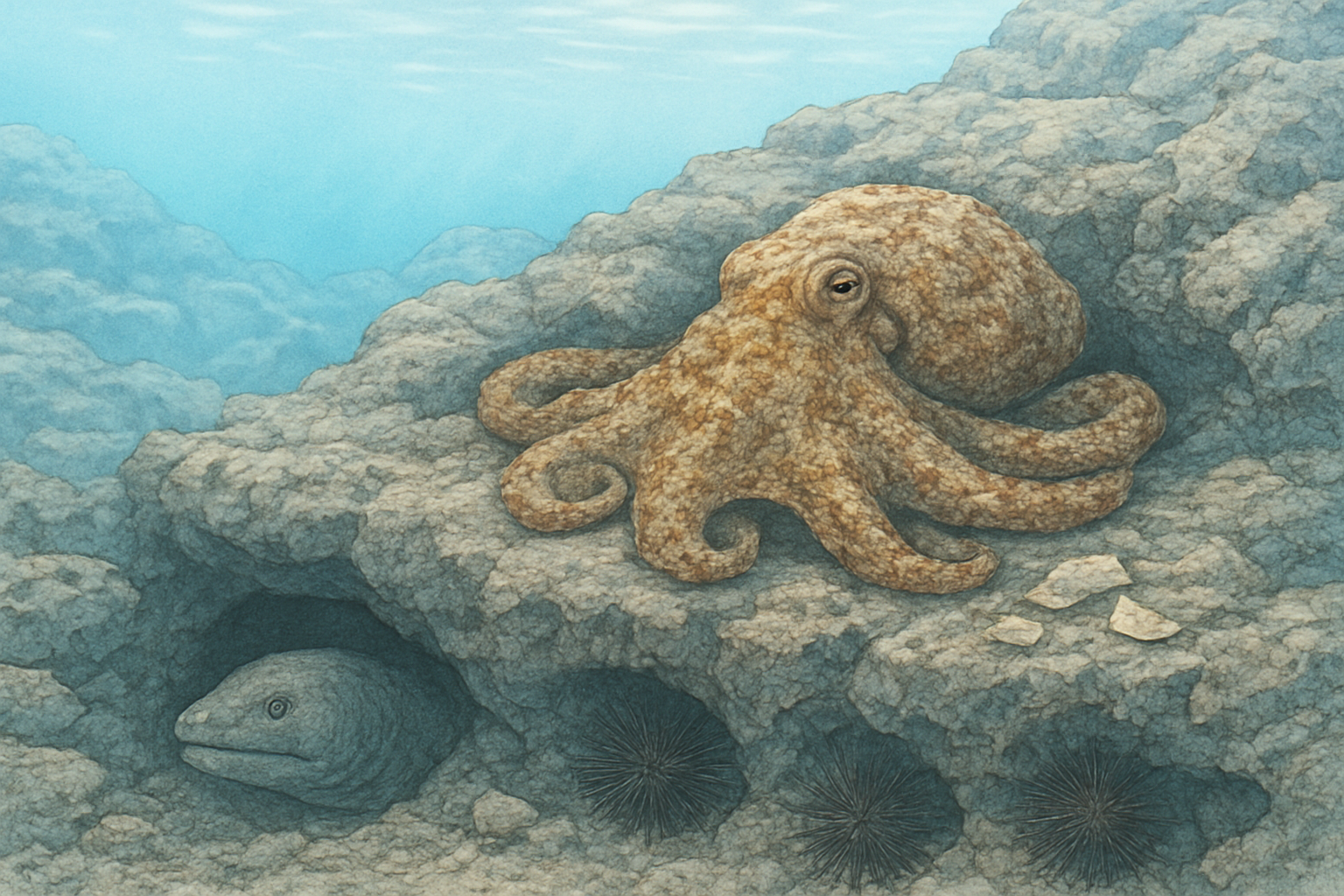
A Maui snorkel can include much more than fish, including sea turtles, octopuses, moray eels, rays, sea urchins, sea stars, sea cucumbers, and living coral. Many of these animals remain still or concealed, so slow observation matters more than covering a large distance.
- Hawaiian green sea turtles: Honu may rest near reef structure, graze, swim through the water column, or rise to breathe. Give every turtle a clear route and never follow it closely.
- Octopuses: A day octopus can change color and skin texture to match rock and coral. Look for an unusual patch of texture, moving eyes, curled arms, or broken shells near a den. The Waikīkī Aquarium's octopus profile describes this camouflage and den behavior. (waikikiaquarium.org)
- Moray eels: A moray may show only its head at the entrance to a crevice. The open mouth helps move water over the gills and is not, by itself, proof that the eel is attacking. Never place a hand into the opening. The aquarium's moray profile explains the breathing posture and defensive risk. (waikikiaquarium.org)
- Rays and reef sharks: These larger fish may pass through reef or open-water habitat, but a possible encounter is not a prediction. Stay calm, maintain space, and follow the direction of a guide or lifeguard.
- Urchins, sea stars, and sea cucumbers: Scan rock holes, shaded ledges, sand borders, and reef flats. The aquarium's echinoderm guide covers the variety of urchins, stars, and sea cucumbers found around Hawaiian reefs. (waikikiaquarium.org)
The animals that seem absent are often present but camouflaged, sheltered, or below the level where a fast swimmer is looking.
Where on the reef should I look for each animal?
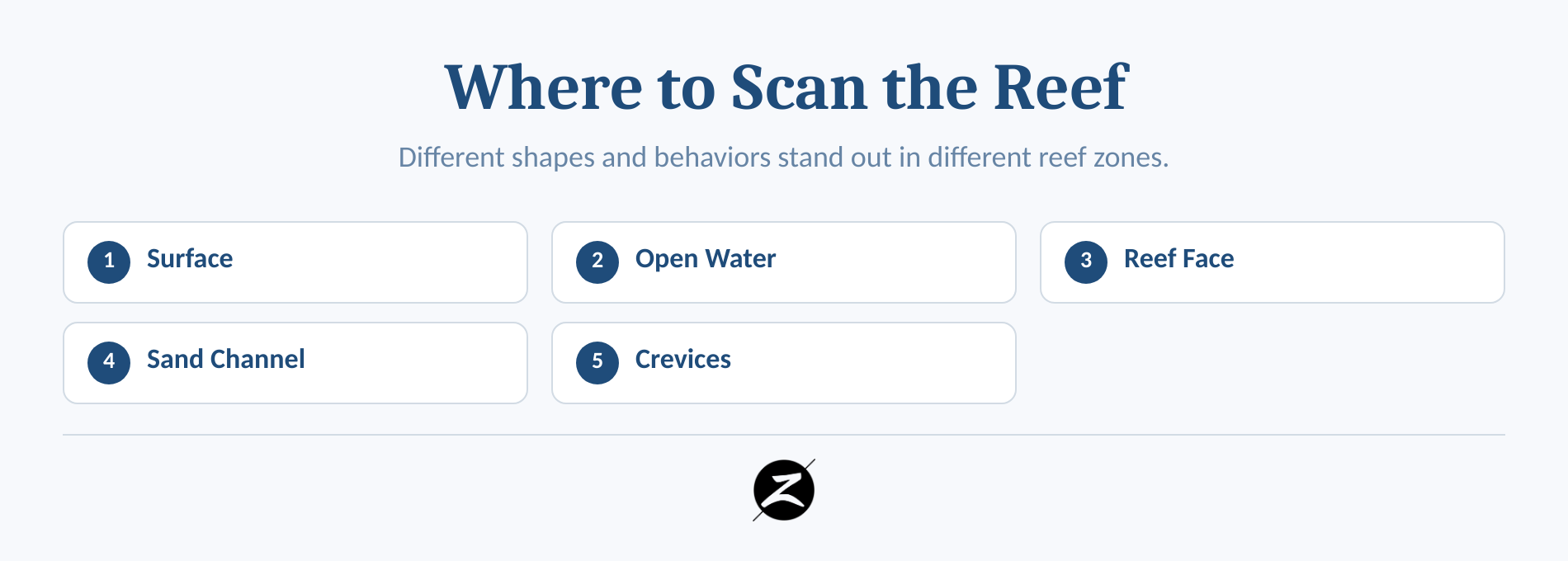
Treat the reef as a set of habitats rather than one flat scene. A reef-zone map cannot tell you where a moving animal will be, but it can tell you where to direct your attention.
- Near the surface: Look for narrow fish holding just below the waterline and schools crossing above the reef.
- In open water: Watch for passing schools, jacks, turtles, rays, and occasional larger animals moving between reef areas.
- Along the reef face: Scan for grazing tangs and parrotfish, paired butterflyfish, active wrasses, Moorish idols, and triggerfish.
- Over sand channels: Look for goatfish probing the bottom, camouflaged flatfish, and animals moving between isolated coral or lava-rock structures.
- Inside crevices and below ledges: Pause for moray heads, octopus eyes, resting fish, urchins, and other sheltering invertebrates. Do not reach inside.
Move slowly enough to revisit the same section from a different angle. A shape that looked like rock may reveal an eye, a breathing movement, or a change in texture after a few seconds.
A reef map is most useful when it shows where to look, not when it pretends wildlife stays in fixed locations.
Which Maui reef animals should I give extra space?
Give extra space to every wild animal, especially turtles, morays, camouflaged fish with spines, long-spined urchins, rays, and unfamiliar animals inside crevices. The most useful safety rule is simple: observe without touching, cornering, feeding, or provoking.
The State of Hawaiʻi's snorkeling safety guidance tells snorkelers to use a buddy, understand the area and water conditions, and avoid contact with unfamiliar marine animals. Water movement, waves, currents, entry points, and personal swimming ability require attention before fish identification begins. (dlnr.hawaii.gov)
Morays may defend their shelters if hands or feet come too close. Wana, the long-spined urchins found on reef flats and slopes, can cause punctures and painful stings. Camouflaged scorpionfish have venomous spines, which is another reason never to rest a hand or bare foot on a reef surface. (waikikiaquarium.org)
As of September 2026, NOAA Fisheries' Hawaiʻi viewing guidance recommends staying at least 10 feet, or 3 meters, from sea turtles in water and on land. The distinction matters: 10 feet is NOAA's recommended viewing distance, while federal and Hawaiʻi laws protect turtles from harassment and harm. If your presence changes an animal's behavior, increase the distance. (fisheries.noaa.gov)
The safest close-up is made with patience or camera zoom, not by closing the distance to the animal.
How can I watch reef life without disturbing it?
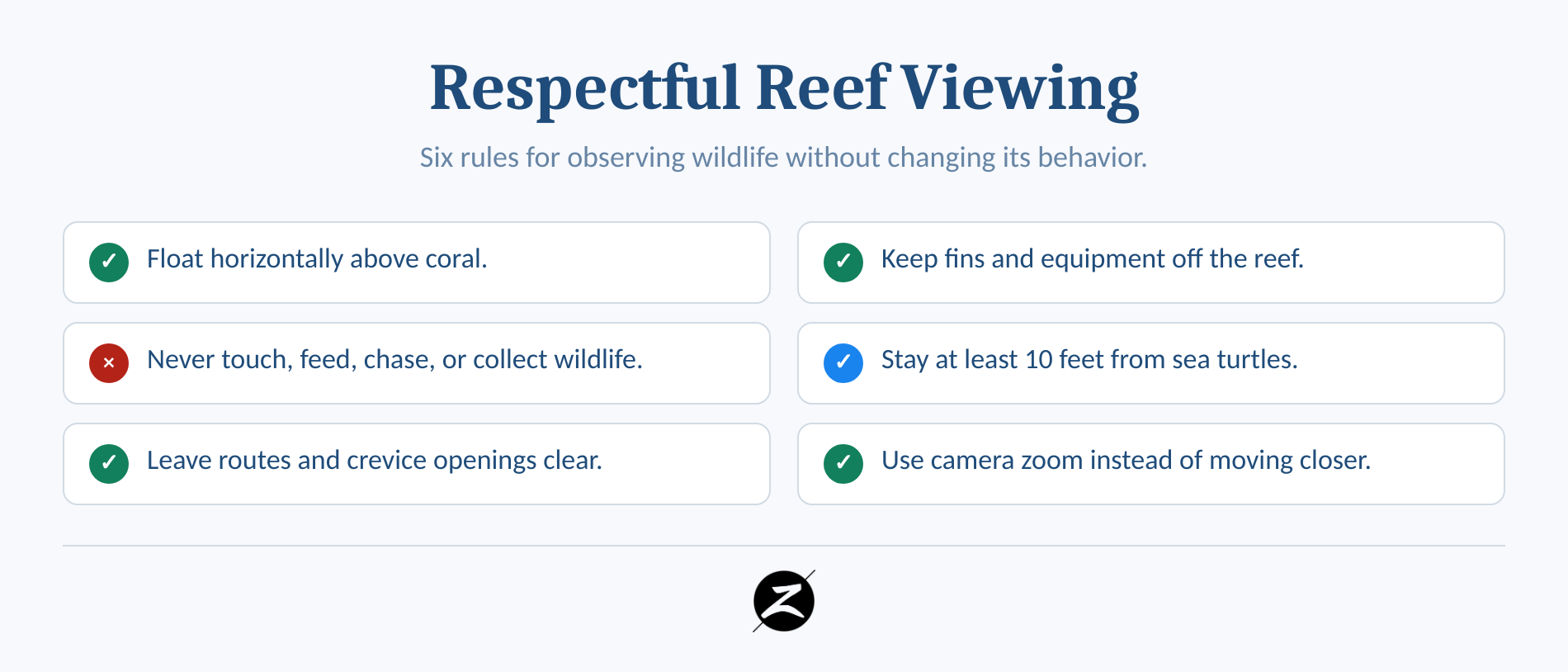
Good reef observation keeps the snorkeler horizontal, controlled, and outside the animal's path. Avoiding contact also improves sightings because undisturbed animals are more likely to continue feeding, resting, or moving naturally.
- Float above coral instead of standing on it.
- Keep fins, cameras, flotation equipment, and loose straps away from the reef.
- Never touch, hold, chase, ride, feed, or collect marine life.
- Stay at least 10 feet from sea turtles and back away if a turtle approaches too closely.
- Leave openings, ledges, cleaning areas, and routes to the surface unobstructed.
- Use camera zoom rather than swimming into an animal's space.
NOAA's updated 2026 shallow coral reef guidance advises keeping hands and fins off reefs and avoiding stirred sediment, which can settle on coral. NOAA's coral tutorial also says snorkelers should be able to float above coral without standing or walking on it. (fisheries.noaa.gov)
Prepare before entering so mask adjustments and equipment problems do not force an unplanned stop over coral. Zephyr Maui's snorkeling preparation FAQs cover what to bring, equipment, age considerations, and beginner support, although wildlife and ocean conditions remain variable. (zephyrmaui.com)
The best wildlife encounter leaves the animal's route and behavior unchanged.
What else do Maui snorkelers ask?
The questions below address common identification and safety concerns that arise after a Maui snorkel. Each answer is a starting point rather than a guarantee about a particular reef or day.
What fish will I see while snorkeling in Maui?
Maui snorkelers may see tangs, butterflyfish, wrasses, parrotfish, goatfish, triggerfish, Moorish idols, and long, narrow fish such as trumpetfish. Turtles, moray eels, octopuses, rays, urchins, and sea stars are also possible. The exact wildlife changes with habitat, conditions, depth, time, and chance.
How do I identify Hawaiian reef fish?
Begin with body shape, then record one strong marking, the fish's behavior, and its position on the reef. For example, an oval yellow grazer suggests a yellow tang, while a tall yellow fish with a narrow projecting snout suggests a butterflyfish. A photograph can help confirm the identification later.
Are there dangerous fish in Maui?
Some Maui reef animals can injure a person if touched, stepped on, cornered, or provoked. Morays can bite, scorpionfish have venomous spines, and long-spined urchins can puncture and sting. Avoid unfamiliar animals and reef crevices, snorkel with a buddy, and evaluate waves, currents, and entry conditions first.
What is the long skinny fish I saw in Maui?
A long, narrow reef fish may be a trumpetfish, cornetfish, needlefish, or halfbeak. Location helps: some remain near the surface, while trumpetfish often hover beside reef structure and have an obvious tubular snout. Record the tail shape, snout, color pattern, swimming depth, and body position before choosing a species.
How close can I get to sea turtles in Maui?
As of September 2026, NOAA Fisheries recommends remaining at least 10 feet, or 3 meters, from sea turtles on land and in the water. Never touch, chase, feed, surround, or block a turtle's route to the surface. If a turtle approaches, remain calm and create more space when possible.
A useful identification respects uncertainty, while a useful encounter respects the animal's space.
Ready to put this Maui fish guide to use?
A field guide becomes more useful when someone can point out the small movement, feeding clue, or camouflaged shape that is easy to miss. For a supported South Maui outing, choose an experience that combines wildlife observation with in-water guidance and realistic expectations.
Our Wailea Wildlife Experience combines a guided sea-turtle snorkel with beach stops and a South Maui coastal drive. The tour page notes that guides may point out animals such as red pencil urchins, pincushion starfish, and sometimes an octopus, but sightings of any wild animal are never guaranteed. (zephyrmaui.com)
Bring the four-pass identification method into the water, then let the reef set the pace.