
In short
Ocean animals in Hawaii range from reef fish and green sea turtles to spinner dolphins, humpback whales, and endangered Hawaiian monk seals. Around Maui, sightings depend on habitat, weather, and season, so treat every encounter as possible, not promised. The safest rule is simple: observe from a distance and never pursue wildlife.
Key takeaways
- Hawaiʻi has unusually high marine endemism: the State of Hawaiʻi’s 2025 Wildlife Action Plan estimates that about 15% to 20% of marine species are endemic. Source: Hawaiʻi DLNR. (dlnr.hawaii.gov)
- A green sea turtle is a realistic reef animal to recognize, but NOAA Fisheries recommends staying at least 10 feet (3 meters) away in the water and on land. Source: NOAA Fisheries. (fisheries.noaa.gov)
- Spinner dolphins and humpback whales have enforceable approach restrictions in Hawaiʻi: 50 yards for spinner dolphins and 100 yards for humpback whales. Source: NOAA Fisheries. (fisheries.noaa.gov)
- Ocean safety depends more on conditions, swimming ability, and local warnings than on the chance of seeing a shark or other sea animal. Source: Hawaiʻi Ocean Safety. (oceansafety.hawaii.gov)
Contents
- What ocean animals might you see around Maui?
- How can you identify Hawaii sea creatures without getting close?
- What viewing distances protect Hawaii’s marine life?
- How should ocean conditions change your wildlife plans?
- What else do visitors ask about ocean animals in Hawaii?
- What should you do before an ocean wildlife outing?
A Maui ocean outing is not a wildlife checklist. A shallow reef may reveal reef fish, a honu, or a camouflaged invertebrate in minutes, while a monk seal, dolphin, shark, or whale remains a special encounter that cannot be scheduled.
What ocean animals might you see around Maui?
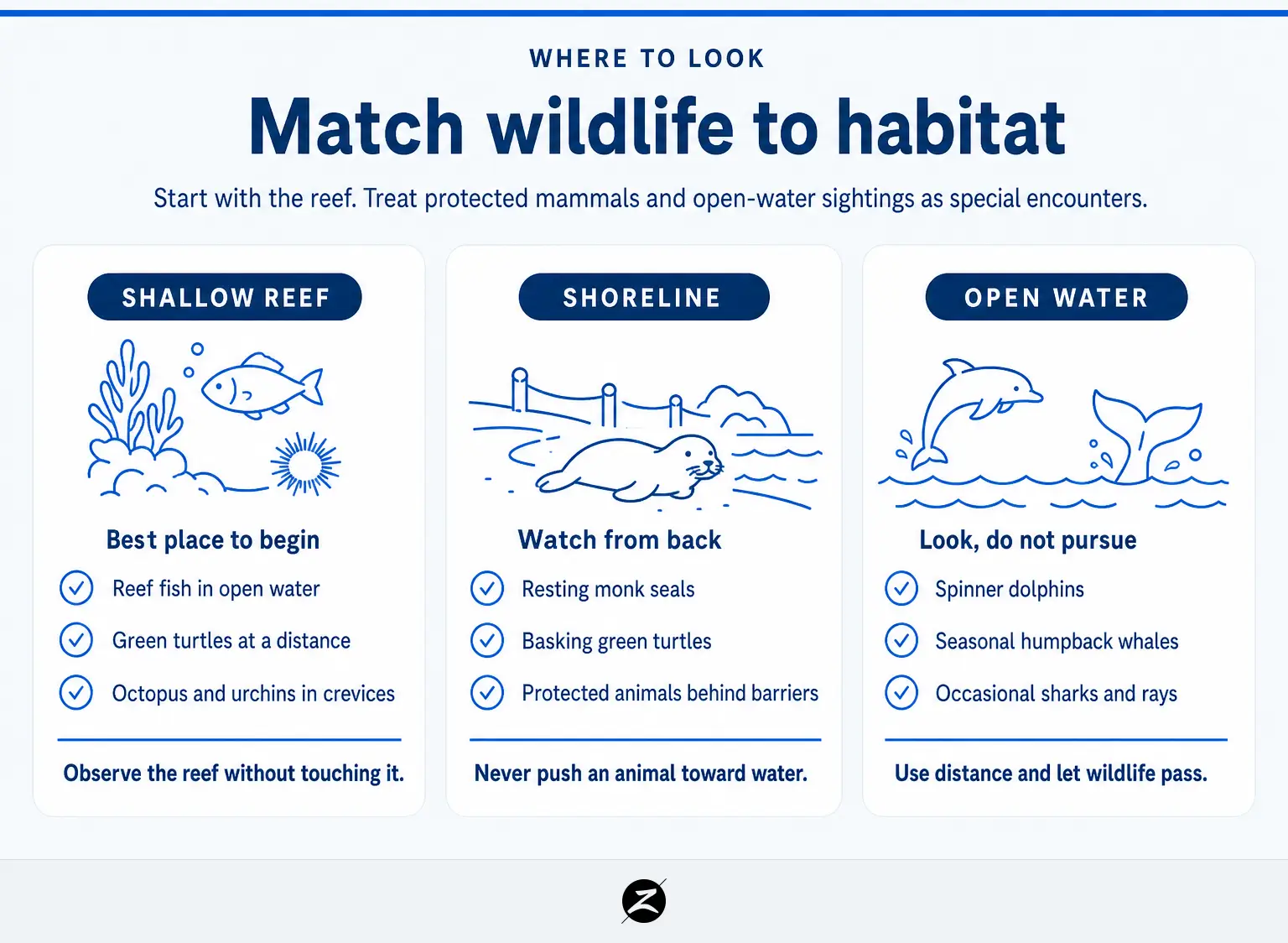
The best starting point is the habitat directly in front of you: shallow reef, shoreline, or open water. Reef animals are the most sensible focus for a snorkeling outing, while dolphins, monk seals, sharks, and whales should be treated as possible sightings rather than the purpose of the trip.
Shallow reef and rocky coast
Reef fish are often the first animals visitors notice because they occupy open water above coral and rock. Look for distinct body shapes, color blocks, and feeding behavior rather than trying to identify every fish at once. Our Maui fish identification guide is useful when you want to slow down and learn the common visual cues after your outing.
Hawaiian green sea turtles, or honu, are air-breathing marine reptiles that use land, sea, and reef habitats. Adults can reach 3 to 4 feet in shell length, but size is not an invitation to approach: a turtle needs room to surface, rest, and move away without being followed. NOAA Fisheries’ green turtle guide explains that green turtles depend on healthy reef and coastal habitats. (fisheries.noaa.gov)
Octopus, sea urchins, and small reef animals may be harder to notice because they use crevices, ledges, and camouflage. Never reach under a rock or into a hole to confirm an identification. A wildlife encounter should leave the reef exactly as it was.
Beaches and nearshore resting areas
A Hawaiian monk seal resting on a beach can look surprisingly still. That is normal. NOAA Fisheries says Hawaiian monk seals are endangered, occur nowhere else on Earth, and number about 1,600 across their range as of July 2026, with roughly 400 in the main Hawaiian Islands. Source: NOAA Fisheries. (fisheries.noaa.gov)
Do not try to return a turtle or seal to the water. Do not gather around it for a photo. NOAA advises viewers to stay behind barriers and signs where present, and to give monk seals space both on shore and in the water. (fisheries.noaa.gov)
Open water and seasonal visitors
Spinner dolphins may rest in nearshore areas during the day, which is why a close interaction is not a responsible goal. In Hawaiʻi, federal rules prohibit swimming with, approaching, or remaining within 50 yards of spinner dolphins. Source: NOAA Fisheries. (fisheries.noaa.gov)
Humpback whales migrate to Hawaiʻi’s warm, shallow waters in winter to mate, give birth, and raise calves. A whale sighting can be memorable, but it belongs in the category of seasonal observation, not an expectation for every ocean trip. NOAA Fisheries reported this winter behavior in 2026. (fisheries.noaa.gov)
The useful mindset is simple: look closely at the reef, stay alert to the wider ocean, and let rare encounters remain rare.
How can you identify Hawaii sea creatures without getting close?
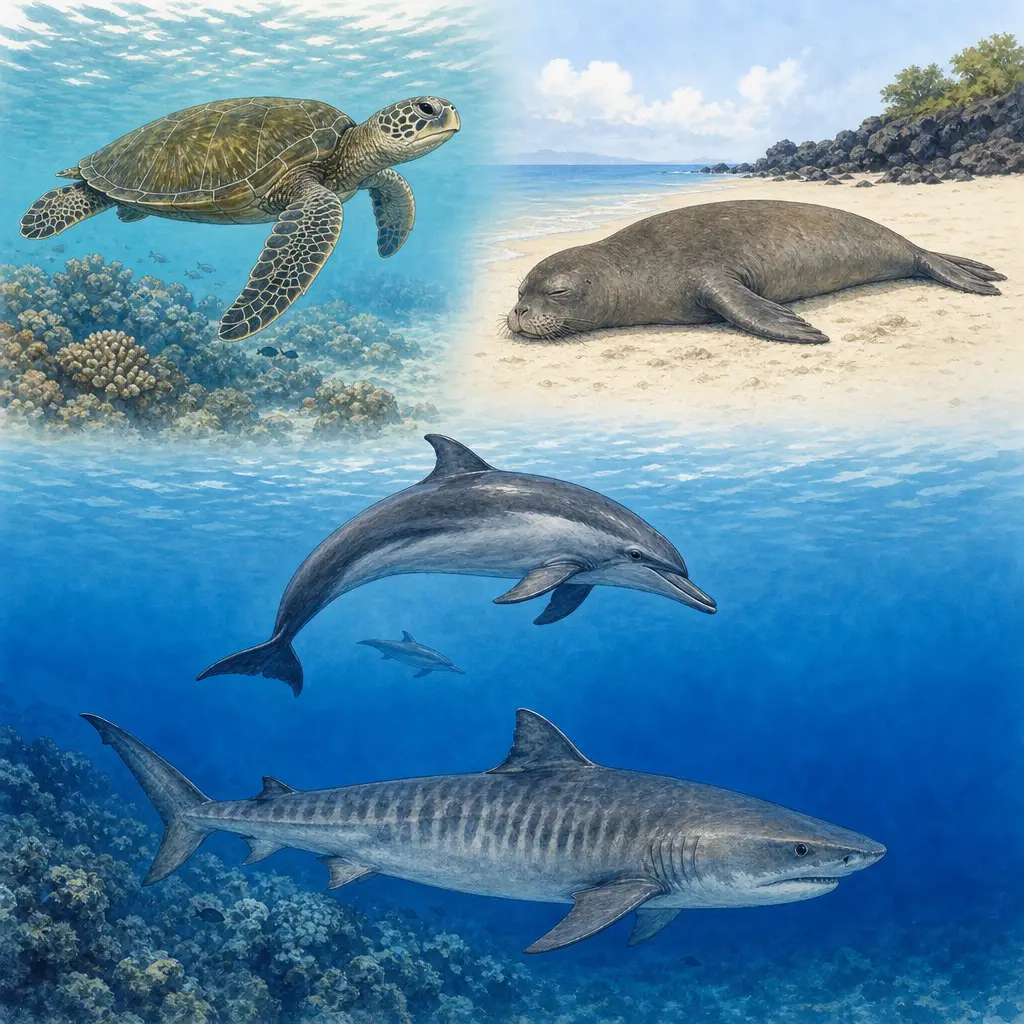
Use shape, movement, and habitat before color. The safest identification is one you can make while giving the animal enough room to behave normally.
Use these broad cues as a starting point:
| Animal or group | Useful distance cue | What to do next |
|---|---|---|
| Green sea turtle | Oval shell, paddle-like flippers, periodic surfacing | Stop advancing and give the turtle room to choose its path. |
| Hawaiian monk seal | Large, gray-brown seal resting alone on sand or rock | Back away, keep others and pets away, and respect barriers. |
| Spinner dolphin | Sleek gray body, group movement, occasional spinning leaps | Watch from shore or at a legal distance. Do not enter the water to follow. |
| Reef shark | Long body, upright dorsal fin, deliberate swimming | Remain calm, keep distance, and leave the water if you feel uncertain. |
| Tiger shark | Broad snout and vertical striping that may fade with age | Do not attempt an identification from close range. Exit calmly if necessary. |
The State of Hawaiʻi notes that tiger sharks can reach up to 18 feet, although they are generally under 14 feet, and move between coastal and pelagic habitats. Source: Hawaiʻi DLNR. (dlnr.hawaii.gov)
A practical example: if your group notices a turtle feeding near a reef ledge, stop kicking toward it, stay at least 10 feet away, and watch quietly until the turtle moves on. The sighting becomes better when the animal does not have to react to you.
For a closer look at the places where fish, coral, and other reef life interact, read our guide to Maui reef habitats.
The best identification habit is to observe first and name the animal second.
What viewing distances protect Hawaii’s marine life?
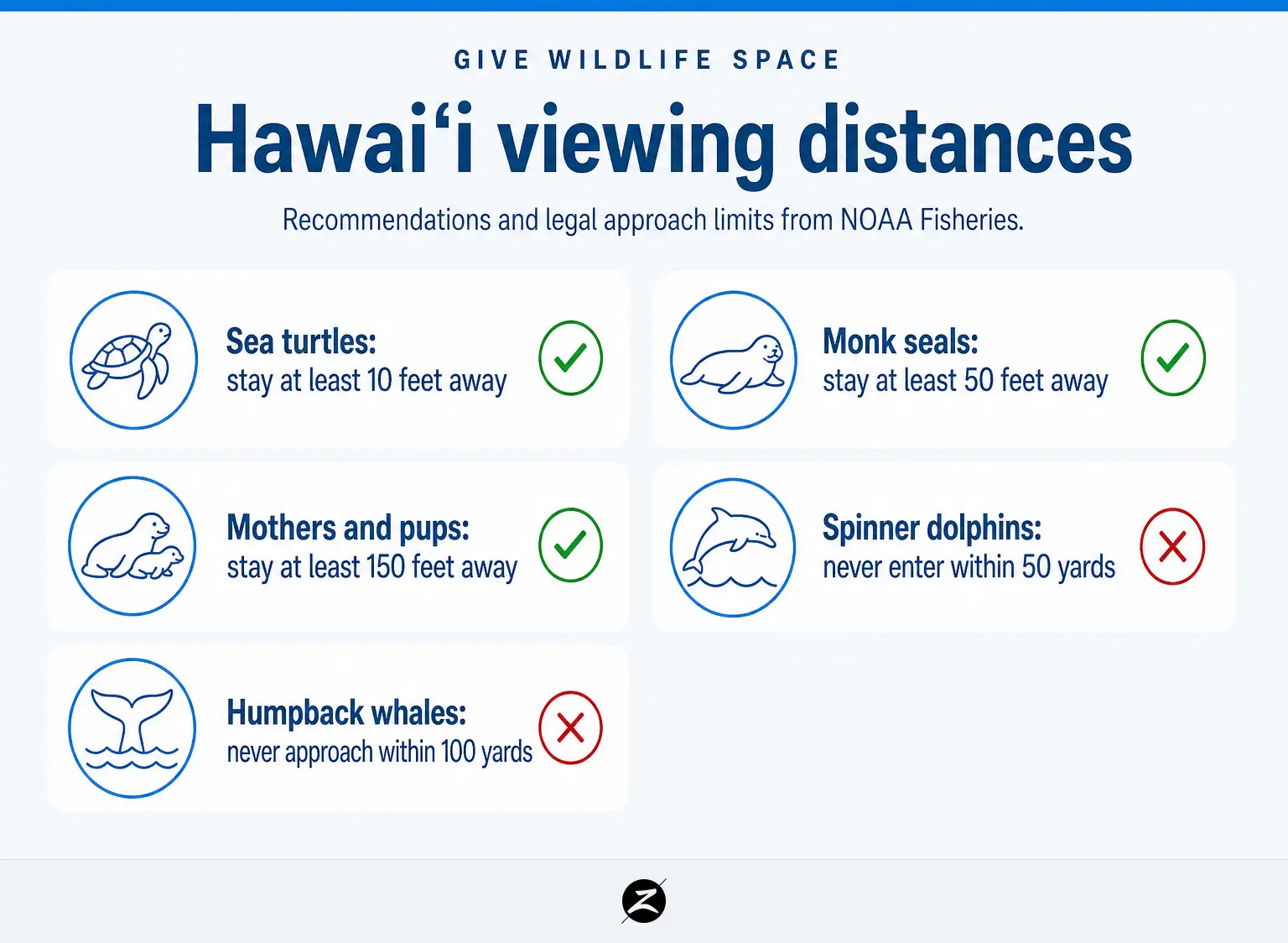
Distance rules differ by animal, and some are recommendations while others are enforceable federal restrictions. As of September 2026, the practical rule is to give every animal more space than you think it needs, then use zoom rather than moving closer.
NOAA Fisheries’ Hawaiʻi guidance gives these distances:
- Sea turtles: at least 10 feet (3 meters) away on land and in water.
- Hawaiian monk seals: at least 50 feet (15 meters) away; keep at least 150 feet (about 45 meters) from mothers and pups.
- Dolphins and small whales: at least 50 yards (46 meters) away.
- Spinner dolphins: it is illegal to swim with, approach, or remain within 50 yards (46 meters).
- Humpback whales: federal law prohibits approaching within 100 yards (91 meters) by any means, including while swimming, kayaking, or using a drone.
Read NOAA Fisheries’ full Hawaiʻi wildlife-viewing guidance. (fisheries.noaa.gov)
Distance is not just etiquette. It reduces the chance that a photo attempt becomes harassment, blocks an animal’s travel path, or puts a swimmer in an unsafe position.
For turtle encounters in particular, our guide to responsible turtle viewing can help set the right expectations before you enter the water.
The right wildlife photo is the one taken without changing the animal’s behavior.
How should ocean conditions change your wildlife plans?
Ocean conditions should decide whether you enter the water, even when wildlife is visible. A calm-looking reef can still have surge, currents, shorebreak, or a difficult exit.
Hawaiʻi Ocean Safety recommends swimming near a lifeguard, checking warnings, swimming with a buddy, staying aware of wave action, and asking a lifeguard about conditions before entering. Source: Hawaiʻi Ocean Safety. (oceansafety.hawaii.gov)
For families and first-time snorkelers, the order of decisions matters:
- Check current beach conditions and posted warnings.
- Choose an entry point that suits the least confident person in the group.
- Confirm how you will exit before putting on fins.
- Treat wildlife as a bonus, not a reason to push past your comfort level.
A shark sighting is not the everyday danger most visitors need to plan around. Hawaiʻi DLNR says fatal shark bites are extremely rare, while Hawaii Ocean Safety emphasizes the more immediate risks of strong currents, changing waves, poor visibility, and ocean conditions that exceed a visitor’s ability. Sources: Hawaiʻi DLNR and Hawaiʻi Ocean Safety. (dlnr.hawaii.gov)
Conditions, not animal excitement, should set the limits for your day.
What else do visitors ask about ocean animals in Hawaii?
These questions come up often because travelers want a direct answer before they choose a beach or book an ocean activity. The official guidance is clear: respect wildlife, assess conditions, and do not treat a close encounter as the goal.
What is the biggest predator in Hawaii?
“Biggest predator” can mean different things. Whale sharks can reach 50 feet or more in Hawaiian waters, but they filter-feed rather than hunt large prey; Hawaiʻi DLNR identifies tiger sharks as occupying the top niche in inshore feeding relationships. Tiger sharks can reach up to 18 feet, so they should be avoided, not sought out. Source: Hawaiʻi DLNR. (dlnr.hawaii.gov)
Is it safe to swim in the sea in Hawaii?
Swimming in the sea in Hawaii can be enjoyable when conditions, location, ability, and supervision are appropriate, but no ocean entry is risk-free. Hawaiʻi Ocean Safety recommends lifeguarded beaches, buddy swimming, attention to warning signs, and checking with a lifeguard before entering because currents, shorebreak, and surf can change quickly. Source: Hawaiʻi Ocean Safety. (oceansafety.hawaii.gov)
What is the rarest animal to see in Hawaii?
There is no single official ranking for the rarest animal a visitor might see in Hawaii because many deep-water and small marine species are seldom observed. Hawaiian monk seals are a notably rare and recognizable encounter: NOAA Fisheries estimates about 1,600 remain, including roughly 400 in the main Hawaiian Islands. Keep at least 50 feet away. Source: NOAA Fisheries. (fisheries.noaa.gov)
The most respectful answer to every wildlife question is usually the same: give the animal space and let the encounter end on its terms.
What should you do before an ocean wildlife outing?
Choose conditions and support that match your experience, then arrive ready to observe rather than chase sightings. If a small-group guided afternoon combining a sea-turtle snorkel, beach stops, golden-hour scenery, and a South Maui coastal drive suits your group, we offer the Wailea Wildlife Experience through Zephyr Adventures Maui.
Bring reef-safe sun protection where appropriate, secure your camera before you enter, listen to local safety guidance, and leave room in the plan for the ocean to set the pace. That is how marine life in Hawaii stays memorable for visitors and undisturbed for the animals.